

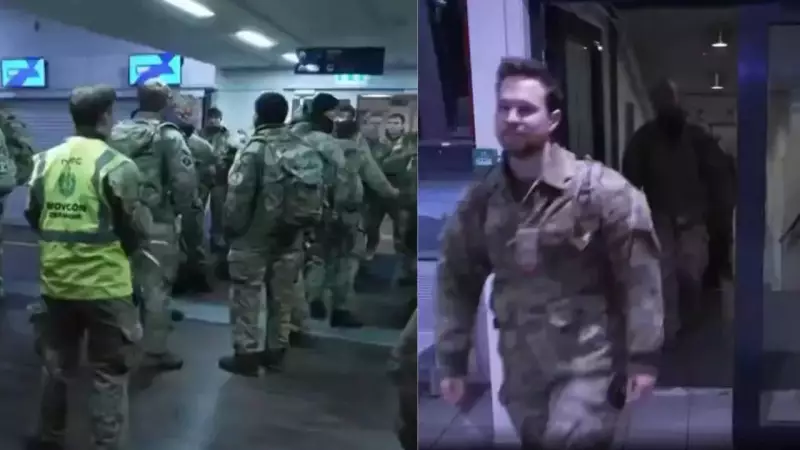
Denmark Reinforces Military Presence in Greenland
Denmark has significantly increased its military footprint in Greenland. This move comes as tensions rise in the Arctic region. The escalation follows repeated threats from United States President Donald Trump. He has openly discussed taking control of the self-governing Danish territory.
Danish Troops Arrive in Western Greenland
The Royal Danish Army chief, Peter Boysen, arrived in western Greenland on Monday evening. He was accompanied by a substantial contingent of soldiers. Their aircraft landed at Kangerlussuaq, a crucial logistical hub in the Arctic.
Public broadcaster TV2 reported that 58 Danish troops were part of this latest deployment. They are joining approximately 60 personnel already stationed in the region. These earlier arrivals were participating in a multinational military exercise named Operation Arctic Endurance.

Footage from the arrival shows around 50 Danish soldiers disembarking from a chartered plane. Major General Peter H. Boysen led the group onto a snow-covered runway. The troops wore specialized cold-weather military gear. They carried equipment and rifles as they stepped onto the tarmac.
Local authorities welcomed the soldiers at the airport. Overcast Arctic skies provided the backdrop for the orderly reception. Danish flags were clearly visible during the proceedings.
United States Announces NORAD Deployment
Meanwhile, the United States has revealed its own military plans for Greenland. The North American Aerospace Defence Command, known as NORAD, will deploy an aircraft to the Pituffik Space Base in Greenland.
This announcement comes amid growing friction over Trump's push to acquire the semi-autonomous territory. In a statement posted on X, NORAD explained the deployment.
"North American Aerospace Defence Command aircraft will soon arrive at Pituffik Space Base, Greenland," the statement read. "Along with aircraft operating from bases in the continental United States and Canada, they will support various long-planned NORAD activities."
The command emphasized that this deployment builds on existing defence cooperation. It involves the United States, Canada, and the Kingdom of Denmark.
NORAD added that the activity received proper diplomatic clearance. It was coordinated with local authorities through established channels.
"This activity has been coordinated with the Kingdom of Denmark, and all supporting forces operate with the requisite diplomatic clearances," the statement continued. "The Government of Greenland is also informed of planned activities."
Multinational Military Exercise Underway
The US announcement follows a Danish-led multinational military exercise. This training event occurs amid the diplomatic standoff with Washington over Trump's acquisition statements.
Several European nations have contributed small numbers of troops to the exercise. Participating countries include Germany, Sweden, France, Norway, the Netherlands, and Finland.
Denmark has described the exercise as essential for ensuring security in the Arctic region. The United States received an invitation to participate in these military activities.
Trump's Tariff Threats and Security Concerns
President Trump has intensified his push to secure Greenland for the United States. He has warned about imposing tariffs on Denmark and other European nations. The United Kingdom is also included in these potential trade measures.
Trump argues that acquiring Greenland is vital for US national security. He cites growing interest in the territory from both China and Russia as primary concerns.
The US president says he remains open to negotiations about the territory. However, he has issued specific tariff threats if no agreement is reached.
Trump proposes tariffs of 10 percent starting February 1, 2026. These would increase to 25 percent from June 1, 2026, if Denmark refuses to sell Greenland.
He added a historical dimension to his argument. "It's time for Denmark to give back," Trump stated, referencing years of American support for the European nation.
The situation continues to develop as both nations maintain their military activities in the strategically important Arctic region.






