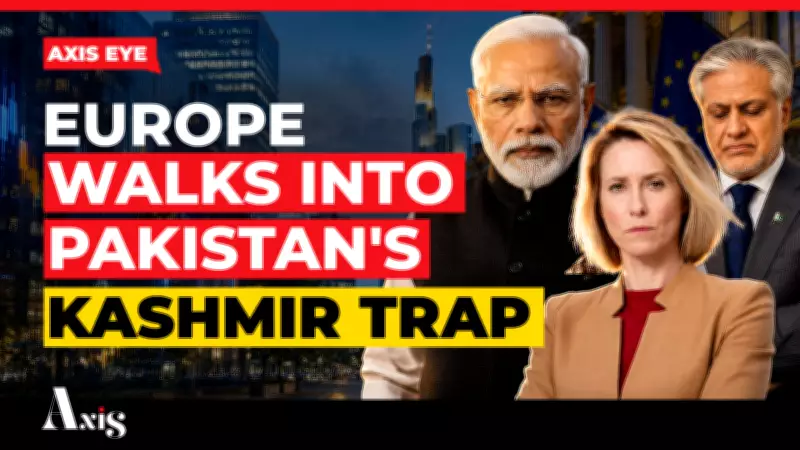
The European Union has been accused of hypocrisy after its foreign policy chief, Kaja Kallas, lectured Pakistan on human rights while simultaneously risking India's trust over the Kashmir issue. During her visit to Islamabad, Kallas told Pakistani officials that access to the lucrative European market cannot continue without significant reforms in human rights, governance, media freedom, and civil liberties. The EU raised concerns over enforced disappearances, minority rights, judicial independence, and censorship in Pakistan.
EU's GSP+ Trade Scheme Conditions
Pakistan heavily depends on the EU's Generalized Scheme of Preferences Plus (GSP+) trade scheme, which grants preferential access to European markets. Brussels made it clear that these economic benefits come with strict conditions. The EU emphasized that Pakistan must demonstrate progress in implementing international human rights conventions to retain its GSP+ status.
Kashmir Controversy
However, the visit took a dramatic turn when Kallas appeared to endorse language on Kashmir that India has consistently rejected. By referencing United Nations-backed resolutions and conflict resolution language favored by Islamabad, the EU chief touched one of New Delhi's biggest diplomatic red lines. India has long maintained that Kashmir is an integral part of the country and opposes any third-party mediation or reference to UN resolutions.

This move has raised questions about the EU's consistency in its foreign policy. Is Europe sending mixed signals? Why is Brussels pressuring Pakistan on human rights while simultaneously giving Islamabad diplomatic space on Kashmir? The controversy highlights the delicate balance the EU must maintain between its values and strategic interests.
Implications for India-EU Relations
India has been a key partner for the EU in the Indo-Pacific region, with growing trade and strategic ties. The EU's stance on Kashmir risks undermining the trust that has been built between New Delhi and Brussels. Indian officials have expressed disappointment over the EU's remarks, emphasizing that any discussion on Kashmir must respect India's sovereignty and territorial integrity.
The EU's approach also contrasts with its criticism of Pakistan's human rights record. While Brussels demands reforms from Islamabad, its willingness to entertain Pakistani narratives on Kashmir could be seen as rewarding behavior that contradicts European values. This double standard could weaken the EU's credibility as a promoter of human rights and international law.
Pakistan's Response
Pakistan welcomed the EU's references to Kashmir, viewing it as a validation of its position. Islamabad has long sought international intervention on the issue, and the EU's remarks provide a diplomatic boost. However, Pakistan also faces pressure to implement human rights reforms, which could strain its domestic political landscape.
The EU's dual approach reflects the complexity of engaging with South Asia, where regional rivalries and historical disputes complicate foreign policy. As the EU seeks to expand its influence in the region, it must navigate these tensions carefully to avoid alienating key partners like India.