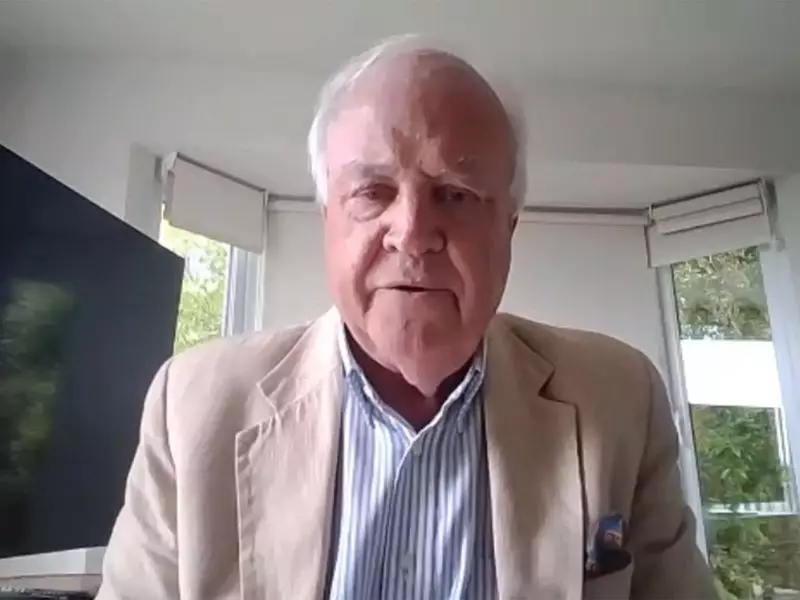
In a sharp critique of recent American actions, a former top Chilean diplomat has declared that a dangerous line has been crossed in international relations. Jorge Heine, who served as Chile's Ambassador to India, has publicly condemned a United States military operation conducted in Venezuelan territory, labeling it a blatant violation of sovereignty and international law.
A Former Diplomat's Stern Rebuke
Jorge Heine, a respected academic and former Chilean Ambassador to India, China, and South Africa, did not mince words in his assessment. He stated unequivocally that the United States' military incursion into Venezuelan airspace and territorial waters represents a significant and alarming escalation. The operation, which reportedly involved the deployment of assets, was framed by Washington as a counter-narcotics mission. However, Heine and critics argue it was an unauthorized intervention into a sovereign nation's affairs.
"The threshold has been crossed," Heine asserted, emphasizing the gravity of the move. His condemnation stems from a fundamental principle of the United Nations Charter: the prohibition of the use of force against the territorial integrity of any state. By acting without the explicit authorization of the Venezuelan government or the UN Security Council, the US operation, in his view, sets a perilous precedent that undermines the global legal order.

Context of US-Venezuela Tensions
The controversial operation did not occur in a vacuum. It is the latest flashpoint in years of heightened tension between the United States and the Venezuelan government led by Nicolás Maduro. The US, along with dozens of other nations, recognizes opposition leader Juan Guaidó as Venezuela's legitimate interim president. This political standoff has been accompanied by severe economic sanctions imposed by Washington aimed at ousting Maduro.
Heine pointedly connected the military move to this broader strategy of regime change. He argued that such interventions, under the guise of drug interdiction or promoting democracy, often exacerbate regional instability rather than resolve underlying issues. The former envoy's perspective carries weight given Chile's own historical experience with external intervention and its traditional advocacy for the peaceful resolution of disputes and respect for sovereignty in Latin America.
Broader Implications for International Law
The core of Heine's argument extends beyond the immediate US-Venezuela conflict. He warns that actions of this nature erode the very foundations of the post-World War II international system. When powerful nations unilaterally decide to breach another country's borders, it weakens the rule of law and encourages a might-makes-right approach to global politics.
This incident raises profound questions about the future of multilateralism and the respect for national sovereignty, especially for smaller nations. Heine's critique echoes concerns voiced by other international law experts and diplomats who fear such precedents could be used to justify interventions elsewhere, creating a more volatile and unpredictable world order.
In conclusion, the forceful condemnation by Jorge Heine, a seasoned diplomat from a respected Latin American nation, highlights the deep divisions and serious legal concerns triggered by the US operation. His statement serves as a stark reminder of the enduring tensions between unilateral power projection and the established norms of international conduct. The event marks a significant moment in hemispheric relations, one that will likely fuel further debate on the limits of intervention and the sanctity of national borders in the 21st century.