

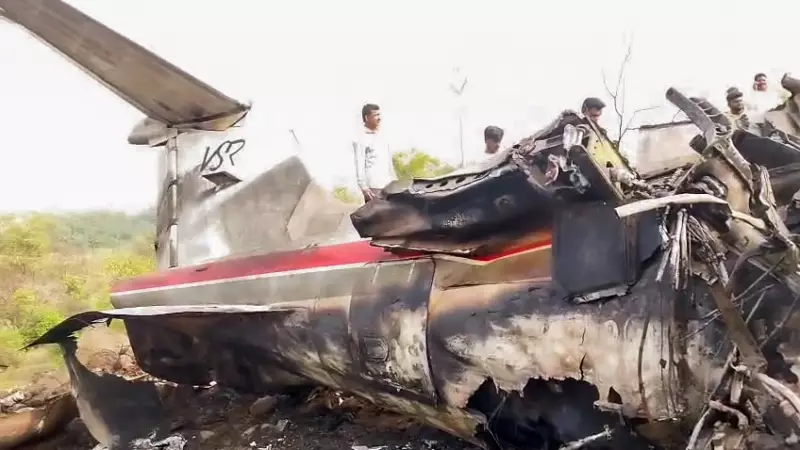
The tragic plane crash that claimed the life of Maharashtra Deputy Chief Minister Ajit Pawar and four others has been detailed in a sequence of events released by the Civil Aviation Ministry. The statement outlines the critical 26-minute period between the aircraft's initial contact with Baramati and the moment its flames were spotted, revealing a failed landing attempt and possible visibility concerns that preceded the fatal incident.
The Fatal Flight and Its Details
The chartered aircraft, a Bombardier Learjet 45 registered as VT-SSK and operated by Delhi-based private jet charter operator VSR Ventures, was airborne for approximately 35 minutes before the crash. The flight was en route from Mumbai to Baramati, carrying five individuals including the prominent political figure Ajit Pawar. While the Aircraft Accident Investigation Bureau (AAIB) continues its probe into the accident, the Civil Aviation Ministry has provided preliminary information based on available data and statements.
Understanding Baramati Airport's Challenges
Before examining the sequence of events, it is crucial to comprehend the nature of Baramati airport and why landing there presents significant difficulties. Baramati airport is a regional airstrip primarily utilized for pilot training and private plane operations. It lacks navigational aids to assist pilots during low visibility conditions, forcing them to rely heavily on visual cues for both landing and avoiding other aircraft.

Radio communication serves as the primary method of operation at such airports. This detail becomes particularly relevant as the flight operator, VSR, has cited possible visibility issues during the landing attempt. Furthermore, Baramati is classified as an uncontrolled airfield, meaning it does not have a conventional air traffic control (ATC) tower. Instead, air traffic information is managed by instructors or pilots from the local flying schools, with at least one senior official overseeing operations.
The Critical 26-Minute Timeline
The Civil Aviation Ministry's statement meticulously details the sequence of events between 8:18 AM, when the Bombardier aircraft "first came in contact with Baramati," and 8:44 AM, when flames from the crashed plane were spotted. This information is based on the account of the person managing air traffic for Baramati at the time of the crash.
After initial contact, the aircraft's next communication occurred at 30 nautical miles inbound to Baramati, having been released by Pune approach. The pilots were advised to descend in Visual Meteorological conditions at their discretion. According to the ministry, the pilots then enquired about wind and visibility conditions, receiving information that winds were calm and visibility was approximately 3,000 metres.
The pilots proceeded to approach the airport but decided against landing as they did not have the runway in sight. Initial information from the crash site and statements from VSR indicated that low visibility conditions in the area might have played a significant role in the accident. The crew executed a go-around maneuver to attempt another landing, a move consistent with flight path data from tracking service Flightradar24, which shows the aircraft taking a loop before approaching Baramati airport again.
Experienced Crew and Final Communications
Notably, the aircraft's captain was highly experienced with over 15,000 flying hours, while the co-pilot had more than 1,500 hours. Following the go-around, the aircraft was queried about its position, with the crew reporting a "final approach of runway 11." The operator then asked them to confirm if they could see the runway, to which the crew responded: "Runway is currently not in sight, will call when runway is in sight."
After a few seconds, the crew reported that the runway was in sight, according to the ministry. The operator cleared the plane to land at 8:43 AM, but there was no response. The next development occurred at 8:44 AM IST when the ATC saw flames around the threshold of runway 11. Emergency services were immediately dispatched to the crash site.

Investigation and Aftermath
An AAIB team from Delhi has departed for the accident site, and AAIB Director General GVG Yugandhar, who was in Hyderabad, is also en route to Baramati. The investigation aims to uncover the precise causes behind this tragic incident that has shocked the political landscape and aviation community alike.
The sequence of events highlights the challenges of operating at airports like Baramati without advanced navigational aids and proper air traffic control infrastructure. As the investigation progresses, questions about aviation safety protocols and infrastructure limitations at regional airports are likely to come under increased scrutiny.





