

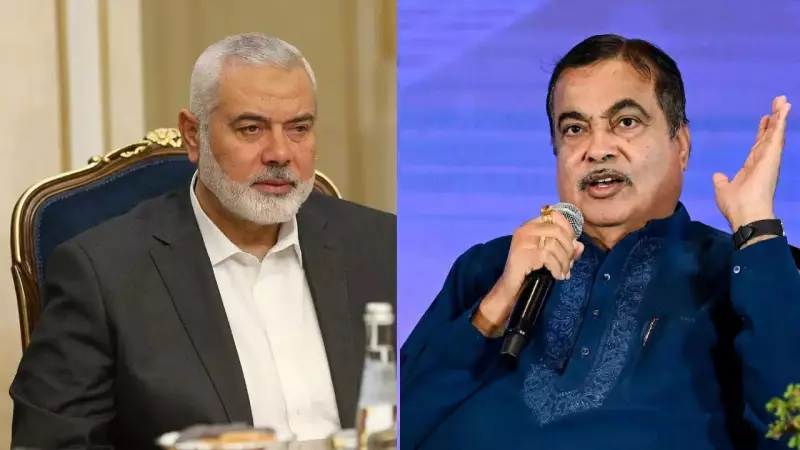
Union Minister for Road Transport and Highways, Nitin Gadkari, has shared a startling personal account of coming face-to-face with Hamas political chief Ismail Haniyeh merely hours before the latter was assassinated in Tehran. Gadkari linked the incident to the evolving nature of modern warfare and the critical importance of advanced technology for national security.
A Fateful Handshake in Tehran
Speaking at a recent book launch event, Gadkari detailed his visit to Iran. He had travelled there at the personal request of Prime Minister Narendra Modi to represent India at the swearing-in ceremony of Iran's newly elected President, Masoud Pezeshkian. The minister stated that all foreign dignitaries were accommodated at a five-star hotel in the Iranian capital ahead of the official function.
"Modi ji had sent me for the Iranian President's ceremony," Gadkari recounted. Among the gathering of heads of state, his attention was drawn to one individual who stood out. "I wondered who he was. I also shook hands and asked. He was the head of Hamas," the minister revealed. Gadkari observed that later, during the ceremony, Haniyeh walked in alongside Iran's President and the Chief Justice, with other delegates following them.

The Sudden Morning Evacuation
The minister described returning to his hotel after dinner and retiring for the night. The calm was shattered in the early hours of the morning. At around 4 AM, the Indian ambassador urgently knocked on his door, instructing an immediate evacuation. When Gadkari inquired about the reason, he was informed of a major incident.
"He said the Hamas leader who was here yesterday, a powerful man, was killed in his room," Gadkari told the audience. Iranian authorities later confirmed that Ismail Haniyeh was killed at approximately 1:15 AM on July 31, 2024. The attack occurred not at the hotel mentioned by Gadkari, but within a highly secure military complex supervised by Iran's Islamic Revolutionary Guard Corps (IRGC). Official reports cited by the Associated Press noted that Haniyeh's bodyguard was also killed in the strike.
Gadkari's Take on Technology and Future Security
Gadkari pointed out that the precise method of the assassination remains shrouded in mystery, which itself is a lesson in modern conflict. He emphasized how futuristic technology is becoming paramount for national security, warfare, and protecting critical infrastructure.
"No one knows from where the missile was fired, where it entered - now some say it was his mobile phone number, he was specially hidden in one place in a bungalow, went to that room and killed him there," Gadkari remarked, alluding to various theories about the high-tech attack. He stressed that the coming era demands a technological and futuristic vision across all sectors, including defence, agriculture, and industry.
Contrasting the vulnerability demonstrated in the attack, Gadkari added that strong nations with technological and military prowess, like Israel, are difficult to target and thus wield significant global influence.
While Iranian Revolutionary Guards stated a short-range missile hit the building housing Haniyeh, other reports, such as one from The Telegraph, suggested Israel's Mossad may have planted explosives inside the guesthouse. Iranian authorities have not publicly confirmed this version of events.






