

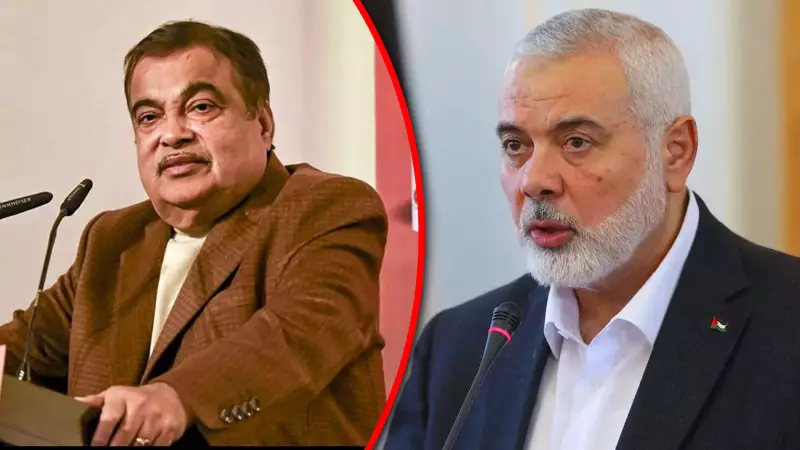
In a startling revelation, Union Minister for Road Transport and Highways, Nitin Gadkari, has shared details of a chilling diplomatic encounter. The senior BJP leader disclosed that he met Hamas political chief Ismail Haniyeh in Tehran merely hours before the militant leader was assassinated in July 2024.
A Routine Visit Turns into a Haunting Memory
Gadkari was in the Iranian capital attending the presidential swearing-in ceremony. The event saw the gathering of various world leaders and dignitaries. It was there, amidst the formal proceedings, that Gadkari came face-to-face with Ismail Haniyeh. This meeting was notable because Haniyeh, as the leader of Hamas, held no official government position, yet he was present among state representatives.
The Indian minister completed his diplomatic engagements and returned to his hotel. The night took a dramatic turn when, at around 4 am, he received the shocking news. Gadkari was informed that the very man he had met hours earlier, Ismail Haniyeh, had been killed.

The Assassination and the Glaring Security Lapse
Iranian authorities later confirmed the assassination. The killing occurred inside a heavily guarded facility of the Islamic Revolutionary Guard Corps (IRGC). This detail turned the event from a mere attack into a significant security scandal. The fact that a high-profile target could be eliminated within one of the most secure military complexes in the country pointed to serious internal failures.
To this day, the exact method of the killing remains shrouded in mystery. Conflicting reports have emerged from various sources, with no single, clear account of how the assassination was carried out. This ambiguity has only fueled further speculation and analysis about the capabilities of the actors involved.
Reigniting Debates on Security and Regional Stability
Gadkari's personal account has brought this international incident back into the spotlight. It has reignited critical debates on multiple fronts. Primarily, it raises urgent questions about Iran's internal security apparatus. How could such a breach happen in a tightly controlled environment?
Furthermore, the revelation prompts a re-examination of the regional fallout from Haniyeh's assassination. The event sent shockwaves through the Middle East, impacting the dynamics of the Palestinian cause and Iran's proxy network. Gadkari's firsthand experience adds a unique, human dimension to this geopolitical event, underscoring how closely global players can brush against moments of high-stakes conflict.
The minister's disclosure serves as a stark reminder of the unpredictable and often dangerous undercurrents in international diplomacy, where a routine meeting can precede a moment of history-altering violence.






