From Kashmir to Iran: When Politics Targets Women's Bodies and Futures
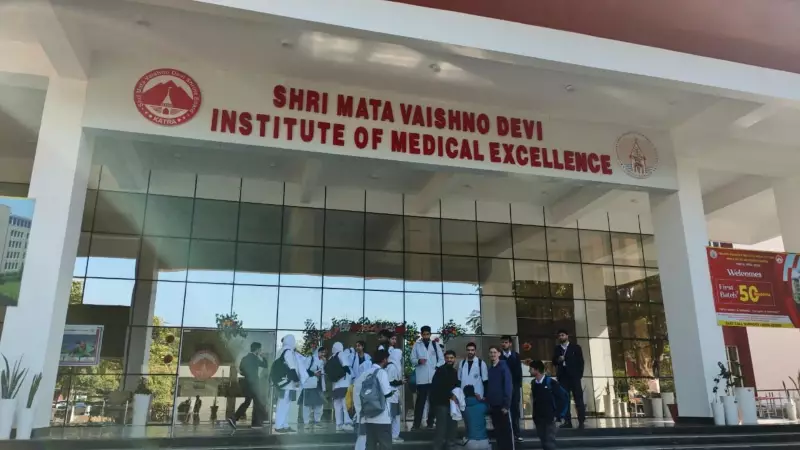
The story of Bilkis Manzoor and her classmates at Shri Mata Vaishno Devi Institute of Medical Excellence (SMVDIME) reveals a troubling pattern. These young women worked hard to reach medical school, only to see their dreams deferred when the National Medical Commission withdrew permission for their MBBS course. This institutional failure hits women students hardest, narrowing their life possibilities in decisive ways.
The Cost of Educational Disruption
Bilkis Manzoor made two difficult attempts at cracking NEET to travel from Budgam in Kashmir to SMVDIME in Jammu's Katra. She would have been her family's first doctor. Now, like fifty other students, she faces uncertainty as they await placement in other institutions through supernumerary seats.
For young women experiencing their first real independence, such disruptions carry heavier consequences. When intellectual aspirations get dismissed or disrupted, society imagines women's presence in public life more narrowly. Their bodies become sites of collective anxiety rather than vessels of possibility.

India's Gender Politics Blind Spot
India often celebrates nari shakti and courts women as vote banks while neglecting their actual agency. We grieve after terrible events like sexual assaults but shrug at conditions that make women vulnerable. Debates focus more on what women wear than what they contribute.
Protection gets prioritized over participation. Consider medical education: more women graduate from medical courses, yet studies show no proportional increase in practising women doctors. Honor often trumps autonomy in our social calculations.
Women's agency isn't a simple binary. It forms a complex web where today's classroom barrier becomes tomorrow's independence impediment.The Tangled Web of Consequences
Education isn't an abstract good. It serves as foundational infrastructure for freedom. Without it, legal rights become ornamental, economic independence stays elusive, and physical safety remains fragile.
The consequences are real and measurable:
- Women occupy just a sliver of political office
- They hold an even thinner slice of corporate power
- India's female labor force participation ranks among the world's lowest
When women miss from decision-making tables, policies get made without them—and often against them. Remember the 2023 Wrestling Federation of India scandal, where women athletes toppled a predatory chief after months of protest, only to see his proxy return to power soon after.
Global Patterns of Control
Beyond India, the pattern appears starker. Mahsa Amini's custodial death in Iran in 2022 for an alleged dress code violation ignited resistance demanding jin, jiyan, azadi—women, life, freedom. Control over women's bodies connects directly to control over their voices.
In Afghanistan under Taliban rule, women face bans on education, employment, reproductive rights, and even public speech. These aren't isolated incidents but part of a global continuum where women's participation gets systematically restricted.
Why Institutional Access Matters
Public institutions aren't gender-agnostic spaces. Who enters them matters profoundly. When women enter institutions in significant numbers—hospitals, courts, universities, legislatures—they change what becomes possible.
Shutting down a medical college in a conflict-scarred region isn't neutral governance. It represents a political act with gendered consequences:
- Fewer women doctors mean poorer healthcare access
- Poorer maternal health outcomes follow
- Fewer women professionals weaken representation
- Fewer women with incomes means fewer exits from abusive situations
The SMVDIME story disturbs on many levels, but its impact on women students proves particularly unsettling because this narrowing of possibilities shapes their lives most decisively. A society allowing educational pathways to collapse without protest shouldn't wonder when inequalities harden elsewhere.
From Jammu to Iran, the question remains: Can our politics look beyond women's bodies to see their full humanity and potential?