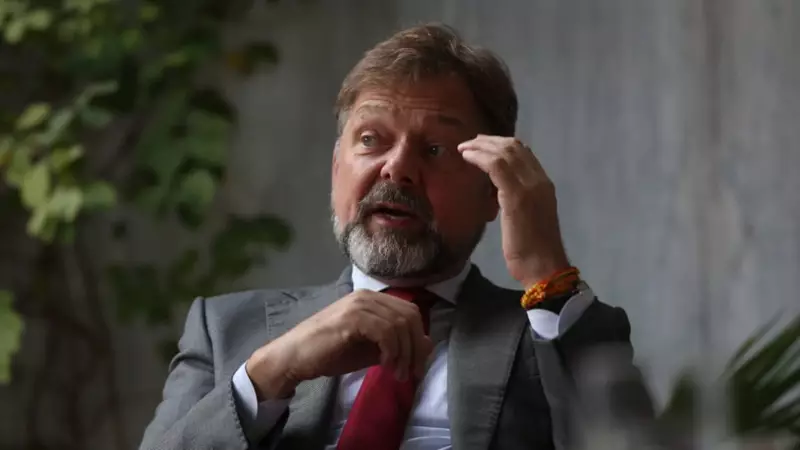
When official duties permit, Germany's top diplomat in India immerses himself in a world of aesthetics and history. Dr Philipp Ackermann, the German Ambassador to India, is not just a seasoned diplomat but also a trained art historian with a profound appreciation for the subcontinent's artistic heritage.
A Diplomat's Residence Steeped in Art
Walking through his official residence in Delhi's Chanakyapuri, Ambassador Ackermann points out the details with an expert's eye. The white Makrana marble underfoot, he explains to his German guests, is the very same stone used in the construction of the Taj Mahal. He notes its unique colour nuances and rarity in today's market.
A centrepiece of the home is a bronze Nataraja sculpture from the Chola period, placed elegantly on a round black table. Ackermann reveals that this piece was a gift to a former German ambassador from the Chief Minister of Tamil Nadu back in 1955. "It fits perfectly in the residence. It's a copy, of course, but it's a beautiful piece," he remarks.

The ambassador has also put his personal curatorial touch on the space. One striking red-walled room features a rotating display of contemporary Indian art. Collaborating with a Gurgaon gallery, he ensures the room is refreshed every six months with works by young Indian artists, creating a dynamic dialogue between the historic diplomatic setting and modern creativity.
An Art Historian's Favourites: Ajanta to Humayun's Tomb
In an exclusive conversation, coinciding with the 75th anniversary of Indo-German diplomatic relations in 2026, Ackermann shared the Indian artworks that resonate with him personally.
When asked about the first piece that spoke to him, he found it difficult to choose just one. However, he singled out the Ajanta Caves as "the most stunning and breathtaking art" he has seen in India. He is moved by the early Buddhist frescoes, noting their surprising sensuality, vibrant colours, and powerful storytelling.
In architecture, his admiration falls on Humayun's Tomb in Delhi, which he considers "perhaps the most perfect piece of construction of architecture in India." He praises its clear forms, abstract surfaces, and the unique interplay between marble and red sandstone.
His expertise also draws him to South Indian sculptures, particularly the exquisite Chola bronzes. He admires the advanced metalwork, refined aesthetics, and extreme finesse of these ancient artefacts.
Art as a Bridge for Diplomacy and Understanding
Ackermann strongly believes in the connective power of art. He points to historical examples like the Flemish painter Rubens, who was also a diplomat. "I think diplomats must have some empathy… you must see your counterparts in an empathetic way. Only then can you be a good diplomat. And I think the artist sees the world in an empathetic way," he reflects, drawing a parallel between the two professions.
He challenges the notion of isolated civilisations, emphasising centuries of artistic exchange. He cites the Chola expeditions to Malaysia and the presence of Hindu temples in Angkor Wat and Bali as evidence. A fascinating example he provides is the influence of 17th-century Dutch landscape prints on the Srinath Pichwai painting tradition in India.
For art lovers visiting India, the ambassador recommends two standout museums: the MAP Museum in Bengaluru for its insightful shows on Indian popular art, and the world-class Bihar Museum in Patna for understanding the origins of Indian Hindu, Jain, and Buddhist art.
Beyond classical art, Ackermann enjoys exploring local crafts at Delhi's Nature Bazaar and holds a particular fondness for Warli art from Maharashtra, appreciating its strong bond with nature and depiction of village life.
Currently, his reading list includes Anirudh Kanisetti's "History of the Chola Empire" for a day-to-day understanding of South Indian medieval history, and Arundhati Roy's "Mother Mary Comes to Me" for its insights into Kerala's society decades ago.
Through his scholarly perspective, Dr Philipp Ackermann not only fosters diplomatic relations but also builds a deeper, more empathetic cultural bridge between Germany and India, one artwork at a time.