Harsh Goenka's Mumbai Metro Experience Sparks National Infrastructure Debate
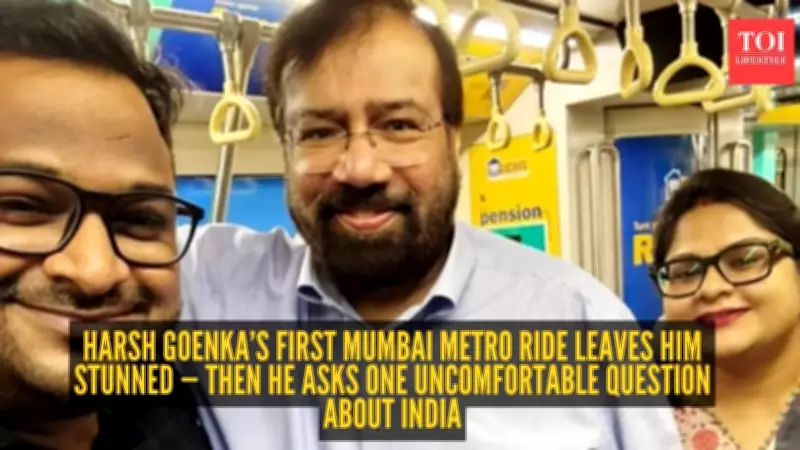
What began as a routine morning commute for industrialist Harsh Goenka has evolved into a significant national conversation about India's infrastructure development and maintenance standards. The prominent businessman recently became the first passenger to ride the newly inaugurated Mumbai Metro Line 3, an experience he shared online that has since generated substantial public discourse.
An Unexpected Journey That Changed Perspectives
Goenka admitted he didn't anticipate being particularly impressed by the metro system, but his actual experience proved transformative. "I had travelled on the Mumbai Metro yesterday, the first time. I was surprised, I must admit," he stated in his social media post, a simple declaration that quickly gained momentum across digital platforms.
The industrialist described encountering clean stations, well-organized access points, and trains arriving punctually - a stark contrast to the typical Indian urban travel experience characterized by:

- Crowded conditions and congestion
- Frequent delays and scheduling issues
- Noise pollution and chaotic environments
- A perpetual sense of urgency and stress
Goenka emphasized the fluidity of his journey, noting that ticketing, boarding, and station navigation all proceeded smoothly. The ride proved comfortable and borderline relaxing - an unusual experience for Mumbai commuters at any time of day.
International Comparisons That Captured National Attention
The most discussed aspect of Goenka's post was his comparison of Mumbai's Aqua Line with international metro systems. Having experienced public transit networks in Paris, London, and New York City - cities long regarded as models of efficient urban transportation - Goenka suggested Mumbai's metro could compete with these global benchmarks.
This assertion ignited social media platforms, challenging the common perception among Indians that Western infrastructure remains inherently superior. For many citizens accustomed to hearing about international transportation excellence, the idea that an Indian metro system could rival global standards proved both unexpected and reassuring.
Praise Followed by Provocative Questioning
While appreciating the metro's efficiency and global-standard execution, Goenka posed a deeper question that resonated with commuters nationwide: If India can construct a metro system of this quality, why do city roads continue to underperform at similar efficiency levels?
This simple inquiry highlighted a glaring urban infrastructure disparity. Inside metro stations, everything appears modern and precise, but stepping outside returns commuters to potholes, traffic congestion, uneven roads, and unpredictable travel conditions. The contrast underscores a painful reality - excellence is achievable but difficult to maintain consistently across all urban infrastructure sectors.
Social Media Echoes Public Sentiment
The internet responded almost immediately to Goenka's observations. Many users praised the Aqua Line, sharing their own experiences of clean platforms, punctual trains, and stress-free commuting. Daily commuters noted that the metro has finally made urban travel dignified rather than exhausting.
However, appreciation mingled with frustration. Commentators observed that while metro projects demonstrate India's capabilities, road conditions remain persistently problematic. One user encapsulated this sentiment perfectly: "The metro is world-class while the roads remain a daily battle." What began as a businessman's review had transformed into a broader expression of commuter sentiment.
Metro Systems as Symbols of Urban Transformation
Metro networks across India - including those in Delhi, Bengaluru, and Mumbai - have been quietly revolutionizing urban mobility. These systems represent thoughtful planning, effective implementation, and visionary thinking. They demonstrate that when infrastructure projects receive adequate funding and responsible management, they can achieve global standards.

Goenka's post resonated beyond Mumbai because Indians view modern metro systems as evidence of possibility - proof that large-scale public mechanisms in India can be efficient, hygienic, and reliable. However, this success has simultaneously raised public expectations.
As citizens experience ease in one urban sector, they naturally question why similar efficiency shouldn't extend to roads, sidewalks, buses, and daily civic structures. The metro has become both an innovation and a reminder that world-class experiences shouldn't exist in isolation.
A Simple Commute That Sparked Substantial Dialogue
Ultimately, Goenka's metro ride represented more than mere transportation. It expressed a new attitude among urban Indians - less willing to tolerate infrastructure disparities and more determined to demand consistent civic amenities across all urban sectors.
The Aqua Line serves as both an achievement and a benchmark. Citizens have now witnessed what functional infrastructure looks like, and with changed expectations, there's no returning to previous acceptance levels. This single commute has illuminated both India's infrastructure capabilities and the work remaining to achieve comprehensive urban excellence.