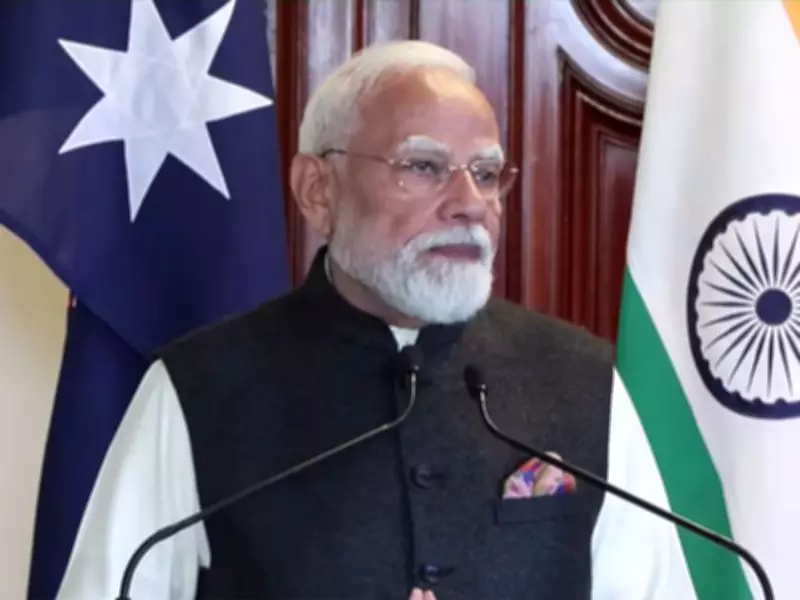
India and Australia have signed a landmark nuclear energy agreement under which Canberra will supply uranium to fuel New Delhi's civil atomic programme, Prime Minister Narendra Modi announced on Thursday in Melbourne. Delivering a joint press conference alongside Australian Prime Minister Anthony Albanese, Modi declared the atomic breakthrough a transformative catalyst for India's ecological targets.
Key Details of the Uranium Supply Agreement
"Australia will supply uranium to India. We have signed an important agreement in the field of nuclear energy. It will give new momentum to our clean energy goals," PM Modi announced. The agreement enables uranium exports to India for peaceful purposes under the 2015 Australia-India Nuclear Cooperation Agreement, as formally confirmed by Prime Minister Albanese.
Strengthening the Comprehensive Strategic Partnership
Modi framed the deepening consensus within a shared geopolitical vision, noting that India and Australia, as "two vibrant democracies, multicultural societies and important ocean powers," share a common worldview that continues to strengthen their Comprehensive Strategic Partnership. He further noted that the third Annual Summit had added new dimensions to bilateral ties.

Multi-Sectoral Breakthroughs
PM Modi also announced that the two countries had decided to work towards a Comprehensive Economic Cooperation Agreement (CECA), which he described as a balanced, ambitious and mutually beneficial pact. To further cement this trade axis, the Prime Minister indicated that both sides would move forward on a bilateral investment treaty to deepen economic engagement.
Bolstering high-tech supply chains, Modi said India and Australia would work together on a Critical Minerals Corridor to strengthen resilient supply chains and support the clean energy transition. In a parallel security push, he also announced the creation of an India-Australia Defence Innovation Corridor to deepen collaboration in defence technology.
Defence and Security Cooperation
Expanding their operational matrix across the Indo-Pacific, the two maritime powers unveiled a joint declaration on defence and security cooperation, a maritime security collaboration roadmap, and a new partnership on cyber security, critical technologies and supply chains. Highlighting the critical nature of the alliance, Albanese described India as one of Australia's most important strategic partners and said the relationship had "never been more consequential."
"We share a focus on deepening and diversifying the relationship between our countries so we can continue to grow from strength to strength. Today, we have done exactly that across the breadth of our relationship. With new landmark agreements, we are expanding our relationship across defence and security, education, science and technology, and energy security and critical minerals," the Australian Prime Minister asserted.
Space and Technology Collaboration
In a remarkable show of expanding multilateral and aerospace cohesion, the leaders also endorsed a trilateral technology partnership involving Australia, India and Canada, while Australia agreed to commission a temporary space tracking terminal on the Cocos (Keeling) Islands to support India's Gaganyaan programme.
These high-level frameworks materialise at a defining moment as both countries seek to strengthen cooperation in clean energy, critical minerals, defence, technology and Indo-Pacific security, with the two leaders reaffirming their commitment to a stable, secure and prosperous region.