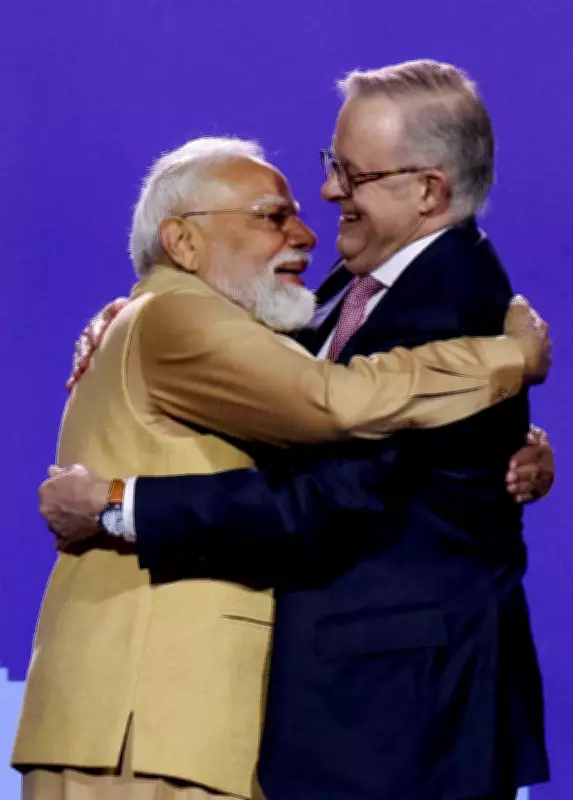
India and Australia on Thursday operationalised the 2014 civil nuclear agreement, clearing the way for Australian uranium supplies to India's civilian nuclear programme, as part of a comprehensive strategic partnership upgrade. The decision was announced after the third India-Australia Annual Summit in Melbourne, where Prime Minister Narendra Modi and his Australian counterpart Anthony Albanese adopted a security roadmap and agreed to accelerate negotiations on a trade pact and a bilateral investment treaty.
Civil Nuclear Deal Operationalised for Uranium Supplies
A major outcome of the summit was the finalisation of the administrative arrangement under the India-Australia Civil Nuclear Agreement, signed in 2014, which operationalises the pact and enables uranium supplies from Australia to India for its civilian nuclear programme. "In the field of nuclear energy, we have reached an important agreement today. This will open the way for uranium supplies from Australia to India and give fresh momentum to our clean energy goals," Modi said at a joint press conference.
Defence and Maritime Security Roadmap Adopted
Defence and maritime security emerged as key pillars of the upgraded partnership, with the two sides adopting a Joint Declaration on Defence and Security Cooperation that renews the existing 2009 framework and expands collaboration in military interoperability, defence industrial cooperation, cybersecurity, counter-terrorism and humanitarian assistance and disaster relief. India and Australia also adopted a Maritime Security Collaboration Roadmap aimed at enhancing information sharing, capability development and operational coordination in the Indo-Pacific. Modi said India and Australia, as two vibrant democracies and important Indo-Pacific maritime powers, shared a common vision for a free, open and rules-based regional order.

Economic Pacts: CECA and Investment Treaty Fast-Tracked
The two leaders also agreed to accelerate negotiations on the long-pending Comprehensive Economic Cooperation Agreement (CECA), building on the Economic Cooperation and Trade Agreement (ECTA) signed in 2022, which has expanded bilateral trade. They also decided to expedite negotiations on a bilateral investment treaty to encourage greater two-way investments.
Critical Minerals, Cyber and Clean Energy Cooperation
Recognising the importance of critical minerals and emerging technologies, the two countries launched the Australia-India Partnership for Cyber, Critical Technologies and Supply Chains (PACTS) to strengthen cooperation in cybersecurity, digital resilience and trusted supply chains. The two sides also agreed to work towards establishing a critical minerals corridor, while the Geological Survey of India and GeoScience Australia signed an understanding to promote advanced exploration methods, capacity building and technological modernisation. Highlighting clean energy as a central pillar of the partnership, Modi said both countries would deepen collaboration in renewable energy, technology transfer and industry-to-industry cooperation. He also announced the operationalisation of a rooftop solar training academy at Pandit Deendayal Energy University, Gandhinagar, with Australian support to train 2,000 women and youth as solar technicians under the PM Surya Ghar Yojana.
Maritime Law Enforcement Agreement Signed
The Indian Coast Guard and Australia’s Maritime Border Command signed an agreement to strengthen cooperation in maritime law enforcement, domain awareness and maritime border protection. Australia also invited India to deploy a military instructor at the Australian Defence College during 2028-29.
Education and Skill Development Initiatives
Education and skill development also featured prominently in the outcomes, with Australia’s Flinders University submitting a Letter of Intent to establish a campus in Bengaluru and Victoria University receiving approval to set up a campus in Gurugram. A Centre of Excellence in Mining Equipment, Technology and Services (METS) will also be established at the National Skill Training Institute, Bhubaneswar, in collaboration with Technical and Further Education (TAFE), Western Australia, to develop expertise in mining operations, safety, mineral processing and machinery.

People-to-People Ties and Cricket Analogy
Modi highlighted the growing people-to-people ties between the two countries, noting that the Indian diaspora had become an important contributor to Australia’s economic and social life. Comparing India-Australia ties to cricket, he remarked, "Our agenda is as focused as a One-Day match, our decisions are as fast as T20 cricket and our partnership is as enduring as a Test match."