The diplomatic relationship between India and Bangladesh has encountered significant turbulence, marked by a reciprocal suspension of visa services. This development follows a series of protests and security alerts around diplomatic premises in both nations, casting a shadow over bilateral ties during a period of intense political unrest in Bangladesh.
Reciprocal Visa Suspensions Strain Ties
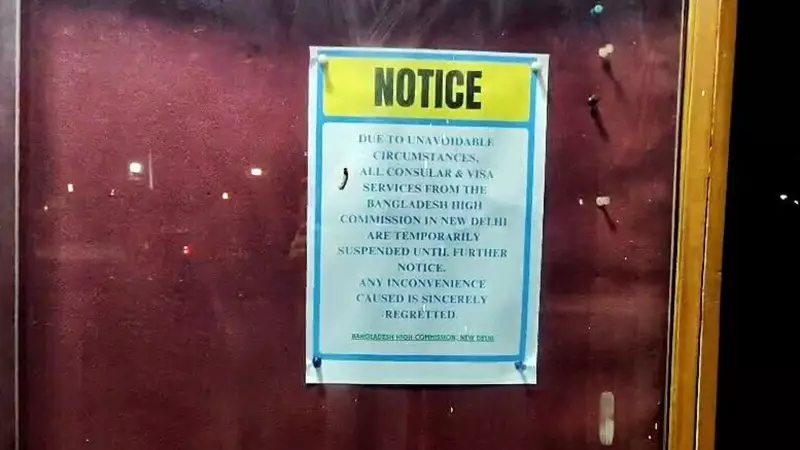
Bangladesh has officially halted visa services at its High Commission in New Delhi and its Assistant High Commission in Agartala, Tripura. The missions cited "unavoidable circumstances" for this sudden move. This action came after demonstrators gathered outside the mission in Tripura on Sunday, according to people familiar with the developments.
In a parallel step, a private visa processing agent appointed by Dhaka in Siliguri, West Bengal, has also stopped accepting applications. This suspension by Bangladesh is a direct response to India's earlier decision to suspend visa services at its Assistant High Commission in Chittagong. That Indian move was triggered on Thursday when a group of protesters attempted to storm the diplomatic premises.

Security Concerns and Political Unrest at the Core
The diplomatic friction intensified when India summoned Bangladesh's envoy, Riaz Hamidullah, to express "strong concern." New Delhi pointed to plans announced by what it termed extremist elements to create a security situation around the Indian mission in Dhaka. India's Ministry of External Affairs (MEA) issued a statement completely rejecting the "false narrative" being propagated by these groups regarding recent events in Bangladesh.
The MEA also expressed disappointment, stating, "It is unfortunate that the interim government has neither conducted a thorough investigation nor shared meaningful evidence with India regarding the incidents."
The current wave of protests and political instability in Bangladesh revolves around the killing of a prominent activist. Sharif Osman Hadi, the spokesperson for the Inqilab Moncho platform and a key figure in Bangladesh's July uprising, was shot at close range in Dhaka's Bijoynagar area on December 12. This occurred just a day after the Election Commission announced national elections for February 12, 2026. Despite being airlifted to Singapore for advanced treatment on December 15, Hadi succumbed to his injuries on December 18.
Pressure Mounts on Interim Government
Hadi's assassination sparked immediate protests across Dhaka, with demonstrators demanding the swift arrest and punishment of the perpetrators. In response to the public outcry, Bangladesh's Law Adviser, Asif Nazrul, announced that the murder case would be transferred to a Speedy Trial Tribunal. He confirmed that under the relevant 2002 law, the trial must be concluded within 90 days of the police submitting their investigation report.
Separately, Home Adviser Lt Gen (retd) Jahangir Alam Chowdhury stated that authorities had made progress in the investigation and were working to apprehend the main accused, Faisal Karim Masud. He emphasized that the government was treating the case as a top priority.
However, the pressure on the interim government led by Chief Adviser Muhammad Yunus continues to mount. Inqilab Moncho, a major platform from the July uprising, has warned of launching a mass movement to oust the government if justice is not delivered. The group had earlier issued a 24-hour ultimatum after Hadi's funeral prayers, later criticizing the government for not taking concrete action within the deadline. Hadi, who was being considered as a potential candidate from Dhaka-8 in the upcoming elections, was a central leader in the movement that led to the fall of former Prime Minister Sheikh Hasina's government. Following his death, the interim government declared December 20 a national day of mourning.
The intertwining of domestic political violence in Bangladesh with the security of diplomatic missions has now spilled over into the bilateral relationship with India, leading to a tangible disruption in consular services and raising concerns about the stability of ties between the two neighbors.