India and Brazil Forge Ambitious $30 Billion Trade Partnership by 2030
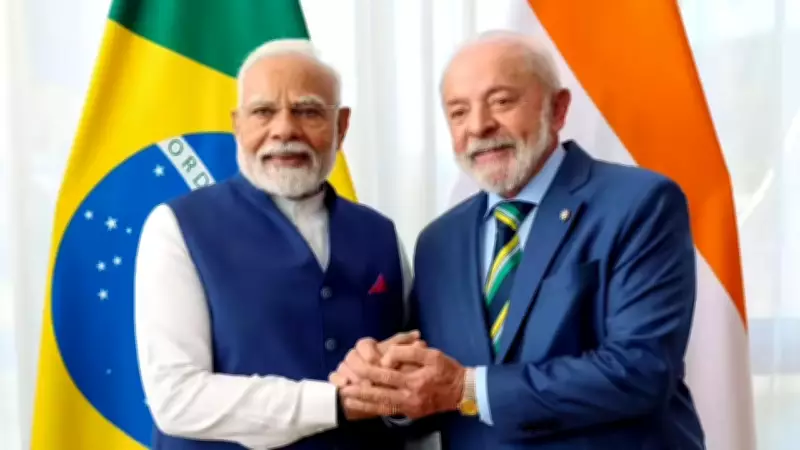
In a significant diplomatic development, India and Brazil have committed to dramatically scaling up their economic engagement, setting a bold target to achieve $30 billion in annual bilateral trade by the year 2030. This ambitious goal was announced following comprehensive talks between Prime Minister Narendra Modi and Brazilian President Luiz Inacio Lula da Silva in New Delhi on Saturday.
The two leaders also formalized a crucial cooperation agreement focusing on rare earth and critical minerals, a strategic move aimed at building more resilient global supply chains. This pact underscores the deepening strategic partnership between the two major democracies of the Global South amid a rapidly evolving international economic landscape.
Trade Target Reset and Strategic Sector Expansion
Secretary (East) in the Ministry of External Affairs, P Kumaran, confirmed that both leaders agreed bilateral trade should at least double from current levels to reach the $30 billion milestone within the next six years. Official data reveals that India-Brazil trade stood at $12 billion during the 2024–25 period, with Indian exports accounting for $6.77 billion and imports from Brazil valued at $5.43 billion.

"Brazil is India's largest trading partner in Latin America. We are committed to taking bilateral trade beyond USD 20 billion in the next five years. Our trade is not just a figure, it's a reflection of trust," Prime Minister Modi emphasized in his joint media statement alongside President Lula.
The discussions yielded nine substantive agreements, including a joint declaration on digital partnership and memoranda of understanding spanning multiple sectors such as mining, micro, small and medium enterprises (MSMEs), healthcare, and traditional knowledge systems. The leaders identified defense, energy, healthcare, and digital public infrastructure as priority areas for expanded cooperation.
"The agreement on critical minerals and rare earth is a major step towards building resilient supply chains," Modi highlighted, pointing to the strategic importance of this collaboration.
Navigating Global Trade Developments
The bilateral talks also addressed recent developments in international trade policy, particularly the implications of the US Supreme Court decision that struck down reciprocal tariffs previously imposed by the Trump administration. Both sides reviewed the subsequent imposition of a new 10 percent global tariff by the US administration following this judicial ruling.
"Both leaders agreed that it is a rather new development that both sides need to study its implications and wait for further developments by the US administration," Kumaran stated, as reported by PTI. He added, "We will be essentially in wait and watch mode on how the administration responds to this judgement and whether any further steps are taken and to study the implications for our trade."
Global South Leadership and Institutional Reform
Prime Minister Modi articulated the shared perspectives of India and Brazil on global governance challenges, stressing that reform of international institutions has become imperative to effectively address contemporary issues. "We believe that every problem must be resolved through dialogue and diplomacy. India and Brazil are unanimous that terrorism and its supporters are enemies of all humanity," he asserted.
President Lula, who is on a five-day visit to India that includes participation in the AI Impact Summit, condemned terror attacks in Kashmir and emphasized that terrorism should not be associated with any particular religion or nationality. "The turbulent global environment requires India and Brazil to deepen our strategic ties," Lula observed, characterizing the engagement between the two nations as a partnership of "superlatives."
"We are not just the two biggest democracies of the Global South. This is a meeting of a digital superpower with a renewable energy superpower," the Brazilian president elaborated.

Both leaders strongly advocated for comprehensive reform of the United Nations Security Council to better represent Global South interests. "We emphasized our commitment to the UN reform, particularly of the UN Security Council so that it represents the interests of the Global South. Brazil and India are natural candidates to become permanent members of the Security Council," Lula affirmed.
Broadening Defense and Technological Collaboration
The discussions encompassed substantial defense cooperation initiatives, including maintenance collaboration for French-origin Scorpene submarines through a tripartite arrangement involving Mazagon Dock Shipbuilders Limited along with the Indian and Brazilian navies.
Brazilian aerospace giant Embraer's proposal to establish an assembly line for its E175 regional jet in India and create a maintenance, repair, and overhaul facility also featured prominently in the talks.
Modi highlighted technology and innovation as crucial areas for mutual benefit, stating, "We are also prioritizing our cooperation in areas such as Artificial Intelligence, supercomputers, semiconductors, and blockchain. We both believe that technology must be inclusive and it must become a bridge for shared progress."
Energy cooperation emerged as another key pillar, with both nations exploring collaboration in renewable energy, ethanol blending, and sustainable aviation fuel. Modi welcomed Brazil's participation in the Global Biofuel Alliance, while Brazil proposed co-chairing the India-backed Coalition for Disaster Resilient Infrastructure (CDRI), an initiative the Prime Minister said would significantly strengthen global cooperation in disaster resilience.
Prime Minister Modi concluded that President Lula's visit had injected fresh momentum into India-Brazil relations, noting that this strategic partnership continues to play an influential role on the global stage while advancing the collective aspirations of the Global South community.