

India and Canada Forge New Strategic Partnership with Major Economic and Energy Agreements
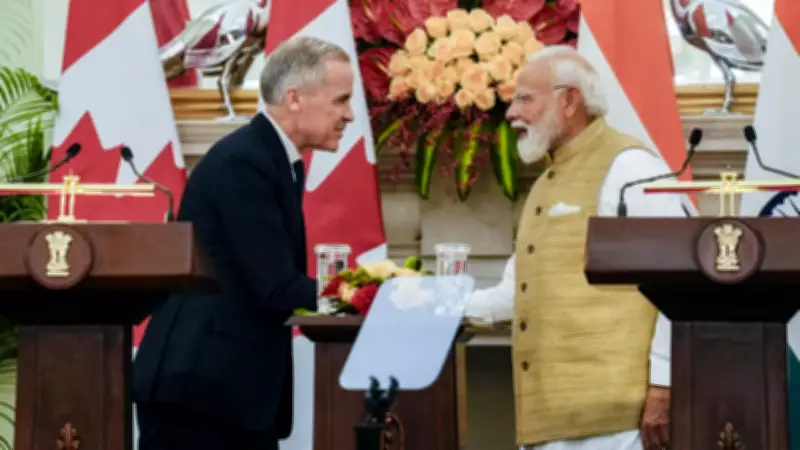
In a significant diplomatic development, Prime Minister Narendra Modi hosted Canadian Prime Minister Mark Carney in New Delhi on Monday, resulting in a series of groundbreaking announcements that signal a dramatic turnaround in bilateral relations over the past ten months. The centerpiece of this renewed engagement is a landmark $2.6 billion agreement for Canada to supply 22 million pounds of uranium to India from 2027 to 2035, ensuring long-term energy security for India's nuclear power sector.
Comprehensive Economic Partnership Agreement and Trade Targets
The leaders committed to concluding a Comprehensive Economic Partnership Agreement (CEPA) by the end of this year, with both sides finalizing the terms of reference. This ambitious trade pact aims to significantly boost economic ties, with Prime Minister Modi setting a goal of reaching $50 billion in annual trade by 2030. The Canadian side projected that CEPA could generate $70 billion in trade over the next five years, reflecting the substantial potential for enhanced commercial cooperation.
"It is our priority to unlock the full potential of economic cooperation. Therefore, we have decided to finalise the CEPA as soon as possible. This will create new opportunities for investment and employment in both countries," stated Prime Minister Modi during the joint announcements.

Strategic Energy Partnership and Critical Minerals Cooperation
Beyond the uranium deal, the two nations launched a new strategic energy partnership and signed a Memorandum of Understanding (MoU) on critical minerals. This agreement is designed to strengthen supply chain resilience and foster collaboration in securing essential resources for advanced technologies. Prime Minister Modi emphasized that this partnership would help transform both economies to be more diversified, independent, and resilient.
Prime Minister Carney echoed this sentiment, noting that the relationship represents not just a renewal but an expansion of the partnership. "With Canada and India as innovation partners, we will turn ideas into global solutions," Modi added, highlighting the broader vision for technological collaboration.
Security Dialogue and Addressing Concerns
The discussions included sensitive security concerns, with India raising issues about separatist activities and Canada addressing transnational repression. While these topics were not explicitly mentioned in public remarks, both leaders endorsed ongoing security cooperation and focused on consolidating the relationship. According to a Canadian readout, they agreed to advance bilateral cooperation on security and law enforcement, including matters of mutual concern.
However, the Ministry of External Affairs (MEA) later rejected allegations reported in Canadian media linking Indian officials to transnational violence or organized crime. MEA Secretary (East) P Kumaran stated that these claims were "baseless, politically motivated, and unsupported by credible evidence despite repeated requests." He emphasized that such concerns should be addressed through credible law enforcement and judicial processes rather than public or politicized narratives.
Expanding Cooperation Across Multiple Sectors
The summit yielded a total of 32 agreements and partnerships, including:
- Eight government-level MoUs covering areas such as defense dialogue and energy cooperation.
- Twenty-four agreements among universities and institutions focusing on artificial intelligence, healthcare, agriculture, and innovation.
- An MoU under the Australia-Canada-India Technology and Innovation Partnership for the development and deployment of AI technologies.
Prime Minister Modi credited Carney for the increasing momentum in all areas of cooperation, underscoring that the forward movement in ties is powered by shared democratic values, diversity, and humanity. Both leaders also acknowledged that terrorism, extremism, and radicalization pose shared and serious challenges for their countries and humanity at large.

This comprehensive reset in India-Canada relations marks a pivotal shift from previous tensions, setting the stage for deeper economic integration, energy security, and strategic collaboration in the coming years.





