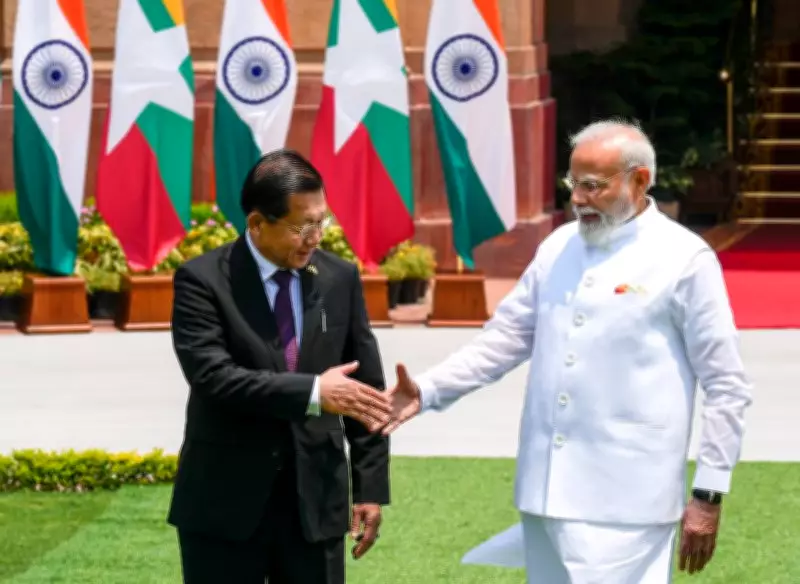
India on Monday defended its continued engagement with Myanmar's military leadership, asserting that isolation had never produced democratic change and only created a vacuum that 'other powers' were quick to fill.
Modi Meets Myanmar President
The remarks came as Prime Minister Narendra Modi held talks with Myanmar President U Min Aung Hlaing during the latter's first official visit to India. Responding to questions on democracy in Myanmar and the status of detained pro-democracy leader Aung San Suu Kyi, Foreign Secretary Vikram Misri revealed that Modi had raised the issue during discussions with the Myanmar President in the broader context of the country's ongoing peace and reconciliation process.
India's Stance on Engagement
'We have always proceeded on the principle that sustained dialogue is what is important and what is an imperative for India as a neighbor and the answer is clearly not disengagement. History has shown that disengagement doesn't give us any results that are better than engagement and it certainly doesn't produce democratic change if that is what we are interested in,' Misri said during a special media briefing.

In an apparent reference to China's growing influence in Myanmar, Misri cautioned that disengagement only created a vacuum that others moved to fill, often without any interest in democratic principles. 'Disengagement only produces a vacuum that others go on to fill, then to their detriment and those others have no interest in democracy. I can assure you about that,' he said.
Support for Inclusive Peace Process
The Foreign Secretary said India had consistently advocated an inclusive peace process involving all stakeholders and supported efforts aimed at national reconciliation, peace and stability in the conflict-ridden country. Misri said Modi stressed the need for enduring peace, inclusion and dialogue among all groups as Myanmar seeks a path back towards democracy. He added that India was not seeking to comment on Myanmar's internal political arrangements but believed sustained engagement was essential given the two countries' shared border and strategic interests.
Myanmar-Led Solution
Misri reiterated India's longstanding position that the challenges facing Myanmar would ultimately require a 'Myanmar-led and Myanmar-owned solution'.
Security Cooperation
On security issues, Misri said India and Myanmar were continuing to work closely to combat cybercrime and human trafficking networks operating along Myanmar's border regions. He disclosed that India had repatriated 2,411 citizens from cyber scam compounds in Myanmar over the past year and a half. Around 150 Indian nationals are still believed to be trapped in such facilities, and discussions are underway with Myanmar authorities to facilitate their return, he said.
Insurgent Groups
As per Misri, Prime Minister Modi raised the issue of Indian insurgent groups operating from Myanmar territory during talks with President Hlaing, who assured India that necessary action would be taken to ensure Myanmar soil is not used against India's security interests.
Connectivity Projects Delayed
The Foreign Secretary also acknowledged that the ongoing conflict in Myanmar had delayed key connectivity projects, including the Kaladan Multi-Modal Transit Transport Project and the India-Myanmar-Thailand Trilateral Highway. He said active hostilities between the Myanmar military and ethnic armed groups in several regions had affected construction work and the movement of personnel.
Vital Indian Interest
Describing peace and stability in Myanmar as a vital Indian interest, Misri said developments in the neighbouring country directly impacted the security of India's Northeast, cross-border connectivity initiatives and the broader stability of Southeast Asia.