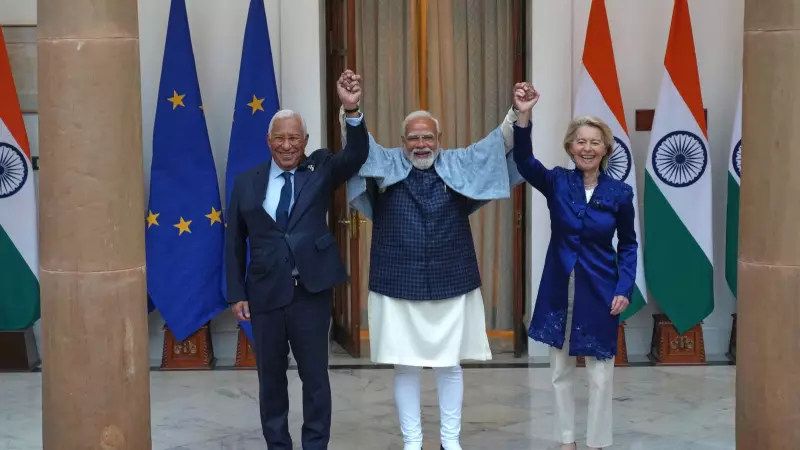
India-Europe Strategic Partnership: A Decade-Long Diplomatic Effort Bears Fruit
The recent visit of European Union leadership to Delhi during the Republic Day weekend brought more than just pleasant winter weather—it delivered a breakthrough in strategic clarity and concrete outcomes. Ursula von der Leyen and António Costa, presidents of the European Commission and European Council respectively, unveiled significant agreements that consolidate the bilateral strategic partnership and validate India's renewed commitment to trade liberalization.
Not a Byproduct of US Politics
Contrary to popular perception, these developments are not accidental consequences of current turbulence in relations with Donald Trump's America. Both India and Europe maintain substantial economic partnerships with the United States and have no intention of weakening their security bonds with Washington. What we are witnessing is a deliberate diversification strategy—a conscious effort by both sides to de-risk their international relationships amid an assertive China and unpredictable American policies.
The agreements on trade, defense cooperation, and mobility announced this week represent the culmination of sustained diplomatic efforts that trace back to the early years of Prime Minister Narendra Modi's first term. This persistent groundwork has often been overlooked in broader narratives of Indian foreign policy, but its results are now unmistakably evident.

Historical Context and Diplomatic Revival
For much of the post-independence period, Europe occupied a peripheral position in India's geopolitical considerations. Delhi traditionally viewed the continent through the lens of Russia-West rivalries, while Europe saw Asia through a narrow framework that contrasted protectionist India with business-friendly China.
By the time Modi assumed office in 2014, India-Europe relations had reached a low point. The strategic partnership announced in 2004 had stalled, free trade negotiations were suspended in 2013, annual summits were on hold, and bilateral relations with key European nations like Italy were significantly strained.
The Modi government's first task was repair work. Early efforts focused on resolving difficult bilateral issues, reopening political channels, and rebuilding trust. The revival of annual India-EU summits in 2016 marked a crucial turning point. Simultaneously, Delhi began moving away from its previous tendency to treat Europe as merely a "flyover continent" en route to the United States.
Comprehensive Diplomatic Engagement
Europe initiated a fresh strategic review of India in 2018, setting the stage for trade talks to resume in 2022—a full decade after their suspension. This diplomatic reboot extended well beyond Brussels. Delhi revitalized relationships with major European capitals including Paris, Berlin, London, Rome, Madrid, and Warsaw, while also reaching out to Europe's sub-regions: the Nordics, Baltics, Central Europe, and Mediterranean nations.
New connectivity initiatives like the India-Middle East-Europe Economic Corridor (IMEC) expanded the partnership's horizons. Security cooperation grew in the western Indian Ocean, defense industrial collaboration accelerated, and advanced technologies—from green hydrogen to semiconductors—moved to the center of the bilateral agenda. Even on contentious issues such as climate change, human rights, and Russia's war in Ukraine, Delhi and Europe found pragmatic common ground to advance their relationship.
Strategic Economic Reorientation
The journey on trade has been particularly remarkable. The BJP government initially approached free trade with skepticism and dramatically withdrew from the Regional Comprehensive Economic Partnership (RCEP) in 2019, reinforcing India's image as a reluctant liberalizer. What followed was a significant strategic reorientation: the recognition that India gains more by negotiating with complementary Western economies rather than competing with manufacturing hubs in East Asia.
Since exiting RCEP, India has successfully negotiated a series of free trade agreements—with Australia, the UAE, the European Free Trade Association, the United Kingdom, Oman, and New Zealand. The forthcoming FTA with Europe represents the capstone of this new economic strategy.

From Breakthrough to Implementation
This week's achievements are the cumulative results of substantial diplomatic investment and political will to overcome entrenched skepticism in both Brussels and Delhi. However, India has little time for extended celebration. Trade liberalization, once agreed upon in principle, requires enormous bureaucratic mobilization to move from negotiation to signature to implementation. Defense cooperation, by its nature, progresses slowly and demands sustained high-level engagement to yield tangible results.
In many respects, India's current moment with Europe resembles the summer of 2005, when Delhi and Washington crafted a new framework for bilateral cooperation. What followed in the American case was unprecedented mobilization across governments, businesses, think tanks, and civil societies. Two decades later, debates continue about whether India fully capitalized on the strategic possibilities that the US relationship opened up. This pattern must not repeat with Europe.
Future Challenges and Opportunities
With Europe, India must generate both innovative ideas and sustained momentum. Delhi needs creative institutional engagement and an expanded presence across Europe's multilingual, multinational geography. Success with Europe should now spur India to accelerate upgrades to the Australia agreement, revive prospects with Canada, and encourage Washington toward a more stable trade compact.
India should also begin exploratory discussions with members of the Comprehensive and Progressive Agreement for Trans-Pacific Partnership (CPTPP). Unlike RCEP, which China dominates, CPTPP excludes both Beijing—the manufacturing hegemon—and Washington, now an increasingly capricious trade partner.
The India-Europe partnership stands at a critical turning point. The challenge now is to move from breakthroughs to delivery and from frameworks to concrete outcomes. For both India and Europe, this represents a moment not just to diversify partnerships but to expand their agency in shaping the emerging international order. The shared priorities are clear: internal economic and institutional reform, strengthened defense capabilities, narrowing the technology gap with the US and China, and strategic diversification.
Binding India to Europe—whose economy now rivals China's and stands second only to the United States—represents the most consequential trade arrangement Delhi has negotiated to date. It reinforces India's growing recognition that trade constitutes a crucial element of its national strategy for becoming a developed nation by 2047. The translation of prolonged rhetoric into concrete outcomes marks a genuine transformation in the geopolitics connecting India and Europe.