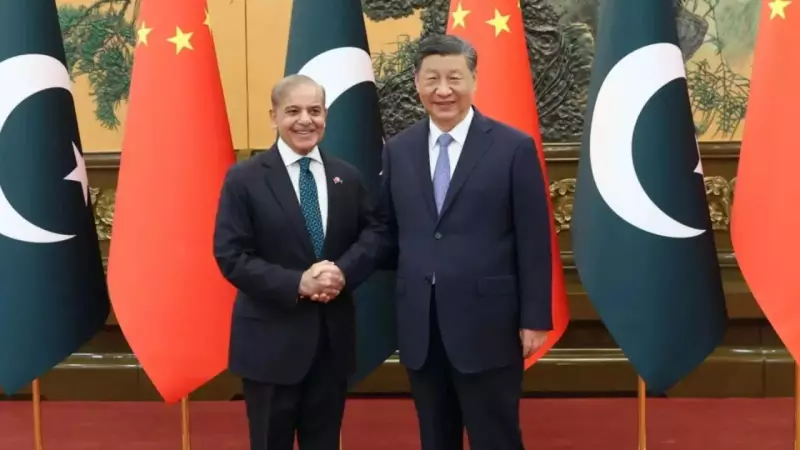
In a firm diplomatic stance, India on Friday categorically rejected the decades-old boundary agreement between China and Pakistan, along with the ambitious China-Pakistan Economic Corridor (CPEC), branding both as "illegal and invalid." The strong rebuttal from the Ministry of External Affairs (MEA) underscores New Delhi's unwavering position on its territorial integrity.
India's Unambiguous Stance on Sovereignty
Addressing the media, MEA spokesperson Randhir Jaiswal left no room for ambiguity. He asserted that the Shaksgam Valley is an integral part of Indian territory. "We have never recognised the so-called China-Pakistan boundary agreement that happened in 1963," Jaiswal stated. "We have consistently maintained that the agreement is illegal and invalid."
He further reinforced India's position by declaring that the entire union territories of Jammu and Kashmir and Ladakh are an integral and inalienable part of India. This official position has been communicated repeatedly to both Islamabad and Beijing over the years.

CPEC: A Persistent Point of Contention
The spokesperson's remarks directly address the core of the China-Pakistan Economic Corridor (CPEC), a flagship project under China's Belt and Road Initiative valued at approximately USD 60 billion. This network of roads, railways, and energy projects links China's Xinjiang region to Pakistan's Gwadar port.
India's opposition to CPEC is rooted in sovereignty. New Delhi firmly opposes the corridor because key sections of it pass through Pakistan-occupied Kashmir, which India claims as its own sovereign territory. India has consistently warned that the involvement of any third country in projects in this region "directly infringes on India's sovereignty and territorial integrity."
Security Moves and Regional Implications
The MEA's statement comes at a time when Pakistan announced the creation of a Special Protection Unit (SPU) to secure thousands of Chinese nationals working on CPEC projects. Pakistan's Interior Minister Mohsin Naqvi announced this during meetings in Beijing with China's Minister of Public Security Wang Xiaohong on Wednesday.
According to reports, the SPU will be set up in Islamabad. This move highlights the persistent security challenges surrounding CPEC, with militant groups like the Baloch Liberation Army repeatedly targeting Chinese interests. Presently, around 20,000 Chinese personnel are involved in CPEC projects, with the Pakistan Army already deploying significant forces for their protection.
Jaiswal concluded by stating that India has "consistently protested with the Chinese side against attempts to alter the ground reality in Shaksgam Valley" and "further reserve[s] the right to take necessary measures to safeguard our interests." This firm posture signals India's readiness to respond to any actions it perceives as undermining its territorial claims, even as Pakistan and China seek to expand CPEC's regional footprint.