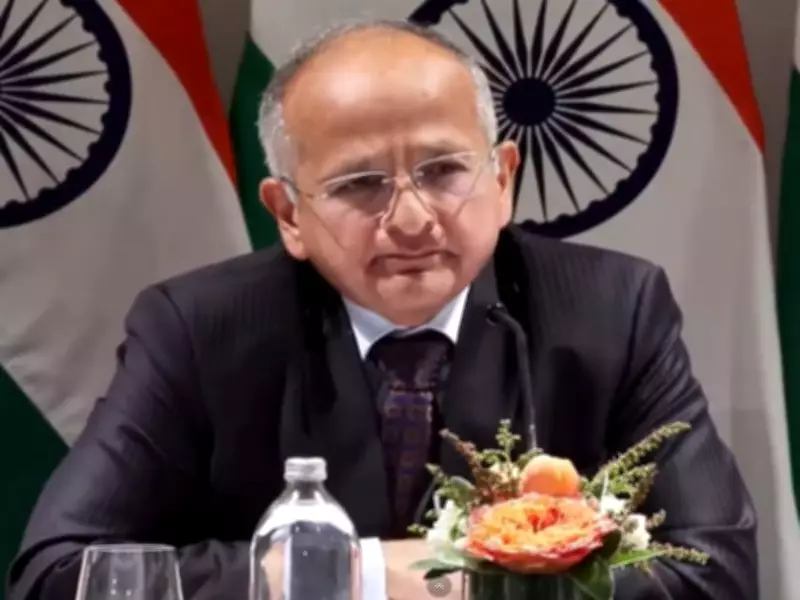
India and New Zealand are set to deepen their bilateral ties through a unique collaboration in traditional medicine, indigenous cultural exchanges, and people-to-people connections, the Ministry of External Affairs (MEA) announced on Saturday. Speaking at a media briefing in Auckland, MEA Secretary (East) Rudrendra Tandon described the initiative as a fundamental pillar of the newly elevated India-New Zealand Strategic Partnership.
Traditional Medicine at the Core of Strategic Partnership
Tandon emphasized that both nations are actively working to build on core cultural similarities, particularly a shared reverence for indigenous traditions and nature. "Traditional medicine and celebrating indigenous cultures, and people-to-people connect will be an important underpinning of the relationship," he said. The collaboration formally integrates India's AYUSH systems alongside indigenous Maori health practices, unlocking cross-border mobility for practitioners and encouraging institutional collaboration in holistic healing.
In April 2026, India and New Zealand signed a landmark Free Trade Agreement (FTA) featuring a dedicated Health and Traditional Medicine Annexe. This historic framework elevates both nations' holistic health heritages into a shared modern healthcare and economic framework. New Zealand agreed to dedicated provisions within the FTA to facilitate trade and education in Ayurveda, Yoga, and other AYUSH disciplines alongside Maori health practices.

PM Modi's Vision for Preventive Healthcare
Tandon noted that Prime Minister Narendra Modi has long believed in the importance of traditional medicine in public healthcare systems as a preventive measure. "One of the things we are doing this time is that we are focusing on traditional medicine. As you know, the Prime Minister has always believed that traditional medicine in a public health care system is a very important preventive health care," Tandon said. He added that during high-level engagements, Modi specifically pointed to structural similarities between Indian heritage and New Zealand's indigenous traditions, including the celebration of the Maori New Year, Matariki.
"Collaboration between New Zealand's ancient Maori culture and India's own traditional medicine is a very exciting area of cooperation and very relevant to contemporary times. This is certainly something that the Prime Minister himself is very interested in promoting, and it is also a very exciting area for developing the relationship forward," Tandon stated.
Strategic Significance in the Indo-Pacific
Explaining the broader significance of the visit, Tandon said New Zealand occupies an important place in India's strategic outlook in the Indo-Pacific. "India is an Indian Ocean country. We are very attentive to what happens in adjoining maritime zones. The Pacific is a very important maritime zone for us. We've always considered New Zealand to be a very important power in this region, and a like-minded power," he said. Tandon credited New Zealand Prime Minister Christopher Luxon for injecting fresh momentum into bilateral ties, noting that Luxon has worked hard to impart new energy to the relationship, which is now a strategic partnership.
"Prime Minister Luxon has been working very hard to impart this new energy to the relationship, which is now a strategic relationship, precisely because of the idea that, as an inhabitant of the Indian Ocean and you as an inhabitant of the Pacific Ocean, we need to establish a close strategic relationship," Tandon added.

Economic Complementarities and Investment
Tandon highlighted the significant economic dimension to the partnership, noting that India is a large, growing market while New Zealand is an advanced economy with advanced technology. "We are always looking to forge partnerships with that. We have a very good basis for building an exciting economic relationship," he said. Responding to a question on monitoring New Zealand's proposed facilitation of USD 20 billion in investment, Tandon expressed confidence that the FTA itself would create sufficient incentives for investors. "The Prime Minister made it very clear that this is a long-term partnership. My suspicion is that when the India-New Zealand FTA is ratified and starts getting implemented, the opportunities will be so attractive. India is a very attractive investment destination in the emerging market space. So I suspect that monitoring will not really be required. But of course, it is part of the understandings we arrived at while drafting the FTA," he said.
Historic Visit and Roadmap to 2030
Prime Minister Narendra Modi is on a two-day official visit to New Zealand from July 10-11 at the invitation of Prime Minister Christopher Luxon. This is the first visit by an Indian Prime Minister to New Zealand in 40 years. During the visit, the two countries elevated ties to a Strategic Partnership and adopted a Roadmap to 2030 for enhanced cooperation across trade, defence, technology, security, and regional affairs.