

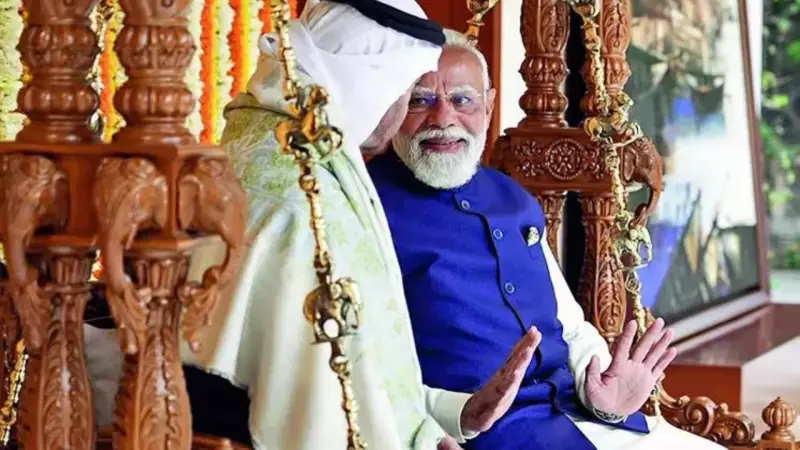
India and the United Arab Emirates took their rapidly growing relationship to a new level on Monday. Prime Minister Narendra Modi hosted UAE President Mohamed bin Zayed Al Nahyan in New Delhi for a visit that lasted just over three hours but produced significant results.
Strategic Defence Partnership Takes Center Stage
The two countries signed a letter of intent for a strategic defence partnership. This agreement is expected to establish a comprehensive framework for defence cooperation between India and the UAE.
The partnership will expand collaboration across multiple areas. These include defence industrial collaboration, innovation in defence technology, training programs, and special operations. Cyber security and counterterrorism efforts will also receive enhanced focus.

Natural Evolution of Defence Ties
Foreign Secretary Vikram Misri described the defence agreement as a natural progression. He emphasized that this development builds upon already substantial defence cooperation between the two nations. The agreement does not represent a response to any specific regional event according to official statements.
The UAE has been actively pursuing defence diversification. The country seeks to reduce reliance on traditional Western suppliers while preserving strategic autonomy. This new partnership with India aligns with that broader strategy.
Multiple Agreements Signed Beyond Defence
The defence partnership was just one of several agreements signed during the visit. The two countries inked four other important documents covering diverse areas of cooperation.
Space collaboration received special attention with a dedicated agreement. Energy cooperation saw significant advancement through an LNG purchase deal. Hindustan Petroleum Corporation Limited will buy 0.5 million metric tonnes of LNG annually from ADNOC Gas for ten years.
A letter of intent was signed for developing the Dholera special investment region in Gujarat. This ambitious project will include multiple infrastructure components:
- An international airport
- A pilot training school
- Maintenance, repair and overhaul facilities
- A greenfield port
- A smart urban township
- Railway connectivity
- Energy infrastructure
Economic and Trade Commitments Strengthened
Both countries made ambitious economic commitments during the visit. They agreed to double bilateral trade to $200 billion by 2032. This represents a substantial increase from current trade volumes.
UAE companies announced significant investments in India's financial infrastructure. First Abu Dhabi Bank and DP World will establish offices and operations in Gujarat's GIFT City. This move signals growing confidence in India's financial services sector.
Infrastructure and Technology Cooperation
The leaders discussed the India-Middle East-Europe Corridor initiative. They reaffirmed commitment to this strategic project that promises to enhance commerce and energy flow between India, the Middle East, and Europe.
Technology cooperation received special emphasis. Both countries announced plans to establish a supercomputing cluster in India. Civil nuclear cooperation will expand through development of large nuclear reactors and small modular reactors.
An innovative concept of Digital Embassies emerged from the discussions. Both sides agreed to explore establishing these under mutually recognized sovereignty arrangements.
Personal Diplomacy and Regional Issues
Prime Minister Modi demonstrated special hospitality by personally welcoming President Al Nahyan at the airport. This gesture highlighted the warm personal relationship between the two leaders.
Modi described the UAE President as "my brother" in a social media post. He noted that the visit illustrated the importance both leaders attach to strong India-UAE friendship.
The joint statement contained strong language on terrorism. Both leaders unequivocally condemned terrorism in all forms, including cross-border terrorism. They emphasized that no country should provide safe haven to those who finance, plan, support, or commit terrorist acts.

While the joint statement did not mention Gaza specifically, Foreign Secretary Misri confirmed that both leaders discussed the situation there. They also addressed other regional and global issues during their meeting.
The visit occurred weeks after President Al Nahyan's trip to Pakistan late last year. This timing underscores the UAE's active diplomatic engagement across South Asia.
The comprehensive agreements signed during this brief but productive visit demonstrate the deepening strategic partnership between India and the UAE. Both countries appear committed to transforming their relationship across multiple sectors including defence, trade, energy, and technology.





