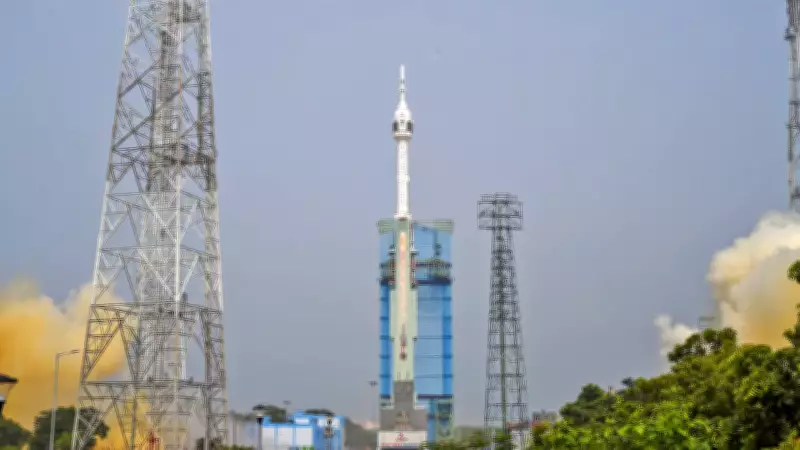
India and US Forge Ambitious New Space Alliance with Historic Docking Plan
India and the United States are poised to significantly expand their collaborative efforts in space exploration through a comprehensive new agenda that includes a groundbreaking uncrewed docking demonstration between India's Gaganyaan Orbital Module and the International Space Station (ISS). This initiative represents a major technological advancement for India's human spaceflight program and underscores the deepening strategic partnership between the two nations in the final frontier.
Three Pillars of Enhanced Space Cooperation
According to a detailed presentation by ISRO Chairman V Narayanan, the future cooperation framework is structured around three primary areas of collaboration between the Indian Space Research Organisation (ISRO) and the National Aeronautics and Space Administration (NASA).
- Comprehensive Personnel Training: ISRO astronauts and technical staff will undergo extensive training at NASA facilities across multiple critical domains. This includes instruction in robotics systems, extravehicular activity (EVA) procedures, extravehicular mobility unit (EMU) systems, resource management protocols, space medicine, spaceflight operations, low-Earth orbit (LEO) and lunar mission control operations, rendezvous and docking procedures, and payload and science operations.
- Uncrewed Docking Demonstration: A key initiative involves demonstrating the uncrewed docking capabilities of India's Gaganyaan Orbital Module with the US Orbital Segment of the International Space Station. This milestone achievement would mark a significant leap forward for India's human spaceflight ambitions and establish new technical benchmarks for international cooperation.
- Docking and Interoperability Systems: The third area focuses on enhanced cooperation in docking, berthing, and interoperability systems, ensuring seamless integration between Indian and American space technologies for future joint missions.
These strategic developments will be formally discussed at the 9th meeting of the India-USA Civil Space Joint Working Group (CSJWG), scheduled to be hosted by India in Bengaluru during April-May 2026.

Expanding Collaboration Beyond Human Spaceflight
The partnership extends well beyond human spaceflight initiatives into broader lunar exploration frameworks and operational data exchange programs. India has been actively engaged with the Artemis Accords since signing the agreement on June 21, 2023. The country has participated in annual workshops and principals' meetings, with India leading discussions on science data-sharing at the Artemis workshop in Abu Dhabi in 2025.
ISRO was also represented at the Artemis Accords principals' meeting held alongside the International Astronautical Congress (IAC) in Sydney in October 2025, demonstrating India's growing role in international space governance.
Operational data exchange represents another crucial dimension of the partnership. ISRO and the United States Geological Survey (USGS) share satellite data between India's Resourcesat-2 and the US Landsat-8 satellites for natural resources assessment and environmental monitoring studies. Additionally, India exchanges Earth observation data with the US National Oceanic and Atmospheric Administration (NOAA), particularly from the EOS-6 satellite, to enhance weather forecasting capabilities and ground station operations.
Under a separate agreement with US Space Command, ISRO receives high-accuracy data and alerts related to space situational awareness, improving safety and coordination for both nations' space assets.
Academic Links and Historical Foundations
The collaboration also features significant academic components, with students from the Indian Institute of Space Science and Technology pursuing advanced studies at the California Institute of Technology (Caltech) under the prestigious Satish Dhawan Endowed Fellowship program.

Lunar exploration remains a particularly fruitful area of cooperation. India's Chandrayaan-1 mission carried NASA's MiniSAR and Moon Mineralogy Mapper payloads, which contributed significantly to the groundbreaking discovery of water molecules on the lunar surface. NASA's Laser Retro Reflector Array flew aboard both Chandrayaan-2 and Chandrayaan-3 missions, while high-resolution images from Chandrayaan-2 have supported planning for NASA's Volatiles Investigating Polar Exploration Rover (VIPER) mission.
Chairman Narayanan traced the origins of this partnership back to 1963, when NASA's Nike-Apache sounding rocket was launched from Indian territory. Subsequent collaborations including the 1975 Satellite Instructional Television Experiment using NASA's ATS-6 satellite, remote sensing studies throughout the 1970s, and joint agricultural and hydrology experiments established the foundation for a relationship that now spans activities from low-Earth orbit to the lunar surface and beyond.
This expanded partnership represents a new chapter in India-US space relations, combining India's growing technological capabilities with America's extensive experience in human spaceflight and deep space exploration. The planned Gaganyaan-ISS docking demonstration symbolizes the practical implementation of this strengthened alliance, potentially opening doors for more ambitious joint missions in the coming decades.