Indian Evacuees from Iran Describe Street Fires, Night Protests, and Communication Blackout
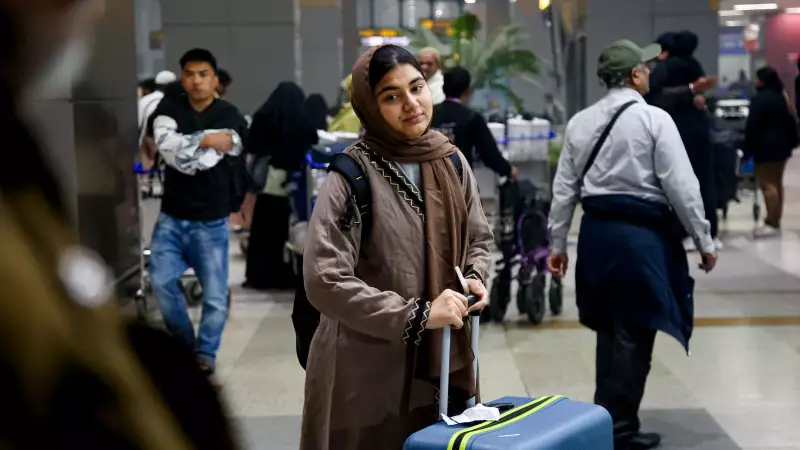
Indian nationals returning from Iran painted a vivid picture of chaos and uncertainty. They described streets lit by fires, sudden nighttime protests, and a complete communication blackout. Several students and professionals arrived at Terminal 3 of Delhi's Indira Gandhi International Airport in the early hours of Saturday.
Families Wait Anxiously at Delhi Airport
In the arrival section, families of Indian pilgrims, workers, and students waited anxiously. Some sat on cold metal benches. A few held flowers wrapped in cellophane. All stared intently at the glass doors every time they opened, hoping to see their loved ones emerge safely.
Just after 3 am, Arsh Sehra stepped out into the terminal. The MBBS student from Shiraz Medical University barely had time to look around before camera lights flared and microphones were shoved into her face. She panicked as questions came from all directions. Her father immediately stepped closer, standing protectively beside her.

"We Had No Idea"
"Everything is fine," she said quickly, trying to compose herself. She explained there had been no internet connection, so warnings, rumors, or videos of unrest couldn't circulate on phones. "We had no idea," she repeated, emphasizing their complete lack of information about the escalating situation.
The Indian Embassy had issued an advisory, after which her family booked tickets and returned on their own. Iran is experiencing one of its most serious bouts of unrest in years. Protests began in late December 2025 over economic hardship and later expanded into anti-government demonstrations.
Government Advisory and Varied Experiences
Amid the crackdown and communication blackout, India's Ministry of External Affairs advised Indian nationals in Iran to remain cautious. They were told to avoid non-essential movement, stay in contact with the Indian Embassy in Tehran, monitor official updates, and consider leaving the country where travel was feasible.
Shabbir Hussain, who hails from Jammu and Kashmir, landed earlier in the night. He described a different experience from other returnees. He had seen fires, he confirmed. He had witnessed protests, but only during nighttime hours. "Protests were happening in Tehran, Mashhad and Qom," Hussain reported.
Communication Breakdown and Family Anxiety
"If you can't contact your family, everyone gets worried," Hussain explained. "Anxiety spread quickly back home." He described Tehran as changing by the hour, with unrest at night and relative calm during daylight hours. Communication returned slowly. "International calling resumed after a few days. By this evening, things are becoming normal again in Tehran... that's what we are hearing."
Mohammad Dilshad, from Hyderabad, had been in Iran for work on an official assignment. He coordinated with supervisors based there. He had been in the country for a month, but for the past two weeks communications were shutting down gradually. Protesters, he recalled, would suddenly rush toward their car, shouting and creating panic. Nothing happened to them physically, he assured.
Emotional Toll on Families
"My mother and father were crying back home in Hyderabad," Dilshad shared emotionally. "We couldn't even send a normal message." With no internet, his flights were cancelled and the Indian embassy's phone lines in Tehran were unreachable. Eventually, his supervisors managed to book tickets for his return.
Speaking to the media at the arrivals gate, Mohammad Jawad from Bijnor waited for his aunt who had traveled to Iran on a pilgrimage. "We kept hearing that protests were happening mostly at night," he said. "We were assured that there was no need to be afraid."
Relief After Days of Uncertainty
Nijmeh Haider, from Uttar Pradesh's Amroha, waited for his younger brother's wife who had been unreachable for days. "The internet was dead," he described. "Then, one night, the call finally came: 'We are fine. The flight leaves at midnight.' These words gave us relief."

The returning Indians shared stories of resilience amid uncertainty. They described navigating through unpredictable situations while maintaining hope for safe return. Their accounts highlighted the challenges faced by foreign nationals during periods of civil unrest in host countries.