India's Military Reforms: Addressing the Leadership Deficit in Theatre Commands
India is currently undertaking one of its most significant military reforms in decades with the establishment of integrated theatre commands. However, a critical structural issue persists at the highest levels of the armed forces: a severe shortage of four-star generals relative to the institution's scale, complexity, and strategic ambitions. The theatre-isation process necessitates not only doctrinal and organizational changes but also a proportional increase in senior military leadership density. This challenge extends beyond administrative concerns, delving deep into strategic imperatives for India's security architecture in the 21st century.
The Leadership Paradox in India's Vast Military
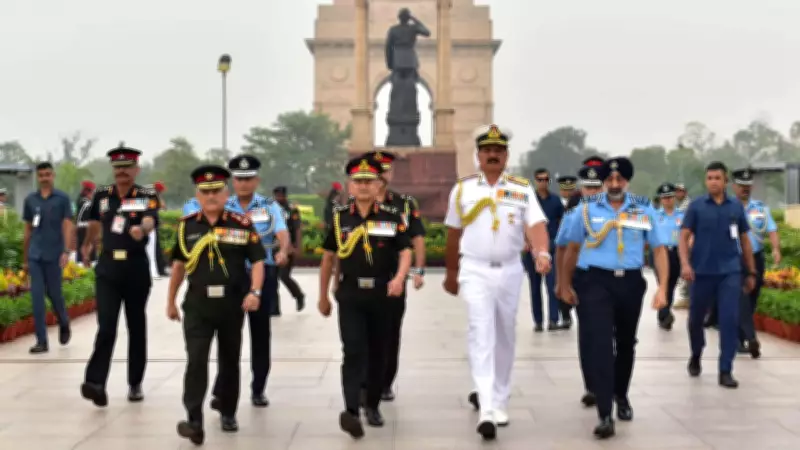
India boasts the world's fourth-largest military by active personnel, with approximately 1.44 million troops across the Army, Navy, and Air Force. The Indian Army alone comprises over 1.2 million soldiers, organized into field armies, corps, and divisions spanning diverse terrains from Siachen's glaciers to the Northeast's jungles. Despite this immense force, India maintains only four four-star officers: the Chiefs of the Army, Navy, and Air Force, plus the Chief of Defence Staff (CDS). This results in roughly one four-star general per 360,000 personnel, a ratio that appears inadequate when compared globally.
A structured comparison highlights India's leadership deficit. The United States supports over 35 four-star officers for an active force of about 1.3 million, including commanders for Indo-Pacific, European, Cyber, and Space Commands. China's People's Liberation Army fields 15 full generals and admirals across its five theatre commands and service leadership. Russia operates with 10-15 four-star equivalents across military districts and services.

Brazil provides a stark illustration: with a military of roughly 366,500—less than a quarter of India's size—it supports 16 four-star equivalents across its services and joint commands. Turkey, with armed forces of about 355,000, similarly maintains a proportionally higher number of four-star generals. When nations with smaller militaries sustain richer senior leadership structures, India's anomaly demands examination based on operational logic rather than bureaucratic tradition. A modern military operating across multiple domains and international commitments requires a deep bench of highest institutional authority.
Theatre-isation and the Demand for Strategic Command Authority
The Theatre Command model, part of India's jointness and integration framework, proposes creating distinct Integrated Theatre Commands, likely including a Northern Theatre Command (focused on China), a Western Theatre Command (focused on Pakistan), and a Maritime Theatre Command. Each Theatre Commander must exercise independent strategic authority over multi-domain, multi-service forces during peace and war, responsible for operations against adversaries like China or Pakistan. In conflict scenarios, such as Operation SINDOOR, a commander would oversee three to four C-in-C equivalent officers, six to nine Corps Commanders, and numerous other three-star rank officers.
India faces a unique two-front strategic challenge with a contested 3,488-km border with China and adversarial dynamics with Pakistan across the Line of Control and international boundary (3,323 km). These are not secondary concerns managed from a centralized headquarters but distinct, simultaneously demanding operational environments. A commander on the Himalayan front against China must possess authority to negotiate with diplomatic actors, coordinate with intelligence agencies, manage tri-service assets, and deter a nuclear-armed peer. Assigning such responsibilities to a rank below four-star creates an inherent asymmetry in command authority and credibility.

Upon theatre-isation, India will require at minimum a CDS, a Vice Chief of Defence Staff (VCDS), three service chiefs, and three theatre commanders, all functioning at a level demanding four-star authority. A four-star VCDS would facilitate coordination between Theatre Commanders, resource allocation, and effective employment of Cyber, Space, Special Forces, and Strategic Communication organizations. The current architecture, designed for a pre-theatre-isation era, is structurally inadequate for this new paradigm. Without authorizing the requisite number of four-star billets, theatre-isation risks creating powerful commands with diminished authority, undermining the reforms' intent.
Modern Warfare Imperatives: Multiple Domains Require Multiple Leaders
Senior military leadership responsibilities in contemporary times extend beyond the classical binary of war and peace. Today's senior officers serve as strategic advisors to the political executive, diplomats in uniform engaging with foreign counterparts, crisis managers in humanitarian and disaster response operations, administrators overseeing vast defence establishments, and institutional leaders responsible for the morale, training, and welfare of hundreds of thousands of personnel. India's military has participated in over 50 United Nations peacekeeping missions, conducts regular bilateral and multilateral exercises, manages extensive defence diplomacy, and is increasingly called upon for disaster relief across the Indian Ocean Region.
Each of these strategic-level responsibilities requires the institutional legitimacy of four-star rank. A Theatre Commander negotiating operational protocols with foreign counterparts or briefing the Cabinet Committee on Security cannot be perceived as a subordinate voice. The weight of the uniform must match the weight of the task.
The United States recognized this logic by creating dedicated four-star Combatant Commands for Cyber and Space. India's Defence Cyber Agency and Defence Space Agency, established in 2019 under the Integrated Defence Staff, are embryonic institutions with significant growth trajectories. The long-term question of whether India's Information Warfare and space-based capabilities will require their own four-star functional commands remains open, but the current theatre-isation exercise should be structured to accommodate such future needs.
Conclusion: Aligning Rank with Responsibility for Strategic Success
The argument for more four-star generals in India is not about prestige, entitlement, or institutional aggrandizement but stems from strategic logic. As India constructs integrated theatre commands to address a complex, multi-domain, two-front security environment, the principle must hold that rank follows responsibility. Nations India benchmarks against, such as the United States, China, and several mid-powers, have long understood that strategic leadership requires structural authority.
India's military leadership at the apex has operated with remarkable efficiency under constrained structures for decades, a testament to individual calibre. However, efficiency under constraint is not a substitute for adequacy of design. Theatre-isation offers India a once-in-a-generation opportunity to align its military architecture with its strategic weight. Seizing this opportunity fully requires, among other reforms, the political and bureaucratic will to authorize the four-star billets that the new architecture demands, ensuring India's security for decades to come.