

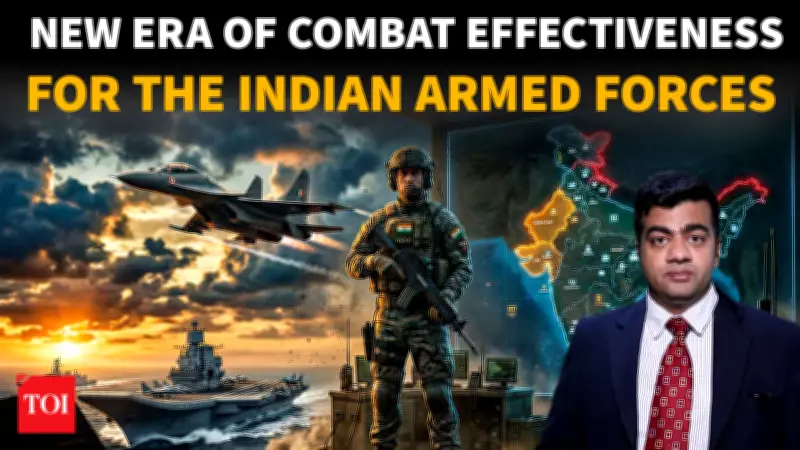
India's Military Prepares for Historic Theatre Command Reform, CDS Announces Consensus
In a landmark development for India's defence architecture, Chief of Defence Staff General Anil Chauhan has declared that the nation's armed forces are now fully aligned on the implementation of integrated theatre commands. This announcement marks a critical step toward the most significant military reform in independent India's history, poised to reshape strategic operations and enhance national security.
Operation Tiranga: Finalizing the Framework
General Anil Chauhan revealed that comprehensive discussions under the codename "Operation Tiranga" have been successfully concluded. A final report detailing the proposed structure and operational guidelines is expected to be submitted imminently. Following this, the proposal will advance to the Ministry of Defence and the Cabinet Committee on Security for formal approval, setting the stage for a transformative overhaul of India's military command system.
Three Integrated Theatre Commands: Structure and Leadership
The reform envisions the establishment of three unified theatre commands, each designed to address specific strategic fronts with enhanced coordination and efficiency:

- Pakistan Front Command: To be headquartered in Jaipur and led by the Indian Air Force, this command will focus on the western border, integrating air, land, and naval assets for a cohesive defence strategy.
- China Front Command: Based in Lucknow and under army leadership, this command will manage the northern and eastern borders, ensuring a unified response to potential threats from China.
- Maritime Theatre Command: Headquartered in Thiruvananthapuram and led by the Navy, this command will oversee India's maritime interests, including the Indian Ocean region, with integrated operations across all services.
Replacing 17 Commands with Unified Leadership
Currently, India's armed forces operate through 17 separate commands across the Army, Navy, and Air Force, which can lead to fragmented decision-making and operational delays. The new theatre command system will consolidate these under single commanders for each theatre, fostering seamless integration and joint operational capabilities. This unification is expected to drastically reduce response times during contingencies and improve overall combat effectiveness.
Strategic Benefits and Operational Efficiency
The introduction of integrated theatre commands aims to deliver multiple strategic advantages, fundamentally enhancing India's military preparedness:
- Enhanced Combat Effectiveness: By unifying forces under single commanders, the system will enable synchronized operations, leveraging the strengths of each service for maximum impact in conflict scenarios.
- Reduced Decision-Making Time: Streamlined command structures will facilitate quicker, more coordinated responses to emerging threats, minimizing delays that could compromise security.
- Optimized Resource Allocation: Joint commands will allow for better sharing of logistics, intelligence, and equipment, reducing duplication and cutting costs while improving operational readiness.
- Improved Efficiency: The consolidation of commands is projected to enhance overall military efficiency, ensuring that resources are deployed strategically and effectively across all fronts.
A Historic Shift in India's Defence Policy
If approved, this theatre command system will represent the most profound defence reform since India's independence, fundamentally altering how the military plans and executes operations. It reflects a forward-looking approach to modern warfare, where integrated and agile responses are crucial for national security. General Anil Chauhan's announcement underscores a collective commitment within the armed forces to embrace this change, setting a new benchmark for military strategy in the region.
As India moves closer to implementing this reform, the focus remains on strengthening defence capabilities through innovation and unity, ensuring that the nation is well-prepared to address future challenges with enhanced coordination and resilience.






