

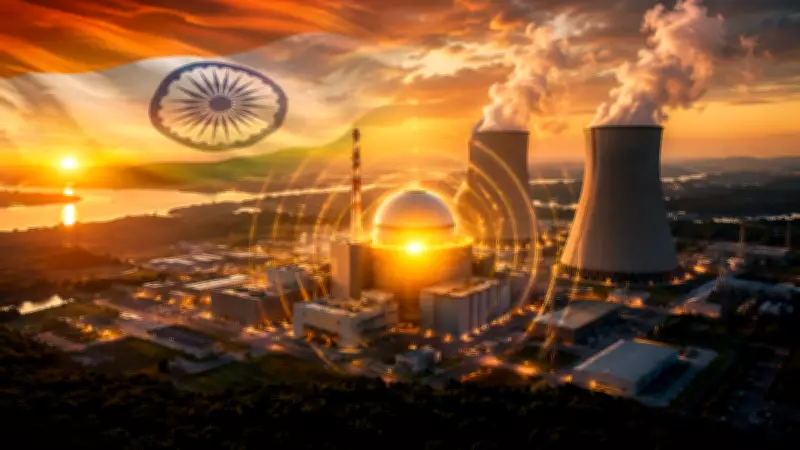
India's Nuclear Energy Ambitions Enter a Decisive Phase with PFBR Milestone
Homi Jehangir Bhabha, the visionary father of India's nuclear program, once famously declared, 'No power is as costly as no power.' Decades later, this wisdom resonates profoundly as India's nuclear energy ambitions reach a pivotal juncture. On April 6, the Prototype Fast Breeder Reactor (PFBR) at Kalpakkam in Tamil Nadu achieved criticality, marking a historic moment with its first sustained nuclear chain reaction. This 500 MWe reactor, constructed by Bharatiya Nabhikiya Vidyut Nigam Limited, signifies India's formal entry into Stage 2 of its meticulously designed three-stage nuclear program.
A Remarkable Achievement in Global Context
India's accomplishment is particularly noteworthy as it becomes only the second country after Russia to operate a commercial fast breeder reactor. This milestone arrives at a time when India's overall power system has expanded dramatically, boasting an installed capacity of 520.51 GW as of January. This growth results from a decade of rapid expansion across both conventional and renewable energy sources, positioning Stage 2 within a broader transformation of the nation's energy architecture.
Understanding Nuclear Energy and Its Strategic Importance
Nuclear energy, generated through the controlled splitting of atoms, is widely recognized as a dependable and clean source of electricity that produces no greenhouse gases. For India, one of the world's largest and fastest-growing economies, energy self-reliance is paramount. As the nation strides toward its goal of becoming a developed country, nuclear energy serves as a cornerstone in the Atmanirbhar Bharat initiative. Its significance is further amplified in an increasingly unpredictable global environment where economic warfare has emerged as a potent weapon.

India's Nuclear Energy Program: Current Status and Expansion Plans
Nuclear energy currently represents a small but strategic component of India's electricity mix. With a capacity of 8.78 GW, it contributes 3.1% of total electricity generation in 2024–25, producing 56,681 million units. This is modest compared to the dominance of renewables and coal in the total installed capacity of 520.51 GW. However, expansion plans are ambitious. India aims to scale nuclear capacity to 22.38 GW by 2031–32, supported by an implementation pipeline of 18 reactors totaling 13.6 GW. Looking further ahead, the Nuclear Energy Mission targets 100 GW by 2047, establishing nuclear power as a major pillar in India's long-term energy transition.
Vikas Gaba, partner and national head of power and utilities at KPMG in India, emphasizes that this scale-up aligns with the Viksit Bharat 2047 vision and the national Net-Zero 2070 commitment. He notes that nuclear power is expected to play a materially larger role in the future energy system. This expansion is timely, given India's rising electricity demand, which saw a peak of 242.49 GW in FY 2025–26, while power shortages have sharply declined to 0.03% from 4.2% a decade ago.
The Significance of Stage 2 and the Path to Stage 3
India's three-stage nuclear program, conceived by Homi Jehangir Bhabha in 1954, is rooted in resource optimization. Stage 1 involves generating plutonium from uranium. With Stage 2 now operational, Fast Breeder Reactors like the PFBR utilize this plutonium to create more fuel than they consume, converting Uranium-238 into Plutonium-239 and expanding fissile material availability. This crucial step lays the foundation for Stage 3, where Thorium-232 will be converted into Uranium-233 for large-scale thorium-based power generation.
India's Unique Nuclear Journey
Unlike countries such as France or China, which rapidly scaled nuclear capacity using imported uranium, India's approach is structurally differentiated due to limited domestic uranium reserves. Somesh Kumar, partner and power & utilities GPS leader at EY India, explains that India's strategy prioritizes a three-stage closed fuel-cycle pathway. This approach aims to convert limited domestic uranium and vast thorium reserves into long-term energy security, emphasizing strategic autonomy over near-term capacity maximization.

Amit Kumar, partner and energy and renewables industry leader at Grant Thornton Bharat, adds that while India ranks eighth globally in installed nuclear capacity, its contribution to electricity generation is only 3%. However, with recent policy reforms and engineering advances, India is poised to emerge as a significant player in nuclear energy.
Nuclear Energy in India's Evolving Energy Mix
India's current energy mix reflects both scale and transition. Coal continues to dominate, with supply reaching 5,52,315 Ktoe in FY 2024–25, while renewable capacity has surged to 2,29,346 MW, growing at a CAGR of over 10%. On peak days, renewables have met over 51.5% of electricity demand, indicating rapid structural change. Amidst rising energy demand—Total Primary Energy Supply grew 2.95% year-on-year, and Total Final Consumption increased over 30% since FY16—nuclear power offers stable, round-the-clock baseload power. This reliability complements intermittent sources like solar and wind, as highlighted by Somesh Kumar.
Energy Access, Demand Growth, and the Role of Nuclear Power
India's power sector has transitioned from scarcity to adequacy, with over 18,374 villages electrified and 2.86 crore households connected, supported by investments of Rs 1.85 lakh crore. Per capita electricity consumption has risen to 1,460 kWh in FY25, up over 50% from a decade ago. Projected peak demand is expected to reach 458 GW by 2032 under the National Electricity Plan, necessitating not just more power but more reliable power. Nuclear energy meets this requirement by providing a consistent supply independent of weather or fuel price volatility, supporting industrial growth, digital infrastructure, and urban demand centers.
Investment and Policy Framework
India's power sector is entering a massive investment phase, with over Rs 50 lakh crore projected through 2032 across generation, transmission, and storage. Nuclear energy forms a key long-term component, with the Nuclear Energy Mission allocating Rs 20,000 crore for Small Modular Reactors (SMRs). The broader scale-up to 100 GW will require sustained capital deployment. The Sustainable Harnessing and Advancement of Nuclear Energy for Transforming India (SHANTI) Act, 2025, serves as an institutional backbone, modernizing India's nuclear legal architecture. It allows limited private sector participation in areas like plant operations and equipment manufacturing while retaining sovereign control over critical functions. The legislation also strengthens regulatory oversight, creating a predictable environment for scaling nuclear capacity.
Debashish Mishra, partner and chief growth officer at Deloitte South Asia, notes that the SHANTI Bill clarifies important aspects like insurance and liability, addressing post-Fukushima concerns. However, Amit Kumar identifies gaps in domestic capability building and faster approval cycles for foreign direct investment, emphasizing the need for localizing nuclear manufacturing.
Self-Reliance, Energy Security, and Economic Benefits
India's nuclear strategy fundamentally aims to reduce vulnerability to global fuel volatility. While fossil fuels dominate energy supply, nuclear energy offers a pathway to lower long-term exposure. Its advantages include low fuel volume requirements, long operating cycles, and the potential for a domestic fuel cycle. Over time, thorium-based systems could further strengthen self-reliance. Experts argue that expanding nuclear power can provide substantial economic benefits by displacing imported fossil fuels used for baseload power. This could improve India's trade balance and support competitive, low-carbon industrial growth.
Amit Kumar explains that increasing electrification and production from non-fossil indigenous resources are key drivers of energy security. He adds that greater nuclear penetration can reduce reliance on fossil fuels, lowering exposure to fuel-price volatility and import dependence. Beyond fuel security, nuclear power enhances grid stability in a renewable-heavy system by providing firm, carbon-free baseload power.
Somesh Kumar highlights the economic case at the system level, noting that India's Net Zero power transition may require $14.23 trillion in cumulative investment by 2070. Nuclear's value lies in reducing reliance on fossil-based reliability resources over time, particularly in displacing coal-based baseload generation and gas-based generation during LNG stress periods.
Sambitosh Mohapatra, partner at PwC India, underscores that civil nuclear power enhances energy security by providing firm, low-carbon baseload power while reducing dependence on imported coal, LNG, and volatile global markets. The fast-breeder pathway enables recycling of spent fuel and gradual reduction in uranium import intensity, with thorium reserves offering near-permanent domestic fuel availability in Stage 3.
Execution Challenges and the Road Ahead
Despite strong fundamentals, execution remains a key challenge. Nuclear projects are characterized by long gestation periods, high capital requirements, and complex regulatory frameworks. Technologies like Fast Breeder Reactors add technical complexity, and the transition to Stage 3 based on thorium is a long-term objective. India's power system added over 52,537 MW capacity in FY26 alone, including 39,657 MW from renewables, but nuclear projects operate on longer timelines and higher capital intensity. Somesh Kumar stresses that the next phase depends on building a credible build-finance-regulate model at scale.
Conclusion
India's nuclear milestone at Kalpakkam is not an isolated event but part of a broader transformation of the country's energy system. From 520.51 GW installed capacity to rising demand and expanding renewables, the system is becoming larger, more reliable, and more complex. In this context, nuclear energy is evolving from a marginal contributor to a strategic pillar—providing stability, supporting clean energy goals, and strengthening long-term energy security. As Somesh Kumar summarizes, the next phase of India's nuclear journey will be determined less by ambition and more by execution. The ambition is clear, the scale is unprecedented, and the outcome hinges on effective implementation.





