India's Quiet Unease Over Iran's Growing Unrest
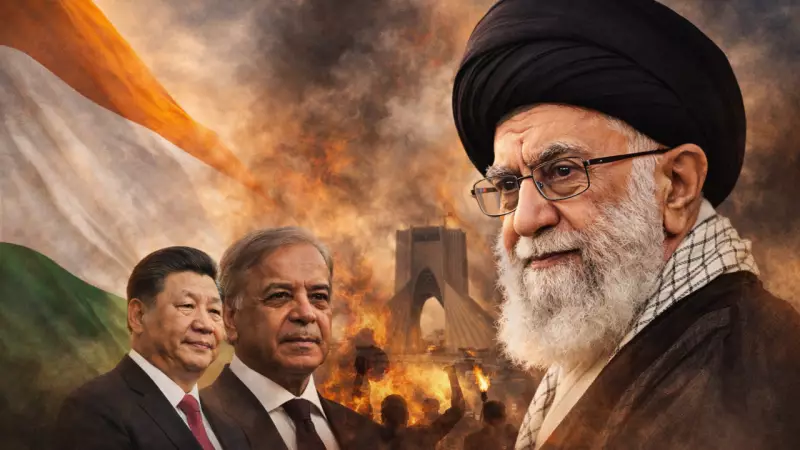
Protests driven by economic distress and political fatigue continue spreading across Iranian cities. New Delhi watches these events unfold with quiet unease. For India, the crucial question is not whether Iran's clerical leadership can survive the unrest. Instead, India must consider what a weakened or collapsing Iranian state would mean for its already constrained strategic environment.
Geography Dictates India's Iran Engagement
India's engagement with Iran has never been ideological. Geography, access, and balance have shaped this relationship for decades. Pakistan blocks overland routes to Afghanistan and Central Asia. This reality makes Iran India's only viable western corridor. Iran also acts as a counterweight to Pakistani influence in the region. Furthermore, Tehran serves as a stabilizing pillar in India's carefully calibrated West Asia policy. This policy seeks engagement across rival power blocs throughout the region.
A sudden weakening or collapse of the Iranian state would not produce a clean transition. It would generate uncertainty at a difficult moment. India's strategic room for maneuver is already narrowing. Bangladesh faces uncertainty with reports of minority killings. Pakistan remains a constant challenge. China expands its footprint across the region. The United States under Donald Trump hurtles the world from one crisis to another. Any disruption in Iran would ripple outward dramatically. It would reshape trade routes, diplomatic alignments, and security calculations that India has spent decades managing.

Iran as India's Gateway to Central Asia
For decades, Iran has served as India's most viable land bridge to Afghanistan and Central Asia. Pakistan denies India overland access consistently. This denial made Tehran the cornerstone of New Delhi's westward connectivity strategy.
Chabahar Port lies at the heart of this strategic vision. Developed with Indian assistance, Chabahar was designed to give India direct access to the Iranian coast. It completely bypasses Pakistan. The port links onward to Afghanistan and Central Asia through extensive road and rail networks.
For India, Chabahar was not merely a commercial port. It represented a strategic statement. The port proved that geography need not be destiny. JNU professor Rajan Kumar explains this clearly. "Iran remains India's most important land bridge to Central Asia, since Pakistan denies India access to overland routes," he told the Times of India. Even after the Taliban's return to power in Afghanistan, the logic of Chabahar persists. Even with rail projects stalling due to sanctions, this strategic logic has not disappeared. If anything, it has become more critical for India's regional access.
A regime change leading to prolonged instability would place these projects in serious jeopardy. Connectivity corridors require political coherence. They need security guarantees and long-term planning. Professor Kumar warns about the risks. "In a post-Khamenei power struggle, Chabahar risks becoming a hostage to instability rather than a strategic asset," he cautions. For India, losing Iran as a stable transit partner would mean losing its only realistic access point to Central Asia.
How Iran Historically Balanced Pakistan
Iran's value to India extends beyond geography. It has always been strategic. Despite being a Muslim-majority country, Tehran has never aligned itself with Pakistan's anti-India narrative. On the contrary, Iran has consistently opposed Sunni extremist groups that threaten Shia populations. These are the very networks that have targeted Indian interests over decades.
This divergence mattered deeply in the 1990s and early 2000s. Pakistan backed the Taliban to secure "strategic depth" in Afghanistan during this period. Iran and India found themselves on the same side. Both nations supported anti-Taliban forces. This convergence quietly limited Pakistan's influence in the region. It prevented Islamabad from monopolizing Afghanistan's political future.

If Iran weakens or splinters, that balance erodes by default. Pakistan's influence in Afghanistan and Central Asia would grow significantly. This growth would not necessarily come through dramatic victories. Instead, it would occur through the absence of a counterweight. Professor Kumar puts this starkly. "If Iran weakens or fragments internally, Pakistan stands to gain indirectly," he states.
Iran has also served as a diplomatic counterweight to Pakistan. In the mid-1990s, Pakistan pushed for international sanctions on India over Kashmir. Tehran came to India's aid during this critical period.
A weakened Iran would remove these quiet levers of influence against Pakistan. Professor Kumar warns about this potential loss. "India would certainly lose an important counterweight in the region if there is a regime change in Iran and a government hostile to India comes to power," he explains. For India already facing a locked-out western corridor due to Pakistani opposition, Tehran's support on regional issues remains valuable. Even largely rhetorical support matters. As Professor Kumar notes, Iran has "never aligned itself with Pakistan's position on Kashmir in any substantive way."
The Critical Shia Factor
Iran stands as the world's largest Shia-majority power. Its position in West Asia gives it a distinctive role as a counterweight to Sunni-dominated states like Saudi Arabia. A collapse of Iran's Shia clerical system would have profound consequences. Its replacement by a Sunni-leaning government aligned with Gulf capitals or the United States could leave the Middle East more uniformly Sunni-oriented.
For India, that shift would matter significantly. New Delhi has carefully built relationships across religious and political divides. It engages simultaneously with Tehran, Riyadh, Abu Dhabi, Tel Aviv, and Washington. This broad-based engagement has long reflected India's non-aligned and pluralist foreign policy tradition. A marginalized or weakened Iran would deprive India of one of its key diplomatic levers.
There is also healthy scepticism about common assumptions. Many assume regime change would automatically produce a more moderate or liberal government. Dr Ashok Sharma cautions against this thinking. "Even if there is a regime change, it does not automatically mean the next dispensation will be liberal or fundamentally different," he argues. He adds another crucial point. "Whether the regime is Shia or Sunni does not radically alter the strategic picture, because the internal dynamics in West Asia are far more complicated."
From New Delhi's perspective, the collapse of the current order could simply lead to another ideologically rigid theocracy. This outcome would make strategic predictions much harder. India has often found it safer to deal with a familiar clerical establishment. Even a difficult partner is preferable to navigating an uncertain and potentially hostile alternative.
This dilemma sharpens when considering India's deep economic and human ties with Sunni Gulf states. Millions of Indian nationals live and work in these countries. Yet India's diplomatic success in West Asia has rested on its non-sectarian posture. Professor Kumar observes this strategic advantage. "India has quietly benefited from Iran being the principal Shia power in West Asia," he notes. With Iran in its current role, India has maintained productive relations across the entire region.
Professor Kumar argues that India's strength lies in "multi-alignment." This approach combines close ties with the US, Israel, and Gulf Arab states with a long-standing partnership with Tehran. A more one-dimensional, Sunni-aligned Middle East would force India into uncomfortable strategic trade-offs.
There is also a critical security dimension. Iran has often opposed Sunni extremist groups that threaten both Shias and Indian interests. Organizations like the Taliban and ISIS have targeted Shia communities in Iran repeatedly. These attacks prompt Tehran to deploy forces like the Islamic Revolutionary Guard Corps against them. These are the same militant networks that have attacked Indian interests in Afghanistan and Pakistan. Losing Iran as a counterweight to such extremism would add to regional instability dramatically.
As Professor Kumar puts it, "India has strong relations with Shia Iran as well as Sunni countries... if Iran were also to turn hostile, that would create serious strategic problems for India in West Asia and beyond."
Trade Relations and Economic Stakes
In trade terms, India-Iran commerce is currently small but not negligible. India's total bilateral trade with Iran was about $1.3 to $1.7 billion in the past year. This represents roughly 0.1% of India's overall trade. The bulk consists of Indian exports of foodgrains, especially basmati rice. Pharmaceuticals and agricultural goods also feature prominently.
Conversely, India's imports from Iran remain limited. They mostly include dry fruits and some chemicals. Oil imports have been virtually eliminated by sanctions. In practice, most Indo-Iran trade today qualifies as "humanitarian." Food and medicine exports are exempt from penalties.
So why does Iran matter economically? First, trade serves as a signal of wider connectivity. The fact that India still ranks among Iran's top 10 sources for exports indicates something important. These linkages, however small, are hard to replace strategically.
Second, India has sunk over $1 billion into Chabahar and related projects. It has committed credit lines for infrastructure development. Any regime change that imperils these investments would hit taxpayer money directly. India has already delayed or restructured parts of the project to comply with US sanctions. Another disruption could force India to write off or renegotiate more of its contributions.
The Growing China Angle
Iran's tilt in favor of China gives India another reason for concern about Tehran's upheaval. In 2021, Iran and China inked a much-publicized 25-year strategic cooperation pact. Trade data reflect this pivot clearly. In 2024-25, China was by far Iran's largest export market. Over $14.5 billion worth of Iranian goods went to China. Most consisted of oil and gas exports.
As Western sanctions have bitten deeper, Tehran has leaned heavily on Beijing. China buys Iran's discounted oil and funds infrastructure projects. If Tehran breaks with its existing regime, China could potentially reap more benefits. An Iran in chaos might lean even further on Beijing for security and investment. A regime installed with external backing might do the same.
Already, Iranian officials discuss Chinese-funded power plants and port projects in Khuzestan. Subnational ties are growing too. President Xi has visited Iran and assured continued support. A new Chinese-aligned government in Tehran could marginalize India's role completely.
Conversely, India's presence in Iran serves as a modest counterbalance to China's inroads. Chabahar Port represents this strategic presence. Beijing-backed Gwadar Port in Pakistan and the INSTC form part of two competing visions. For New Delhi, losing Tehran as an independent player only leaves more space for Chinese dominance.
Professor Kumar emphasizes this point strongly. "Given the ongoing protests, India is likely to adopt a 'wait and watch' policy," he says. New Delhi remains wary of what a US-backed or sudden regime change could mean. If a new Iranian government tilts sharply toward one side, India's ability to engage with multiple poles would shrink. These poles include Tehran, Riyadh, Washington, and even Beijing. Thus, regime upheaval could inadvertently advantage China. A stronger Iran-China axis would give Beijing a bigger say in Iran's regional posture. This development could potentially harm India's strategic interests.
Pragmatism and Caution: India's Current Dilemma
Faced with these complex realities, India's foreign policy remains cautious. New Delhi has refrained from overtly supporting Iranian protesters. It has not endorsed regime change openly. As Professor Kumar notes, "India would not support protest groups or any form of external intervention in Iran... Any political change, if it occurs, must be domestic." India's BRICS philosophy of sovereignty and non-interference guides this approach. The priority is keeping lines of communication open with Iran's government, however challenged it may be.
Dr Sharma highlights that India's goal is continuity of engagement, not ideological victory. "Even if there is a regime change... from India's perspective, whether the regime is Shia or Sunni does not radically alter the strategic picture," he told the Times of India. New Delhi's policy will remain pragmatic. It involves engaging Tehran while managing relations with other powers carefully.
In practice, this means ensuring that sanctions or a new government do not strangle projects like Chabahar entirely. It also means relying on India's deep ties with the United States and the Gulf to maintain leverage.
The glass-half-empty scenario for India is clear. Iranian clerical rule remains imperfect, but it is predictable. It has afforded India important strategic benefits. A sudden regime change could upend this delicate equilibrium completely. This is especially true if foreign powers precipitate or exploit the change.
As Professor Kumar bluntly puts it, "Continuity in Iran's current system has often served India's interests better than chaos." Iran's current system is constraining and often frustrating. It grows increasingly brittle. Yet it remains a known quantity. India has learned to negotiate access with this system. It has balanced rivals and preserved strategic autonomy through this relationship.
A fractured Iran would narrow India's diplomatic options dramatically. An Iran pulled decisively into the orbit of a single external power would weaken India's long-standing policy of multi-alignment. For India, a stable if frosty Tehran presents less risk than an unstable or hostile one. This calculation guides New Delhi's watchful stance as protests continue across Iranian cities.