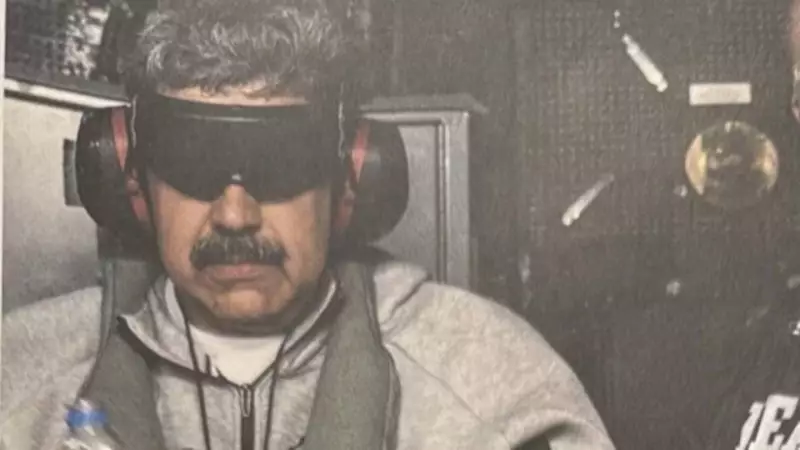
The dramatic seizure of Venezuelan President Nicolás Maduro by the United States, leading to his imprisonment in New York, marks a bold new chapter in Washington's interventionist playbook in Latin America. For India, this audacious move presents not just a diplomatic quandary but a significant strategic opportunity to reassess its historically limited engagement with the vast South American continent.
Delhi's Deliberate Restraint: Pragmatism Over Posturing
India's official reaction to the US action has been notably measured, especially when contrasted with the more forceful statements from its fellow BRICS nations like Brazil, Russia, and China. This caution, as argued by foreign policy expert C Raja Mohan, is rooted in a clear-eyed pragmatism that defines contemporary Indian diplomacy.
Unlike the ideological alignments of the Cold War era, where India routinely condemned Western interventions while overlooking Soviet ones, today's New Delhi is sparing in its moral sermons towards major partners. The country no longer operates with what Mohan calls an "innocent belief in the magical powers of international law." This restrained approach was visible during Russia's 2022 invasion of Ukraine and during US-Israeli strikes on Iranian facilities.

India's core strategic focus remains on its immediate neighbourhood and countering Chinese dominance in Asia. Venezuela, despite the dramatic headlines, is geographically and strategically distant from these primary concerns. Furthermore, the internal political divisions within Latin America itself, where conservative parties have welcomed Maduro's ouster even as leaders like Brazil's Lula da Silva condemn it, justify a wait-and-watch approach.
The Geopolitical Chessboard: A Region in Churn
The event is more than a mere regime change operation. Analysts suggest US President Donald Trump's strategy appears to be one of "regime seduction," aiming to co-opt the remaining Maduro establishment. If successful, this could trigger a profound geopolitical realignment. For decades, Venezuela under Maduro served as a hub for anti-American activity, backed by Cuba, Iran, Russia, and China.
Russia and China invested heavily in the Maduro regime as part of a broader contest against US primacy in the Western Hemisphere. India, despite its rhetoric on a "multipolar world," has never shared the objective of heralding a "post-American order," recognizing the United States as its most crucial strategic partner.
A potential reorientation of a post-Maduro Venezuela could signal a three-fold shift: a reassertion of American influence, an acceleration of the rightward political drift across a continent long dominated by left-wing populism, and a direct challenge to the ambitions of Cuba, Russia, and China in Latin America.
An Imperative for India: From Neglect to Strategic Engagement
However, treating this crisis as a distant spectacle would be a profound error for India. The nation's engagement with Latin America has been historically shallow, characterized more by symbolic gestures—like roads named after Simón Bolívar—than by deep political or economic understanding. The past fascination with figures like Fidel Castro or Che Guevara, as Mohan wryly notes, produced more posters and T-shirts than purposeful policies.
This neglect is no longer tenable. The region, with a combined GDP of $5.5 trillion and a population over 650 million, represents a massively under-explored commercial frontier for India. The stark numbers tell the story: India's annual bilateral trade with Latin America stands at a mere $45 billion, dwarfed by China's approximately $500 billion trade volume. Even the city-state of Singapore trades as much with the region as India does.
The current geopolitical churn creates a unique window. Trump's muscular revival of the Monroe Doctrine, now sharpened by a "Trump Corollary," aims squarely at curbing China's economic influence. As Latin American nations feel pressure to diversify away from overdependence on Chinese capital and technology, they will seek alternatives, not just substitutes. This opens significant room for India to expand its trade, investment, and diplomatic footprint.

The path forward requires a fundamental shift. India must move beyond episodic high-level visits and thin commercial diplomacy. It needs sustained political attention, targeted trade diplomacy, and, above all, a serious, scholarly effort to understand the complex histories, economies, and societies of Latin America on their own terms. As the continent enters a new political phase, tailing the reactions of BRICS partners is not a strategy. India must craft its own proactive and purposeful policy to deepen and widen its footprint in this crucial region.