

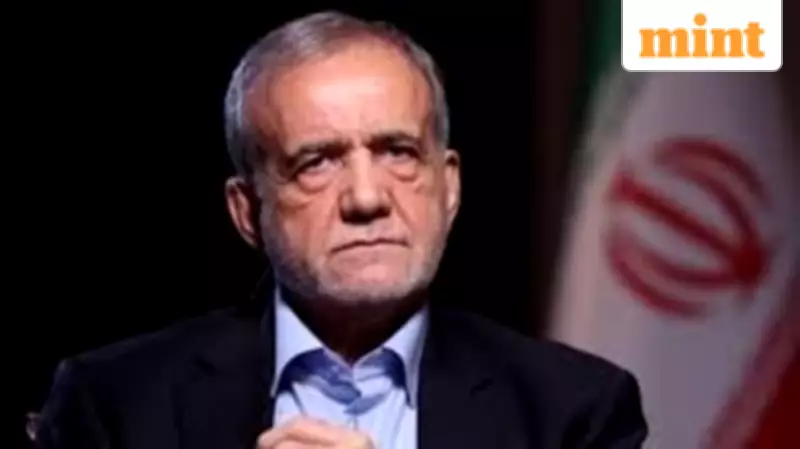
Iranian President Accuses Foreign Powers of Exploiting Economic Crisis to Fuel Unrest
In a strongly worded statement broadcast live on state television, Iranian President Masoud Pezeshkian has accused leaders from the United States, Israel, and Europe of deliberately taking advantage of Iran's severe economic difficulties to stir unrest and attempt to fragment the nation.
Exploitation of Economic Vulnerabilities
President Pezeshkian asserted on Saturday that foreign powers "rode on our problems, provoked, and were seeking — and still seek — to fragment society." He specifically named US President Donald Trump, Israeli Prime Minister Benjamin Netanyahu, and European leaders as having "taken advantage of Iran's economic difficulties" during the recent wave of protests that swept across the country.
The Iranian leader claimed these foreign entities "brought them into the streets and wanted, as they said, to tear this country apart, to sow conflict and hatred among the people." He emphasized that the matter involved far more than just social protest, suggesting coordinated external interference in Iran's internal affairs.

Violent Crackdown and Conflicting Casualty Figures
The nationwide protests, which began in late December amid an economic crisis marked by soaring inflation and rising living costs, lasted approximately two weeks before easing following a violent crackdown by Iranian authorities. The demonstrations represented one of the most significant challenges to Iran's clerical establishment in recent years.
Casualty figures from the unrest remain contested:
- According to the US-based rights group HRANA, at least 6,563 people were killed, including 6,170 protesters and 214 security personnel.
- Iranian Foreign Minister Abbas Araqchi provided different numbers to CNN Turk, stating the death toll included 3,100 people, of whom 2,000 were security forces.
International Responses and Diplomatic Maneuvering
The accusations come amid heightened tensions between Iran and Western powers. President Trump has consistently expressed support for Iranian protesters, warning that the United States stands ready to act if Iran continues targeting demonstrators. According to Reuters, US officials indicated on Friday that Trump was considering various options but had not yet made a decision regarding potential strikes against Iran.
Meanwhile, regional dynamics continue to evolve:
- Israel's Ynet news reported that a US Navy destroyer arrived at the Israeli port of Eilat on Friday, signaling potential military preparations.
- Regional allies including Turkey, the United Arab Emirates, and Saudi Arabia have been pursuing diplomatic efforts to prevent military confrontation between Washington and Tehran.
Missile Program as Sticking Point in Negotiations
The United States has insisted that Iran limit its missile program as a precondition for resuming talks, a demand Tehran has firmly rejected. Speaking in Turkey on Tuesday, Foreign Minister Araqchi stated unequivocally that "missiles would never be a topic for negotiations."
In response to US threats of military action, Araqchi declared that Tehran is prepared for either negotiations or conflict and expressed willingness to work with regional countries to advance stability and peace. He dismissed notions of regime change as "a complete fantasy" and "illusion," asserting that Iran's political system remains "deeply rooted and firmly established."
The Iranian leadership's accusations highlight the complex geopolitical landscape surrounding Iran's internal challenges, with economic pressures intersecting with longstanding international tensions and diplomatic standoffs.






