

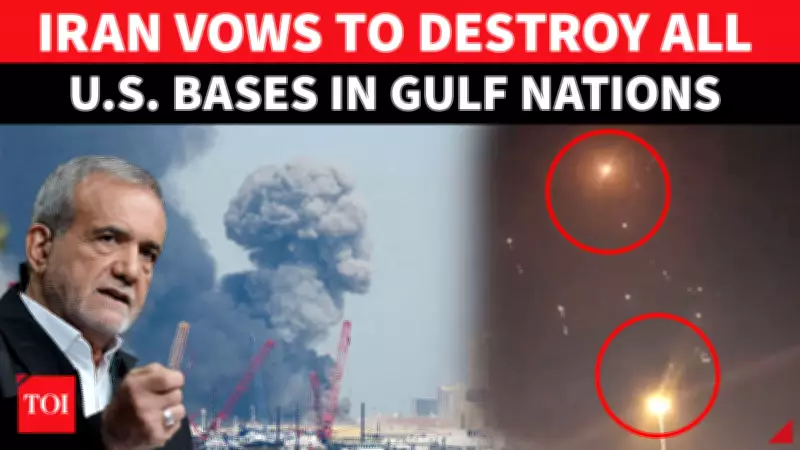
Iran's President Issues Stark Warning to Enemies After Supreme Leader's Assassination
In a dramatic televised address, Iranian President Masoud Pezeshkian has declared that Iran will "destroy all bases of enemies" in response to the killing of Supreme Leader Ayatollah Ali Khamenei. The assassination occurred during joint military strikes by the United States and Israel, marking a significant escalation in regional tensions.
Interim Leadership Council Activated Under Constitutional Provision
President Pezeshkian confirmed that a new three-member interim leadership council has formally begun operations under Article 111 of Iran's constitution. This constitutional mechanism was triggered following Khamenei's death, ensuring continuity of governance during this critical period. The president vowed to continue in Khamenei's footsteps, describing the supreme leader's death as "the culmination of years of sacrifice" for the Islamic Republic.
Foreign Minister Reinforces Iran's Unyielding Position
Iranian Foreign Minister Abbas Araghchi echoed President Pezeshkian's resolve in an exclusive interview with Al Jazeera. He characterized Khamenei's assassination as "absolutely unprecedented" and a major violation of international law that risks making the conflict "even more dangerous and complicated." Araghchi pushed back forcefully against regional pressure for de-escalation, stating that governments angered by the situation should direct their pressure toward Washington and Tel Aviv rather than Tehran.

Iran's Military Response and Strategic Targets
President Pezeshkian emphasized that Iran's armed forces would continue striking enemy military bases with full force. Foreign Minister Araghchi elaborated on this position, stating that Iran is acting in self-defence with no restrictions or limits. He specified that Iran would continue targeting:
- US military personnel across the Middle East
- Operational facilities of American forces
- Military installations in allied nations
Araghchi noted that Iran would maintain a distinction between military and civilian targets, avoiding attacks on diplomatic facilities and non-combatants. This comes as Iran has already conducted strikes against US military installations in several Gulf nations, including:
- Bahrain
- Kuwait
- Qatar
- Saudi Arabia
Regional Implications and International Law Concerns
The assassination of Supreme Leader Khamenei represents a watershed moment in Middle Eastern geopolitics. Foreign Minister Araghchi's characterization of the killing as a major violation of international law underscores the legal dimensions of this conflict. His warning that the situation risks becoming "even more dangerous and complicated" highlights concerns about potential escalation beyond current hostilities.
President Pezeshkian's vow to continue Khamenei's legacy suggests that Iran's foreign policy direction will remain consistent despite the leadership transition. The activation of the interim council under constitutional provisions demonstrates Iran's institutional resilience during this crisis period.
The conflict has already expanded beyond direct US-Iran engagements to involve regional allies on both sides. Iran's targeted strikes against American installations in multiple Gulf nations indicate a calculated strategy to pressure Washington through its regional partnerships while avoiding broader civilian casualties that might trigger different international responses.






