

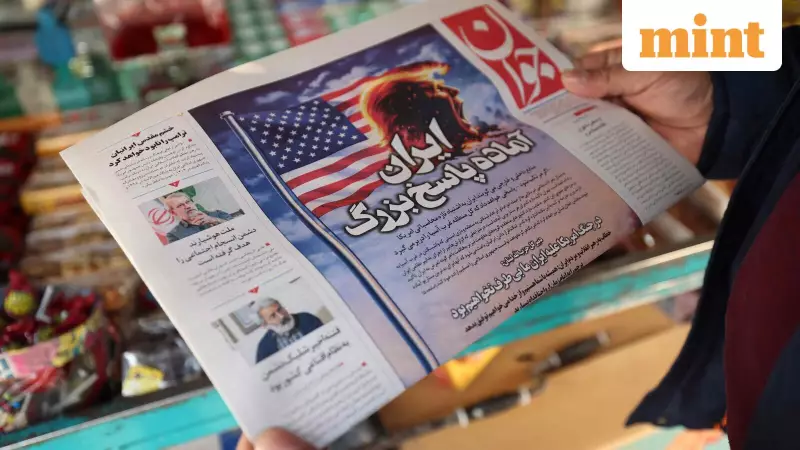
Iran Issues Stark Warning of Unprecedented Response to Potential US Military Action
Iran has issued a stark warning that it would respond to any American attack "like never before" following a provocative statement from former US President Donald Trump regarding Tehran's nuclear program. The escalating rhetoric comes amid heightened military tensions in the Middle East and ongoing internal unrest within Iran.
Diplomatic Ultimatum Meets Defiant Response
Iran's mission to the United Nations declared in a post on X: "Iran stands ready for dialogue based on mutual respect and interests — BUT IF PUSHED, IT WILL DEFEND ITSELF AND RESPOND LIKE NEVER BEFORE!" This statement accompanied a screenshot of Trump's warning, highlighting the direct nature of this diplomatic confrontation.
Iranian Foreign Minister Abbas Araghchi reinforced this position, stating that Iran's forces were prepared to respond decisively to any US military action while maintaining openness to potential negotiations about Tehran's nuclear program. "Our brave Armed Forces are prepared -- with their fingers on the trigger -- to immediately and powerfully respond to ANY aggression against our beloved land, air, and sea," Araghchi wrote in his own social media post.

Trump's Nuclear Deadline Warning
Former President Trump issued his warning through Truth Social, urging Iran to return to negotiations over its nuclear program. "Hopefully Iran will quickly 'Come to the Table' and negotiate a fair and equitable deal — NO NUCLEAR WEAPONS — one that is good for all parties," Trump wrote, adding ominously: "Time is running out, it is truly of the essence!"
The former president also referenced previous US strikes while cautioning Tehran against further confrontation: "The next attack will be far worse! Don't make that happen again." This warning comes as the current US administration has not ruled out military action following weeks of deadly anti-government protests in Iran.
Military Buildup and Regional Tensions
The geopolitical landscape has become increasingly volatile with a US naval strike group, described by Trump as an "armada" and led by the aircraft carrier USS Abraham Lincoln, currently deployed in Middle East waters. This military presence follows last June's US strikes on Iranian nuclear facilities during Israel's conflict with Iran, which significantly escalated regional tensions.
As Trump sharpened his rhetoric, international observers offered assessments of Iran's internal stability. Secretary of State Marco Rubio told the Senate Foreign Relations Committee that Iran's leadership was at its weakest point ever, citing economic collapse as a primary driver of unrest. "They are threatened by their inability to address the fact that their economy is in collapse," Rubio stated.
German Chancellor Friedrich Merz offered an even more dire prediction, suggesting the Iranian leadership might not survive much longer. "A regime that can only hold onto power through sheer violence and terror against its own population: its days are numbered," Merz declared, estimating the government could fall within "a matter of weeks."
Iran Rejects Military Diplomacy and Warns of Consequences
Iranian officials dismissed Washington's approach, with Foreign Minister Araghchi asserting that military pressure would prove ineffective. "Conducting diplomacy through military threat cannot be effective or useful," Araghchi emphasized, noting that Tehran had not sought recent negotiations and had no recent contact with US Middle East envoy Steve Witkoff.
Iran's armed forces chief of staff Habibollah Sayyari issued his own warning to Washington against any "miscalculation," stating that the United States would also "suffer damage" in the event of open conflict.
Regional Efforts Toward De-escalation
Amid these rising tensions, Iran has reached out to US allies in the region in an apparent effort to reduce hostilities. Following a call between Iranian President Masoud Pezeshkian and Saudi Crown Prince Mohammed bin Salman, Iranian officials also engaged with leaders in Qatar and Egypt.

Qatar expressed support for "all efforts aimed at reducing escalation and achieving peaceful solutions," while Egypt stressed the need to "work towards de-escalation." Turkey's Foreign Minister Hakan Fidan warned against renewed conflict, stating plainly: "It's wrong to attack Iran. It's wrong to start the war again."
Deadly Crackdown on Internal Protests
The international diplomatic standoff occurs against the backdrop of a brutal internal crackdown on protests that erupted in late December and peaked in early January. According to the US-based Human Rights Activists News Agency (HRANA), at least 6,221 people have been killed, including thousands of protesters and more than 100 minors.
HRANA reported that more than 42,000 people have been arrested, with security forces now searching hospitals for wounded protesters—a development the organization described as revealing "new dimensions of the continued security crackdown." Iran has also carried out executions linked to the unrest, including a man convicted of spying for Israel's Mossad intelligence agency according to judicial statements.
This complex situation presents multiple challenges: escalating military tensions between Iran and the United States, international pressure regarding Iran's nuclear program, regional diplomatic efforts toward de-escalation, and severe internal repression within Iran itself. The coming weeks will reveal whether diplomatic channels can prevail over military posturing in this volatile geopolitical landscape.





