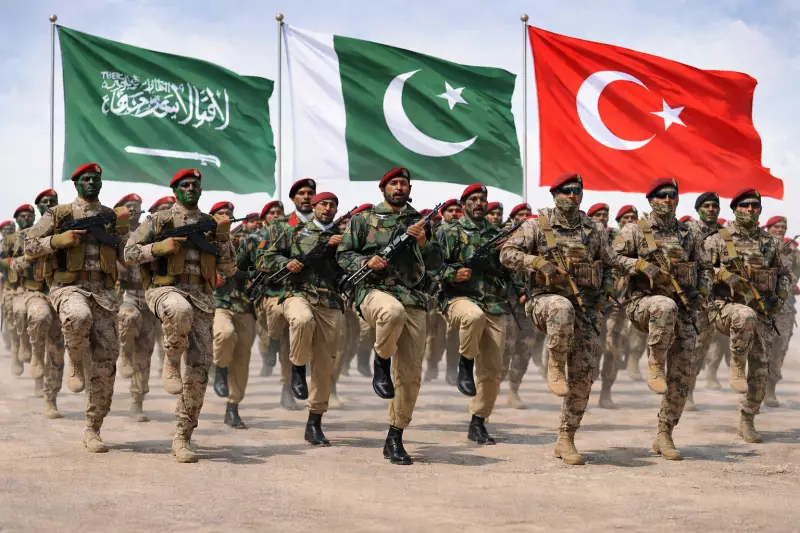
Islamic NATO Emerges: Pak-Saudi-Turkey Defense Pact's Strategic Impact on India
A new defense alliance is taking shape in the Islamic world. Saudi Arabia, Pakistan, and Turkey have signed a security agreement that includes a collective defense clause. This pact closely resembles NATO's famous Article 5. It promises that an attack on one member nation will be treated as an attack on all signatories.
The Genesis of the Pact
The framework for this agreement emerged last September. It followed a significant geopolitical event. On September 9, Israel conducted a strike targeting Hamas leaders in Qatar. This action deeply angered many Arab nations. It prompted an emergency security meeting in Doha. The meeting brought together key regional players to discuss collective responses.
Against this tense backdrop, Saudi Arabia and its long-time ally Pakistan formalized their security cooperation. They signed a bilateral agreement first. This pact featured the critical collective defense provision. Turkey later joined this emerging security architecture. The three nations are now moving towards a trilateral defense understanding.

Understanding the NATO Parallel
The pact explicitly models itself on NATO's Article 5. This is the cornerstone of the North Atlantic Treaty Organization. Article 5 states that an armed attack against one member shall be considered an attack against them all. It commits members to assist the attacked party. This assistance can include the use of armed force.
The new Islamic defense pact adopts a similar principle. It creates a mutual security guarantee among Saudi Arabia, Pakistan, and Turkey. This formalizes defense commitments that were previously more informal or bilateral. It represents a significant step towards military integration among these nations.
Strategic Implications for India
This development carries profound implications for India's security calculus. Pakistan is a central member of this new pact. Any attack on Pakistan could now invoke a collective response from Saudi Arabia and Turkey. This potentially complicates India's strategic options regarding its western neighbor.
Saudi Arabia is a major power in the Islamic world and a significant global player. Its participation lends considerable weight to the alliance. Turkey, under President Erdogan, has pursued an increasingly assertive foreign policy. Its military capabilities are substantial. The combination of these three nations creates a powerful bloc.
India must now consider this new alignment in its regional strategy. The pact could affect diplomatic equations in South Asia and the Middle East. It may influence arms transfers, military exercises, and intelligence sharing among the member states. India's relationships with each of these countries will require careful navigation.
The Regional Context
The pact emerges during a period of heightened Middle East tensions. The Israeli strike in Qatar served as a catalyst. It demonstrated vulnerabilities and prompted collective security thinking. Arab nations felt compelled to strengthen their defense cooperation mechanisms.
Pakistan's inclusion bridges South Asia and the Middle East. It brings a nuclear-armed state into the alliance. Turkey provides NATO-member capabilities and strategic depth. Saudi Arabia offers financial resources and religious legitimacy. Together, they form a formidable combination.
This Islamic defense cooperation is not entirely new. There have been previous attempts at Muslim military alliances. However, the explicit NATO-style clause represents a qualitative shift. It moves beyond consultation towards binding mutual defense commitments.
Looking Ahead
The full implications of this pact will unfold over time. Much depends on how the member states implement the agreement. The precise mechanisms for collective response remain to be detailed. The threshold for invoking the defense clause will be crucial.
For India, this development requires astute diplomacy and strategic assessment. New Delhi maintains important relationships with Saudi Arabia and Turkey. Balancing these ties with national security concerns presents a complex challenge. The emergence of this "Islamic NATO" adds a new dimension to regional geopolitics.

Observers will watch how this pact influences conflicts and crises in the region. Its impact on India-Pakistan relations will be particularly significant. The coming months may reveal whether this alliance strengthens stability or creates new tensions.