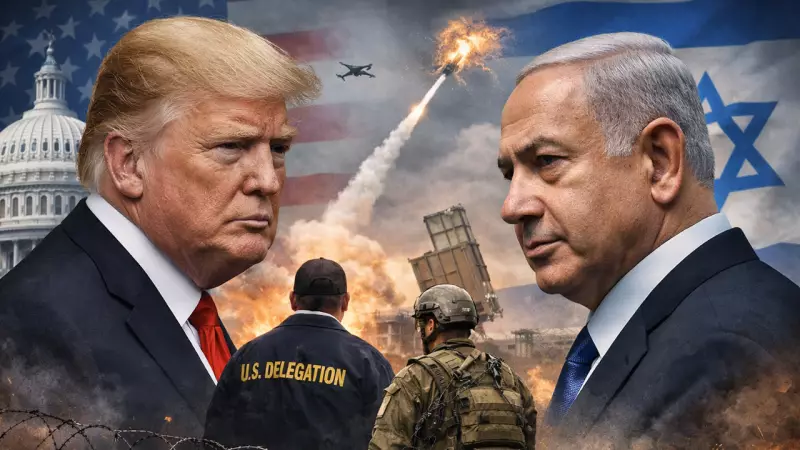
Israel's Surprising Announcement: Phasing Out US Military Support
Israeli Prime Minister Benjamin Netanyahu has made a startling declaration that has captured global attention. He stated that Israel intends to gradually reduce American military assistance until it reaches zero within the next decade. This announcement comes as a significant departure from decades of close security cooperation between the two nations.
Decades of Unwavering Support
For many years, the United States has maintained an exceptionally strong partnership with Israel. This relationship has included substantial military financing, priority access to advanced weaponry, and consistent diplomatic protection at international forums like the United Nations. The bond has often appeared more like a special arrangement than a typical alliance between countries.
Netanyahu explained his position during an interview with The Economist. He framed this move as part of Israel's long-term strategy to achieve greater independence in defense matters. The current security agreement between the United States and Israel remains valid until 2028, providing a framework for this transition period.

Timing and Context of the Statement
This announcement arrives at a crucial moment in Middle Eastern politics. The United States has recently taken a more direct role in managing Israel's military decisions, ceasefire implementations in Gaza, and crisis responses involving Iran. Some observers have begun describing Washington's involvement as supervisory rather than simply supportive.
Meanwhile, American public opinion shows signs of shifting, particularly among younger voters and independent citizens. These changes raise important questions about whether Israel's privileged position in US foreign policy can continue indefinitely. The political landscape in America appears increasingly complex regarding international commitments.
Historical Foundations of the Relationship
The United States first recognized Israel as a sovereign state in May 1948 under President Harry Truman. This decision stemmed from multiple factors including moral considerations and domestic political realities. Initially, Washington maintained an arms embargo across the Middle East region, forcing Israel to seek military equipment from European suppliers, primarily France.
The relationship transformed significantly following major conflicts. The 1967 Six-Day War altered regional power dynamics, increasing American interest in Israel as a stabilizing force during Cold War tensions. However, the 1973 Yom Kippur War proved particularly decisive. When Israel faced simultaneous attacks from Egypt and Syria, the United States launched a massive emergency resupply operation, establishing that Israel's security had become a fundamental American interest.
Structural Military Partnership
From the mid-1970s onward, American involvement evolved into a comprehensive structural partnership. Military assistance expanded from loans to grants, while defense cooperation deepened across multiple domains including air power, intelligence sharing, and joint strategic planning. By the 1980s, when US military aid converted entirely to grants, Israel's armed forces had become increasingly dependent on American platforms and supply chains.
The Foreign Military Financing program forms the core of this system. Israel receives US government credit specifically designated for purchasing American weapons, platforms, spare parts, and related services. This arrangement creates a circular flow where funds return to American defense industries while ensuring Israel remains tied to US military equipment and maintenance networks.
Exceptional Privileges and Protections
Israel enjoys several unique advantages within the American military assistance framework. The country receives its entire annual allocation in a single lump sum at the beginning of each fiscal year, unlike most recipients who get funds in monthly installments. Israel also ranks among the very few nations permitted to use Foreign Military Financing for direct commercial purchases from US defense companies.

Historically, Israel benefited from offshore procurement provisions that allowed spending a portion of American aid within its own defense industry. This helped develop domestic companies like Rafael and Elbit Systems, though this exception is currently being phased out according to existing agreements.
The Legal Guarantee of Military Superiority
Since 2008, United States law has mandated the preservation of Israel's Qualitative Military Edge. This legal requirement means Washington must assess arms sales to other Middle Eastern countries to ensure they don't undermine Israel's military advantage. If potential erosion is identified, the United States must either modify the sale or compensate Israel with more advanced systems.
This legal protection represents an extraordinary commitment unmatched in American foreign policy. No other US ally enjoys similar statutory guarantees of military superiority over regional adversaries. The provision effectively transforms military assistance from discretionary aid into a legally enforced security guarantee.
Missile Defense Cooperation
Missile defense systems represent the emotional heart of the US-Israel relationship. Programs like Iron Dome, David's Sling, and Arrow are framed primarily as civilian protection measures rather than offensive weapons. This distinction makes funding these systems politically sustainable across different American administrations.
Current agreements earmark five hundred million dollars annually specifically for missile defense programs. During conflicts, Congress frequently approves additional billions to replenish interceptor supplies. This cooperation serves American strategic interests by providing combat-tested data and accelerating technological innovation in defense systems.
Diplomatic Protection at International Forums
The United States has consistently used its veto power at the United Nations Security Council to shield Israel from critical resolutions. Since 1972, Washington has vetoed dozens of Israel-related measures, making Israel the most frequent beneficiary of American diplomatic protection at the UN.
These vetoes have blocked resolutions calling for ceasefires, condemning Israeli military actions, and investigating settlement activities. During recent conflicts in Gaza, this pattern intensified with the United States repeatedly opposing immediate ceasefire demands while advocating for alternative approaches focused on humanitarian pauses and hostage releases.
Changing Dynamics in the Relationship
The partnership between the United States and Israel has undergone noticeable transformation in recent years. What began as strong alignment during the Trump administration's early period has gradually shifted toward more transactional and managerial dynamics. American officials have increasingly involved themselves in operational details including ceasefire enforcement and humanitarian access arrangements.
Netanyahu has publicly rejected suggestions that Israel has become a client state. However, the evolving relationship demonstrates that alignment has given way to greater supervision. American support remains substantial but now comes with increased conditions and oversight, creating an interesting paradox as Israel simultaneously declares its intention to reduce dependence.
Looking Toward the Future
Netanyahu's announcement about phasing out US military assistance represents a bold strategic statement. It signals Israel's desire for greater autonomy even as the country continues to benefit from current security arrangements. The coming decade will test whether this transition toward self-reliance can be achieved while maintaining regional security and strategic partnerships.
The complex relationship between the United States and Israel continues to evolve amid changing geopolitical realities, shifting public opinions, and new strategic calculations on both sides. How this partnership adapts to these changes will significantly influence Middle Eastern stability and American foreign policy in the region.