

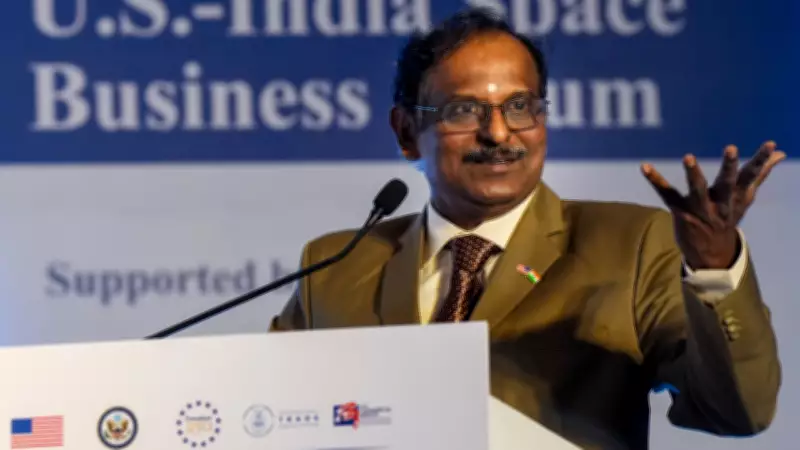
ISRO Chairman Advocates for Enhanced US-India Space Technology Partnership
In a significant address at the US-India Space Business Forum, ISRO Chairman V Narayanan called for a deeper and more robust technology partnership between India and the United States. He emphasized that space must remain a shared domain dedicated to serving ordinary citizens across the globe, highlighting how India's space programme has always been rooted more in cooperation than in competition.
Historical Foundations of US-India Space Collaboration
Narayanan traced the remarkable six-decade journey of India's space programme, acknowledging that early support from the United States played a crucial role in shaping its foundations. He recalled that India's very first sounding rocket in 1963 flew with assistance from both the US and France, marking the beginning of a long and fruitful period of international cooperation.
The programme was never intended to compete with any nation, Narayanan stated, but rather to bring advanced space technology to the common man of India. Today, that vision has expanded to include the common man of the global community, reflecting a broader commitment to universal benefit.

Key Milestones in Bilateral Space Achievements
The ISRO chief pointed to several landmark achievements that underscore the strength of the US-India partnership:
- The 1975 Satellite Instructional Television Experiment, which was enabled by the US's ATS-6 satellite.
- The joint discovery of water molecules on the Moon during the Chandrayaan-1 mission.
- Recent cooperation on the NASA-ISRO Synthetic Aperture Radar (NISAR) satellite project.
Narayanan described the December 2025 launch of the US commercial Bluebird Block-2 satellite as a profound moment of trust in Indian capability. The 5,900-kg spacecraft, the heaviest ever lifted from Indian soil, was placed with less than 2km of orbital dispersion, he noted, demonstrating what India and the US can achieve together through combined efforts.
Expanding Partnership Beyond Technology to Market Building
Janice Starzik, Deputy Director of the US Office of Space Commerce, echoed the sentiment of deepening ties, stating that the partnership had moved beyond mere technology exchange to actively shaping markets. We are not here just to discuss technology. We are here to build the marketplace, she asserted, highlighting the critical nature of US-India space partnerships for the future.
Starzik referred to the Trust Initiative launched last year, which aims to align cooperation in space, semiconductors, and secure supply chains, further solidifying the strategic relationship between the two nations.
India's Space Reforms and Private Sector Growth
Space Swarnashree Rao Rajashekar, Joint Secretary in the Department of Space, emphasized that India's recent space reforms and the expanding private sector have opened a new chapter in commercial cooperation with the United States. She urged industries on both sides to identify and address barriers that still slow business engagement.
As India's co-chair of the sub-working group on space commerce under the US–India Civil Space Joint Working Group, Swarnashree noted that cooperation between the two countries had deepened significantly between 2023 and 2026. This progress has been aided by India's Space Policy 2023, the IN-SPACe regulatory framework, and Washington's push for public-private partnerships.
Future Ambitions and the Need for International Collaboration
Looking ahead, Narayanan outlined Prime Minister Narendra Modi's ambitious goals for India's space programme, including building an Indian space station by 2035 and carrying out a crewed lunar mission by 2040. Achieving these objectives will require a new generation of rockets with nearly 100-tonne lift capacity, he explained, arguing that such grand ambitions demand wider international collaboration rather than isolated efforts.
Narayanan stressed the growing role of industry and start-ups, revealing that more than 450 Indian companies now contribute to space missions and that 320 start-ups have entered the sector since reforms in 2020. Approximately 75% of the budget for a launch vehicle flows to domestic industry, showcasing the vibrant ecosystem.

Invitation to American Firms and a Global Vision
Inviting American firms to invest and build in India, Narayanan assured that the government framework is flexible and supportive. We are ready to hand-hold and be partners in any programme, he said, concluding with the powerful message that space exploration and technology should ultimately benefit every citizen of the globe, reinforcing the ethos of shared progress over competition.





