

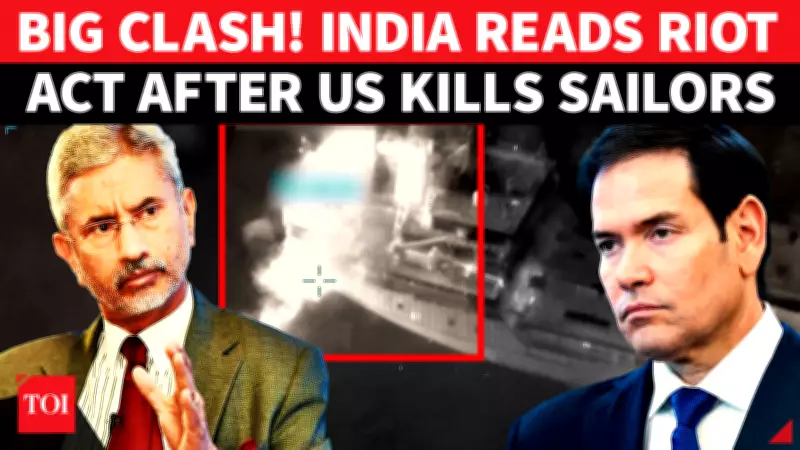
India-US Diplomatic Row Erupts Over Killing of Indian Seafarers
A major diplomatic confrontation has unfolded between India and the United States following the deaths of three Indian sailors in a U.S. Navy strike on an oil tanker in the Gulf of Oman. External Affairs Minister S. Jaishankar held a conversation with U.S. Secretary of State Marco Rubio, delivering a strong protest and characterizing the attack on commercial shipping as 'lethal' and 'not justified.'
The Ministry of External Affairs also summoned the U.S. Chargé d'Affaires in New Delhi, condemning the use of force against civilian vessels. The ministry warned that such actions threaten the safety and stability of international maritime commerce. The diplomatic intervention came after authorities confirmed that three Indian sailors, initially reported missing, had died as a result of the strike.
India has demanded a thorough investigation into the incident and accountability for those responsible. The U.S. has yet to issue an official response, but the incident has strained relations between the two nations, which have historically maintained close strategic ties.

Background of the Incident
The U.S. Navy strike occurred in the Gulf of Oman, a critical waterway for global oil shipments. The targeted oil tanker was reportedly carrying crude oil, and the attack has raised concerns about the safety of commercial shipping in the region. The Indian government has emphasized that such actions violate international law and norms governing maritime conduct.
India's Ministry of External Affairs released a statement saying, 'We condemn the use of force against civilian vessels and express our deep concern over the loss of innocent lives. Such actions are unacceptable and must be addressed through diplomatic channels.'
Diplomatic Fallout
The row has escalated quickly, with both sides engaging in high-level discussions. Jaishankar's conversation with Rubio was described as 'frank and direct,' with the Indian minister pressing for immediate steps to prevent similar incidents. The U.S. Chargé d'Affaires was summoned to receive India's formal protest, and further diplomatic measures are expected.
Analysts suggest that this incident could impact broader India-U.S. relations, particularly in the realm of defense and maritime security cooperation. India has traditionally maintained a non-aligned stance but has deepened ties with the U.S. in recent years. This incident, however, has highlighted differences in approach to regional security.
Global Reactions
The international community has taken note of the developing situation. Several countries have expressed concern over the use of force against commercial shipping, calling for restraint and dialogue. Iran, a key player in the region, has also condemned the strike, with its Foreign Minister making a declaration against the U.S. and Israel.
Meanwhile, the families of the deceased sailors have appealed for justice, and Indian media has extensively covered the story, highlighting the human cost of the military action. The incident has also sparked debates about the safety of Indian workers in conflict zones.
As the situation unfolds, all eyes are on Washington and New Delhi to see how they manage this crisis. The coming days are likely to see further diplomatic exchanges, with both sides seeking to de-escalate tensions while upholding their respective positions.






