

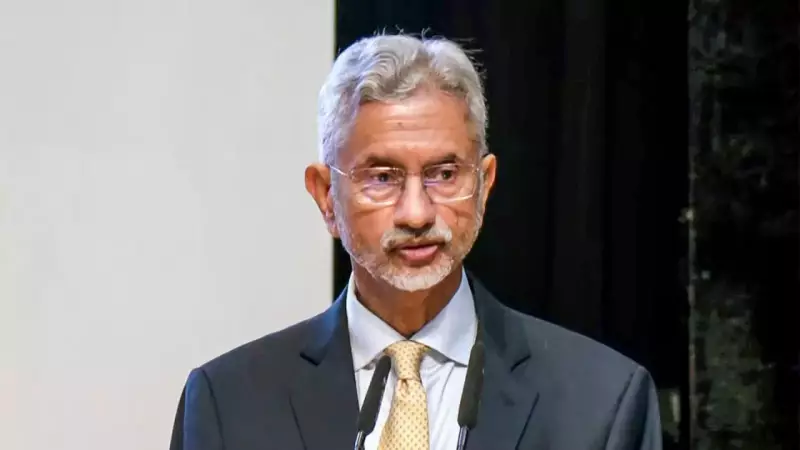
External Affairs Minister Dr. S Jaishankar declared on Saturday that the world's established economic and political hierarchy is witnessing a profound transformation. He positioned India's burgeoning pool of skilled professionals as a decisive advantage in this new era, contrasting it with the demographic and stagnation challenges faced by numerous developed countries.
India Emerges as Global Workforce Driver
Addressing a convocation ceremony in Pune, Jaishankar elaborated on the shifting dynamics of the international labour market. He asserted that India is now becoming a primary driver of the global workforce, capitalizing on a timely convergence of factors. "We have started to surge in trained human resources at the very time when many developed nations are struggling to find them," the minister stated.
He explained that this imbalance between demand and supply has naturally ushered in an "era of mobility." However, Jaishankar was quick to point out that this growing cross-border movement of Indian talent brings with it new governmental responsibilities. "We need to ensure welfare, including in conflict situations, and the politics of this mobility needs to be managed," he said, referencing India's ongoing efforts to safeguard its citizens abroad.

Post-Colonial Realignment and Policy Choices
Reflecting on the broader historical context, the External Affairs Minister observed that the post-colonial global order has evolved, returning control over national destinies to sovereign states. In this landscape, he emphasized, domestic policy choices become the decisive factor for progress.
Jaishankar offered a comparative analysis, noting that while China has "gained the most" since the period of decolonization, India has "done well, especially in the post-reform era." He added that the country's trajectory has seen even greater momentum over the past decade.
Critique of Western Economic Model
In a pointed critique, Jaishankar linked current discontent in the West to past economic decisions. He argued that Western elites consciously outsourced production to maximize profits, a strategy that has eroded their competitiveness over the years. "Their competitiveness has eroded over the years, accelerated by their lifestyle," he remarked.
The minister stated that this has led to a widespread feeling of stagnation across much of the Western world, a sentiment that is now translating into significant political consequences.
Leadership Key to National Progress
Concluding his address to the students, Jaishankar underscored that a nation's advancement is fundamentally shaped by the quality of its leadership and governance. In the Indian context, he noted that these factors have directly influenced the "ups and downs" in the country's economic growth and social transformation.
He urged the graduating students to see themselves as active contributors to the vision of a "Viksit Bharat" (Developed India). The goal, he emphasized, is for India to increasingly shape the global order, not merely participate in it.






