Jaishankar Addresses Global Trade and Technology Challenges at Asia Economic Dialogue
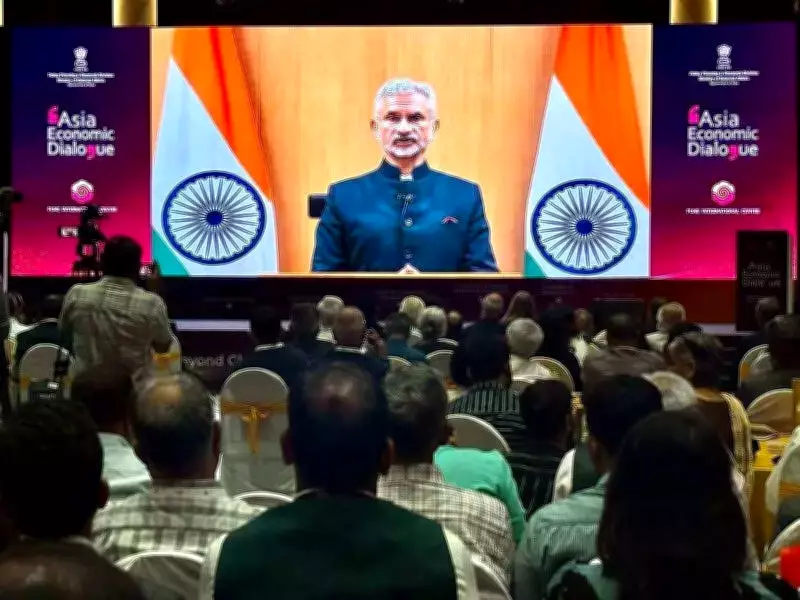
External Affairs Minister S Jaishankar, speaking via video message at the Asia Economic Dialogue in Pune on Thursday, highlighted that numerous countries have encountered significant uncertainty in trade and technology throughout this decade. He emphasized that this trend is likely to persist as nations increasingly focus on securing their interests by controlling supply chains of essential resources and leveraging technological advancements.
India's Strategic Response to Global Uncertainties
In response to these global shifts, Jaishankar outlined India's proactive approach. He stated that India will continue to foster partnerships across various domains, including trade, mobility, production, services, technology skills, and talent. Additionally, the country plans to forge strategic collaborations in critical areas such as minerals, supply chains, migration and mobility, and advanced manufacturing with key international players.
"India has dealt with its challenges through nimble, grounded, and practical policies at home. These have been mirrored by a more confident and virtually beneficial approach to global negotiations," Jaishankar remarked, underscoring India's dual strategy of domestic resilience and international engagement.

Critical Resources as Instruments of National Power
Jaishankar pointed out that several nations are cornering critical resources to secure their supply chains, particularly in high-stakes sectors like artificial intelligence and semiconductors. He elaborated that these elements are no longer viewed merely as economic growth drivers but have transformed into instruments of national power.
"Artificial intelligence, semiconductors, data, and critical minerals are no longer viewed only as drivers of growth. They are also instruments of national power," he asserted, highlighting the geopolitical dimensions of technological competition.
Challenges in the Global Trading System
The minister criticized the current state of the global trading system, noting instances where connectivity has been manipulated for national advantage, rules have been selectively cited and observed, and market shares have been leveraged for non-economic purposes. "There has been a gaming of the world trading system. Connectivity has been purposed for national advantage. Rules have been cited and observed selectively. And market shares have been leveraged for non-economic purposes," Jaishankar explained, pointing to the erosion of fair trade practices.
He added that governments are increasingly making economic decisions based on political and security considerations, with re-industrialization emerging as a compelling strategic requirement. Countries are accordingly deploying technologies, capabilities, and resources to achieve these goals, further intensifying global competition.
Bharat Biotech's Call for Tax Incentives
During the same event, Krishna Ella, executive chairman of Bharat Biotech—the Hyderabad-based firm that developed Covaxin during the pandemic—advocated for policy changes to boost Indian industry. He urged the government to halt freebies and instead offer a five-year tax holiday to enable Indian companies to compete more effectively on the global stage.
"I think in five years we can sweep the entire African and Latin American markets. Every state government is giving freebies. You give incentives to the industry. We can beat the world. But that strategy has to come at a political level," Ella stated, emphasizing the need for strategic economic support to enhance India's international competitiveness.
Event Details and Focus
The three-day Asia Economic Dialogue, organized by the think tank Pune International Centre, is being held in Pune and aims to discuss trends around global trade and new globalization. The conference serves as a platform for experts and policymakers to address pressing economic and technological issues facing the world today.