

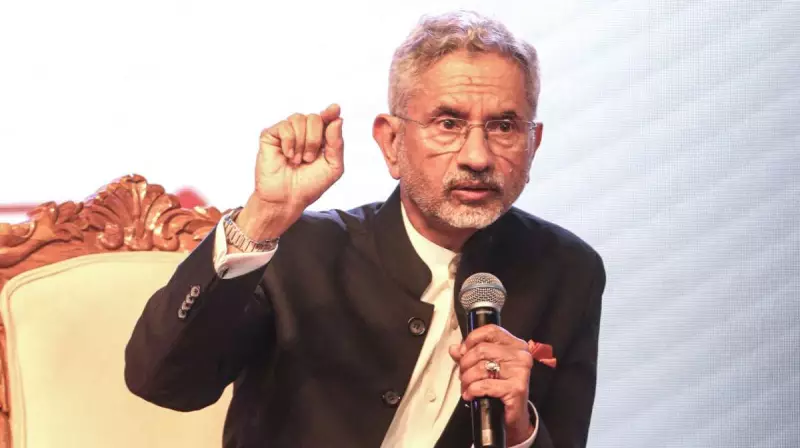
In a pointed and unambiguous diplomatic rebuke, India's External Affairs Minister, Dr. S. Jaishankar, recently labelled Pakistan a "bad neighbour." This stark characterization, delivered in a public forum, is far more than a mere rhetorical flourish. Analysts see it as a clear reflection of a fundamental shift in India's foreign policy approach, moving towards a doctrine of robust and unequivocal retaliation against cross-border terrorism and unfriendly actions.
The Core of the 'Bad Neighbour' Assertion
Dr. Jaishankar's comment was made in the context of addressing Pakistan's long-standing policy of using terrorism as a tool of statecraft against India. He emphasized that India can no longer afford to have a normal relationship with a neighbour that consistently engages in activities detrimental to regional peace and security. The minister's words underscore a hardened stance, where New Delhi is prepared to call out malign behaviour explicitly and without the diplomatic hedging seen in earlier eras.
The remark signifies a departure from a more passive, reactive posture to one of proactive naming and shaming. It aligns with India's consistent efforts to globally isolate Pakistan on the issue of terrorism, highlighting its role as a perennial spoiler in the subcontinent's stability. This directness is a calculated component of India's new retaliation doctrine, which prioritizes clear communication of red lines and the costs of transgressing them.

Pillars of India's New Retaliation Doctrine
This evolving doctrine is not built on a single statement but on a series of concrete actions and policy recalibrations witnessed over recent years. It represents a strategic blend of diplomatic, economic, and military responses designed to impose costs.
First, there is the diplomatic and political offensive. India has aggressively pursued the blacklisting of terrorist individuals and organizations based in Pakistan at international forums like the Financial Action Task Force (FATF). The sustained campaign led to Pakistan being placed on the FATF's 'grey list' for years, scrutinizing its financial mechanisms against terror funding.
Second, the doctrine incorporates a firm military response. The surgical strikes of 2016 and the Balakot airstrikes of 2019 are seminal examples. These were not just tactical operations but powerful strategic signals that India's traditional policy of strategic restraint has its limits. They demonstrated a willingness to retaliate inside Pakistani territory to pre-empt terror threats, marking a significant escalation in response thresholds.
Third, there is an economic and connectivity dimension. India has systematically worked to cut off trade and transit links with Pakistan, most notably after the Pulwama attack in 2019. By revoking Most Favoured Nation (MFN) status and imposing high tariffs, India has leveraged economic tools as part of its retaliatory toolkit. Furthermore, India's efforts in regional diplomacy, such as deepening ties with Afghanistan (despite Taliban takeover) and engaging with Central Asia while bypassing Pakistan, aim to reduce its neighbour's strategic relevance.
A Shift from Defensive to Assertive Posturing
The underlying philosophy of this new approach is to move away from being a perpetual victim of cross-border terrorism to becoming a state that imposes tangible costs on the perpetrator. The doctrine acknowledges that diplomatic silence or measured statements alone have failed to alter Pakistan's behaviour over decades.
Jaishankar's public framing of Pakistan as a "bad neighbour" is itself a form of political retaliation. It seeks to shape the global narrative, putting the onus of hostility squarely on Islamabad. This verbal assertiveness is backed by a demonstrated capacity for kinetic action, creating a credible deterrent posture. The doctrine is also deeply integrated with India's broader rise as a global power, where its foreign policy is increasingly aligned with its national security interests without excessive external deference.

Implications and the Road Ahead
The implications of this hardened doctrine are multifaceted. Regionally, it has raised the stakes for Pakistan, which now faces the prospect of military, economic, and diplomatic costs for supporting proxy warfare. It has also altered the psychological dynamic, with India displaying a greater willingness to take controlled risks.
However, this approach also demands sophisticated statecraft to manage escalation risks and ensure that responses remain proportional and within the bounds of international legitimacy. The doctrine's success hinges on consistent application and the maintenance of domestic and international consensus on the threat posed by state-sponsored terrorism.
In conclusion, Dr. S. Jaishankar's "bad neighbour" jibe is a succinct encapsulation of India's transformed foreign policy mindset. It reflects a mature, confident, and resilient India that is no longer willing to tolerate a one-sided, toxic relationship. The new retaliation doctrine, of which this statement is a part, signals that the era of passive endurance is over, replaced by an era of active deterrence and cost-imposition. The message to Islamabad and the world is clear: India will defend its interests assertively and hold its neighbours accountable for their actions.





