

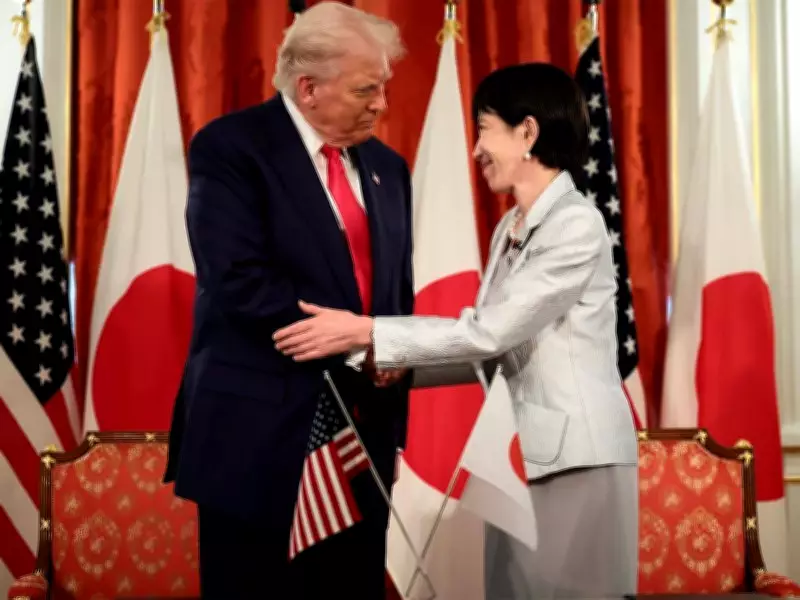
Japan's Prime Minister Sanae Takaichi Confronts Critical US Demands in White House Summit
Japanese Prime Minister Sanae Takaichi is set to engage in high-stakes discussions with US President Donald Trump at the White House on Thursday, where she faces mounting pressure to commit Japanese naval assets to a mission in the Strait of Hormuz. This demand, communicated by Trump, places Takaichi in a precarious diplomatic position, threatening to strain the long-standing security alliance between the two nations.
Trump's Call for Coalition Support in Iran Conflict
President Trump has explicitly requested that Japan, along with other allied nations, deploy ships to escort tankers through the Strait of Hormuz, a vital waterway largely closed by Iran amid ongoing regional conflicts. Takaichi's visit marks the first face-to-face talks between Trump and a major ally since this demand was issued, highlighting the urgency and significance of the issue.
David Boling, a consultant at the Asia Group in Tokyo and former US trade negotiator, noted, "Takaichi is in a tight spot. The biggest risk is that Trump publicly presses her for security commitments that she can’t deliver on." This sentiment underscores the delicate balance Takaichi must strike between placating a key ally and adhering to Japan's pacifist constitutional constraints.

Japan's Diplomatic and Legal Challenges
Japanese officials revealed that Takaichi had initially aimed to focus discussions on the threats posed by a regionally assertive China, particularly ahead of a planned visit that has since been delayed. However, the agenda has shifted dramatically, forcing her to navigate Trump's demand while avoiding significant legal and political pitfalls.
On Monday, Takaichi informed parliament that Japan had not received an official request from the United States but was assessing potential actions within the limits of its constitution. This comes as public opinion in Japan shows strong opposition, with fewer than 10% of Japanese supporting US and Israeli attacks on Iran, according to a recent Asahi newspaper poll.
Global Reluctance and Japan's Strategic Dilemma
Other US allies, including Germany, Italy, and Spain, have already ruled out participation in any Gulf mission. European Union foreign policy chief Kaja Kallas emphasized on Tuesday, "Nobody is ready to put their people in harm's way." This global reluctance adds pressure on Japan, which relies heavily on the Strait of Hormuz for about 90% of its oil shipments.
Kazuhiro Maeshima, a politics professor at Sophia University in Tokyo, explained, "It has turned into a discussion that shakes the very foundations of the Japan-US security alliance." He added that Trump holds considerable leverage over Japan, given its dependence on approximately 50,000 US troops and military assets for defense against China and North Korea, as well as trade imbalances addressed through tariffs.
Potential Consequences and Takaichi's Political Risks
Maeshima warned, "If he can bring Japan into the coalition of the willing, it will increase pressure on other countries. Conversely, if Japan refuses, he can make an example of it - showing what happens when a country says no." This scenario places Takaichi in a bind, as her public support has slightly declined since a recent election victory, partly due to rising costs fueled by Middle East energy disruptions.
During the summit, which includes talks, a working lunch, and dinner, Trump will have ample opportunity to press Takaichi on Iran. Japanese officials had hoped to prioritize deals on diversifying critical mineral supplies away from China and joining Trump's Golden Dome missile defense system, but the focus has shifted to Iran.
Scrambling for Solutions Amid Limited Options
In anticipation of the Iran-focused discussions, Tokyo is exploring alternative ways to offer assistance, such as acting as a mediator with Tehran. Tsuneo Watanabe, a senior fellow at The Sasakawa Peace Foundation, suggested this approach, recalling a similar failed mission by Takaichi's predecessor, Shinzo Abe, in 2019.

However, Kurt Campbell, a former deputy secretary of state under President Joe Biden, expressed skepticism, stating, "I don't think it's going to be enough to talk to the Iranians." He predicted that Trump would likely present a very specific request requiring a clear 'yes' or 'no' answer, describing the situation as "a moment of enormous political peril" for Takaichi.
As the summit approaches, the outcome will not only impact US-Japan relations but also set a precedent for how allies respond to Trump's demands in volatile global conflicts.





