

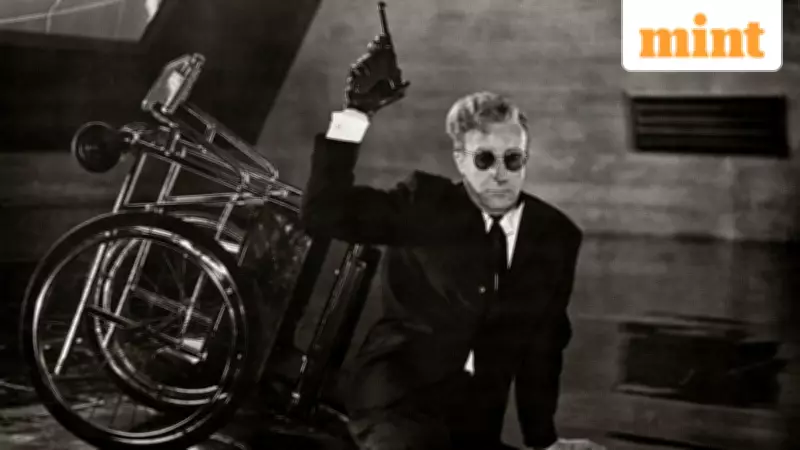
The Return of Dr. Strangelove: How MAD Logic Stages a Nuclear Comeback
Like a nonagenarian on life support, the most significant arms-control treaty of the past half-century quietly expired last week. Those responsible for its maintenance—septuagenarians and octogenarians—merely shrugged, accepting its inevitable demise. Amid the sensational Epstein revelations and celebrity scandals, the death of the most meaningful collective security agreement of our lifetime barely made headlines, yet its implications are profound.
The Historical Context of Nuclear Escalation
Following the US development of the hydrogen bomb in 1952, the world's two superpowers—the United States and the Soviet Union—embarked on a staggering nuclear arms race. From fewer than 400 total nuclear warheads in 1950, the global arsenal exploded to over 22,000 by 1960, dominated initially by the US. By the late 1960s, this stockpile had grown even more ominously, fostering a survivalist culture where American children practiced nuclear drills and suburban homes featured bomb shelters stocked with provisions.
This era saw John Lennon's anthem Give Peace a Chance and Stanley Kubrick's iconic film Dr. Strangelove or: How I Learned to Stop Worrying and Love the Bomb, capturing the absurdity and dread of nuclear brinkmanship.

The Rise and Fall of Arms Control Agreements
Initial attempts to curb warhead growth included the Strategic Arms Limitation Talks, which led to small pacts on first-use and missile delivery but had minimal impact on total numbers. Warheads surged to 38,000 by 1970, 55,000 by 1980, and peaked at 70,000 in 1986. Other agreements like the Non-Proliferation Treaty, Anti-Ballistic Missile Treaty, and Intermediate-Range Nuclear Forces Treaty aimed to prevent uncontrolled escalation.
After 1986, Soviet reforms (perestroika and glasnost) initiated a decline, accelerating with the first Strategic Arms Reduction Treaty (START-I) in 1991 as the Soviet Union dissolved. By 2000, global nuclear warheads dropped to 34,000, nearly half their peak. START-I expired in 2009, succeeded by New START in 2010, which itself expired on 4 February with little hope of revival.
The Current Nuclear Landscape and Escalating Threats
Security experts now warn of a new arms race underway. Current estimates suggest about 12,000 warheads worldwide: 4,400 Russian, 3,700 American, 500-600 Chinese, plus others like approximately 170 each in India and Pakistan. Exact numbers remain secret, based on public data, historical records, and occasional leaks.
Blaming specific leaders for this demise is simplistic. Instead, understanding the conditions that drove the surge and decline reveals insights into today's situation. Three logical foundations underpin nuclear arms races:
- Security Dilemma: Any weapons increase by one nation is seen as aggression by rivals, triggering circular escalation.
- Mutually Assured Destruction (MAD): The belief that mutual destruction capability prevents conflict initiation.
- Economic Warfare: Stronger nations overspend to bankrupt weaker rivals, as seen in the US-Soviet dynamic.
A New World Order and Future Implications
The Soviet Union's dissolution led to de-escalation and a unipolar world, inspiring proclamations like the "end of history" and a "new world order." That era has ended. The Russian Federation has re-emerged militarily, and China, with a rapidly growing arsenal, refuses to join nuclear control regimes, asserting self-defense rights.
This move will likely be interpreted as aggression, spurring escalation. Technological innovations in accuracy, lethality, delivery systems (from underwater and space), and AI capabilities herald a new era of nuclear expansion. We now face a world order of three great powers—potentially four if Europe acts independently—testing humanity's brinkmanship capacity.
To mark this perilous moment, the Bulletin of the Atomic Scientists moved its Doomsday Clock to just 85 seconds to midnight. As distractions like sexual morality and identity politics abound, existential threats loom larger than ever.






