

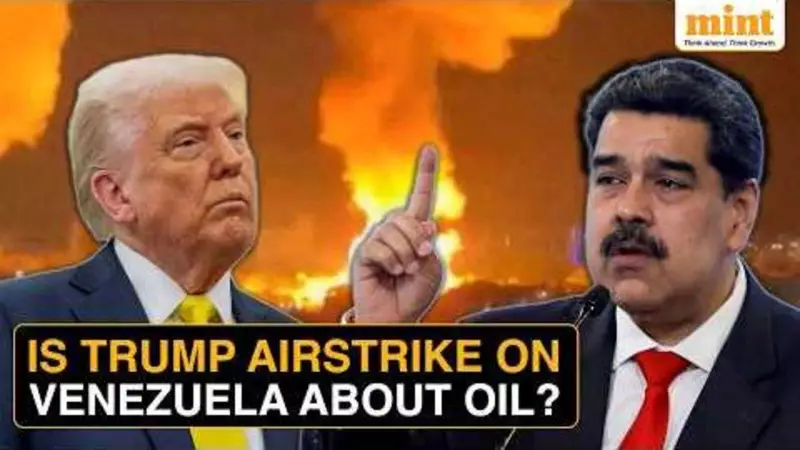
In a dramatic escalation that has sent shockwaves across the globe, Venezuelan President Nicolas Maduro was captured by United States military forces on the direct orders of former President Donald Trump. The bold operation, which has ignited fierce accusations of imperialism against Washington, was swiftly followed by an open declaration from the US to allow its corporations to develop Venezuela's vast oil reserves.
Maduro's Final Meeting Before Capture
Intriguingly, Maduro's last public appearance on state television before his detention showed him in a high-level meeting with Chinese officials. Hours before the US launched 'Operation Absolute Resolve', Maduro was filmed at the Miraflores Palace in Caracas with Qiu Xiaoqi, the Special Representative on Latin American affairs for President Xi Jinping's government.
Posting on Telegram after the meeting, Maduro stated, "I had a pleasant meeting with Qiu Xiaoqi, Special Envoy of President Xi Jinping." He further emphasized that they "reaffirmed our commitment to the strategic relationship that is progressing and strengthening in various areas for building a multipolar world of development and peace." The fate of the Chinese delegation present in Venezuela following the military strike remains unclear.

Global Backlash and China's Sharp Criticism
The capture of a sitting head of state triggered immediate international condemnation, with China leading the charge. Beijing issued a stern rebuke, labeling the US action a "brazen use of force against a sovereign state."
A spokesperson for China's Ministry of Foreign Affairs declared, "Such hegemonic acts of the US seriously violate international law and Venezuela’s sovereignty, and threaten peace and security in Latin America and the Caribbean region. China firmly opposes it." This incident adds a new geopolitical layer to the long-standing rivalry between the two economic giants, who are also locked in a fierce global race for supremacy in critical fields like artificial intelligence.
US Eyes Venezuela's Massive Oil Reserves
Shortly after confirming Maduro's capture, Donald Trump made the US's economic motives unequivocally clear. He announced that American corporations would be tasked with tapping into Venezuela's oil reserves, the largest in the world with an estimated 300 billion barrels.
"We’re going to have our very large United States oil companies, the biggest anywhere in the world, go in, spend billions of dollars, fix the badly broken infrastructure and start making money for the country," Trump stated during a press conference at Mar-a-Lago. He criticized Venezuela's previous output, saying, "They were pumping almost nothing by comparison to what they could have been."
To secure these interests, Trump confirmed that the US would maintain a military presence in the country, stating, "We’re going to have presence in Venezuela as it pertains to oil, because we have to have, we were sending our expertise in." This move solidifies the operation's dual nature: a regime change action coupled with a strategic play for energy resources, setting a contentious precedent in international relations.






