Modi-Merz Engagement Charts New 'Indo-Europe' Strategic Path
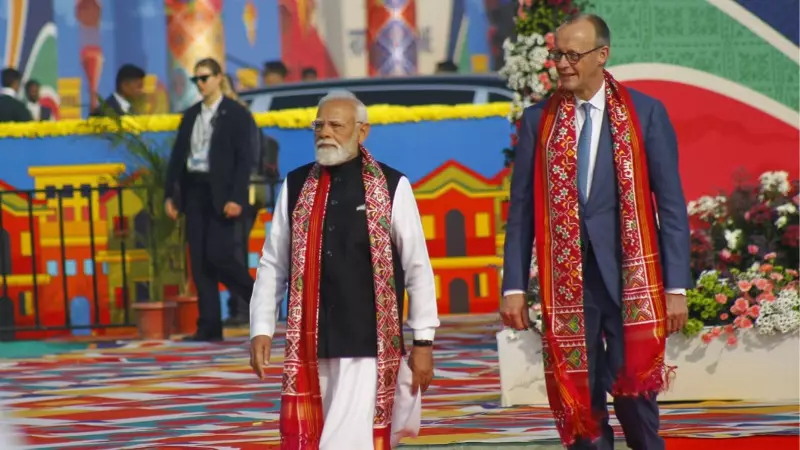
German Chancellor Friedrich Merz's recent visit to India went beyond routine diplomatic exchanges. It represented a significant effort to redefine strategic partnerships in a rapidly changing global landscape. Prime Minister Narendra Modi and Chancellor Merz engaged in talks that produced concrete outcomes across trade and security domains.
The Context of Global Realignments
This engagement occurred against a backdrop of twin disruptions. The United States under President Donald Trump has embraced renewed unilateralism. Simultaneously, Chinese leader Xi Jinping continues to pursue assertive statecraft. These developments compel both India and Europe to reassess their strategic positions.
Europe faces pressing challenges. It must rethink dependencies on Russian energy supplies. European nations also confront overreliance on Chinese supply chains. Traditional American security guarantees appear less certain than before.

India confronts its own complex pressures. The country experiences trade coercion from the United States. Excessive dependence on Russian weapons systems presents another challenge. Mounting Chinese assertiveness along India's frontiers and in global institutions adds to these concerns.
Tangible Outcomes from the Talks
The Modi-Merz discussions yielded specific agreements. Both sides reaffirmed their commitment to conclude the long-delayed European Union-India free trade agreement. They set an ambitious deadline for the end of this month, coinciding with European leaders' visit to Delhi for Republic Day celebrations.
On defence matters, the two leaders agreed to develop a joint roadmap for defence industrial cooperation. This agreement holds particular significance given Germany's ongoing military modernization. Germany has embarked on a massive rearmament program in response to Russia's continuing war in Ukraine and growing doubts about long-term American commitment to European security.
Germany has emerged as the world's fourth-largest defence spender over the last four years. Only the United States, China, and Russia currently spend more on defence. With plans to allocate up to 3.5 percent of GDP to defence, German military expenditure could approach $200 billion annually by the end of this decade. This spending would likely place Berlin ahead of Russia in global defence rankings.
Historical Parallels and Contemporary Significance
A century ago, Germany occupied an important place in India's strategic imagination. During World War I, Imperial Germany viewed Indian nationalism as a potential lever against British imperial dominance. Through what became known as the Berlin Committee and the "Hindu-German Conspiracy," German officials and Indian revolutionaries sought to exploit Britain's wartime challenges.
That historical episode demonstrated how Indian nationalism sought external partners to secure independence and expand strategic space. The contrast with today's context is sharp, but the underlying logic shows continuity. Both nations now seek to expand their strategic autonomy through diversified partnerships.
The Emergence of 'Indo-Europe'
The concept of 'Indo-Europe' represents a new strategic geography. It is not an alliance in the traditional sense. Neither does it attempt to replace existing frameworks like NATO or the Quad. Instead, it functions as supplementary geometry that supports Washington's own calls for greater burden-sharing in Eurasia.
This framework links India's demographic scale and market depth with Europe's industrial strength and technological sophistication. Several initiatives already point in this direction. The India-Middle East-Europe Economic Corridor represents one such project. Cooperation on critical minerals and green hydrogen development offers another avenue. Enhanced maritime awareness across the western Indian Ocean also fits within this emerging framework.
Broader European Engagement
France already plays a significant role in this Indo-European geography. Britain, which withdrew from Europe a decade ago, is now reconnecting with the continent while simultaneously deepening ties with India. Delhi also maintains important relationships with Poland in Central Europe and Italy in the Mediterranean region.

The challenge for both India and Europe lies in implementation. They must translate signed agreements and mutual understandings into concrete outcomes. Both continue to view the United States as an indispensable partner in securing Europe and balancing power dynamics in Asia and the Indo-Pacific region.
Strategic Autonomy Through Diversification
Neither India nor Europe can afford to rely solely on an inward-looking United States to manage risks arising from tightening China-Russia continental alignment. This reality gives the Indo-European idea its genuine strategic meaning.
What Indo-Europe seeks is resilience. It aims to develop capacity to hedge against global volatility without surrendering agency. India and Europe now define strategic autonomy not as equidistance or defiance, but as productive diversification. They recognize that deeper bilateral partnership, embedded within a wider Indo-European framework, can secure greater strategic room for both nations.
The Modi-Merz talks have taken an important step toward giving this Indo-European idea concrete meaning. As Europe's leaders prepare to deepen engagement with India, the challenge remains to build upon this foundation and create lasting strategic partnerships that address contemporary global realities.