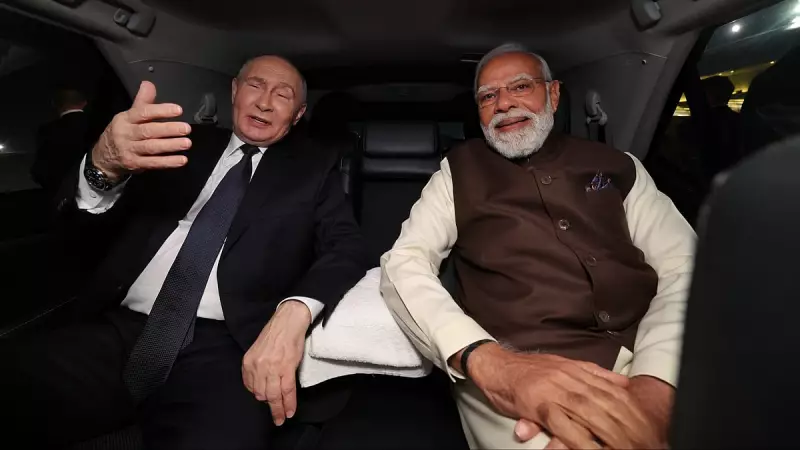
In a powerful gesture that underscored the enduring strength of a strategic partnership, Prime Minister Narendra Modi personally welcomed Russian President Vladimir Putin at his official residence on Monday evening. This rare reception, reserved for the closest of allies, set the tone for a crucial bilateral summit aimed at navigating complex global dynamics and forging a new roadmap for economic cooperation.
A Warm Welcome Amidst Western Frowns
The meeting at 7, Lok Kalyan Marg, which extended for over five hours, was President Putin's first visit to India since 2021 and only his second foreign trip since the start of the Russia-Ukraine conflict. The optics of the warm, informal embrace between the two leaders sent a clear message of India's independent foreign policy, conducted firmly in its national interest despite evident disapproval from Western capitals.
Official sources highlighted that the discussions were "full-bodied and comprehensive," covering the entire spectrum of the bilateral relationship. The primary focus, however, was squarely on enhancing economic and trade ties, which have remained resilient but face challenges due to the global sanctions regime against Russia.

Charting a Roadmap for Trade and Investment
The summit was strategically timed to address these very challenges. A major expected outcome is the formulation of a detailed roadmap for India-Russia economic cooperation for the coming years. This blueprint is anticipated to identify specific sectors and mechanisms to dramatically increase bilateral trade, which has already seen a significant surge.
Key areas of discussion and potential agreement included:
- Energy Security: Deepening cooperation in the oil and gas sector, with a focus on long-term contracts and increased Russian crude oil shipments to India. Discussions also covered potential investments in Russia's Arctic and Far East energy projects.
- Trade Settlement Mechanisms: Advancing the use of national currencies, the Indian Rupee and Russian Rouble, to bypass Western financial systems and ensure uninterrupted trade flows. This is a critical step for sustaining and growing the economic relationship.
- Strategic Connectivity: Giving fresh impetus to the International North-South Transport Corridor (INSTC) and exploring the Eastern Maritime Corridor. These routes are vital for creating efficient and sanctions-resilient trade links between India, Russia, Iran, and Central Asia.
- Defence & Technology: While defence remains a cornerstone, the talks likely explored joint manufacturing, technology transfer, and cooperation in emerging areas like space, nuclear energy, and artificial intelligence.
Navigating Global Headwinds and Regional Issues
Beyond economics, the leaders exchanged views on pressing international and regional issues. The situation in Afghanistan and the evolving security architecture in the Indo-Pacific were on the agenda. India's consistent position advocating for dialogue and diplomacy to resolve the Ukraine conflict was reiterated.
The summit demonstrated India's deft diplomatic balancing act. While engaging deeply with Western partners in groupings like the Quad, India continues to nurture its time-tested partnership with Russia, a key supplier of defence equipment and energy resources. The personal rapport between Modi and Putin, built over two decades, remains a central pillar of this complex relationship.
The outcomes of this summit are poised to have long-term implications. By working to institutionalize trade in national currencies and develop alternative supply corridors, India and Russia are not just bolstering their own partnership but are also contributing to the movement towards a more multipolar global order. The success of the proposed economic roadmap will be the true test of this high-profile diplomatic engagement.