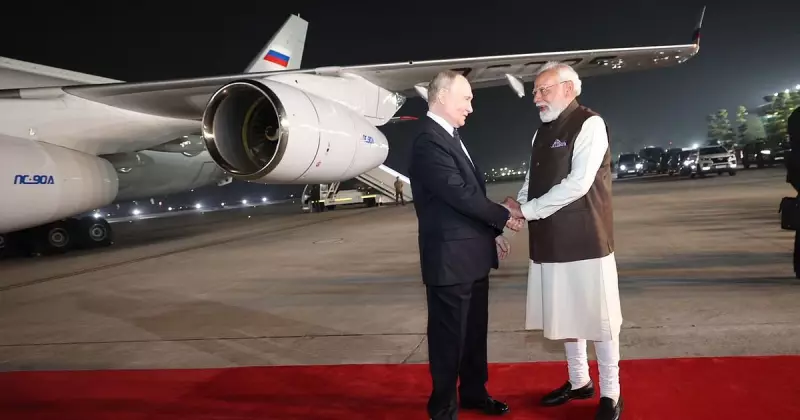
In a significant diplomatic gesture, Prime Minister Narendra Modi personally welcomed Russian President Vladimir Putin at the Palam Technical Area in Delhi, breaking away from standard protocol. The reception, marked by a warm hug against the backdrop of traditional dance performances, underscores the special strategic partnership between India and Russia.
The Significance of the Gesture
Typically, visiting heads of state are received by ministers or officials of equivalent rank. Prime Minister Modi's decision to greet President Putin directly at the airport is a rare honour reserved for close allies and signals the high importance India places on bilateral ties with Moscow. This move, observed on December 5, 2025, is seen as a powerful symbol of personal chemistry and diplomatic warmth between the two leaders.
An Exclusive Club: Leaders Honoured by PM Modi
While notable, this is not the first instance of PM Modi breaking protocol for a foreign dignitary. Over the years, he has extended this personal welcome to a select group of global figures, highlighting evolving geopolitical friendships.
The distinguished list includes:
- 2015: Barack Obama, President of the United States.
- 2016: Sheikh Mohammed bin Zayed Al Nahyan, then Crown Prince of Abu Dhabi.
- 2017: Sheikh Hasina, Prime Minister of Bangladesh, and Shinzo Abe, Prime Minister of Japan.
- 2018: Emmanuel Macron, President of France, and Benjamin Netanyahu, Prime Minister of Israel.
- 2019: Mohammed bin Salman, Crown Prince of Saudi Arabia.
- 2020: Donald Trump, President of the United States.
- 2024: Mohamed bin Zayed Al Nahyan, President of the UAE.
- 2025: Sheikh Tamim bin Hamad Al Thani, Emir of Qatar.
Analyzing the Diplomatic Message
This pattern of protocol exceptions serves as a clear barometer of India's foreign policy priorities. The list reveals a strategic focus on strengthening ties with key partners in the Middle East (UAE, Saudi Arabia, Qatar, Israel), major global powers (USA, France, Japan), and immediate neighbours (Bangladesh). President Putin's addition to this list reinforces that, despite global pressures, the India-Russia relationship remains a cornerstone of New Delhi's strategic autonomy.
The airport welcome is more than a ceremonial formality; it is a calculated diplomatic tool. It generates positive optics, fosters personal rapport at the highest level, and sets a collaborative tone for the official talks that follow. For President Putin, arriving at a time of intense global scrutiny, this public display of solidarity from the Indian leadership carries substantial symbolic weight.
In conclusion, PM Modi's airport welcome for President Putin is a deliberate and powerful signal in the language of diplomacy. It places Russia firmly within the small circle of nations accorded this highest personal honour by the Indian Prime Minister, emphasizing continuity and special privilege in a relationship that continues to navigate a complex international landscape.