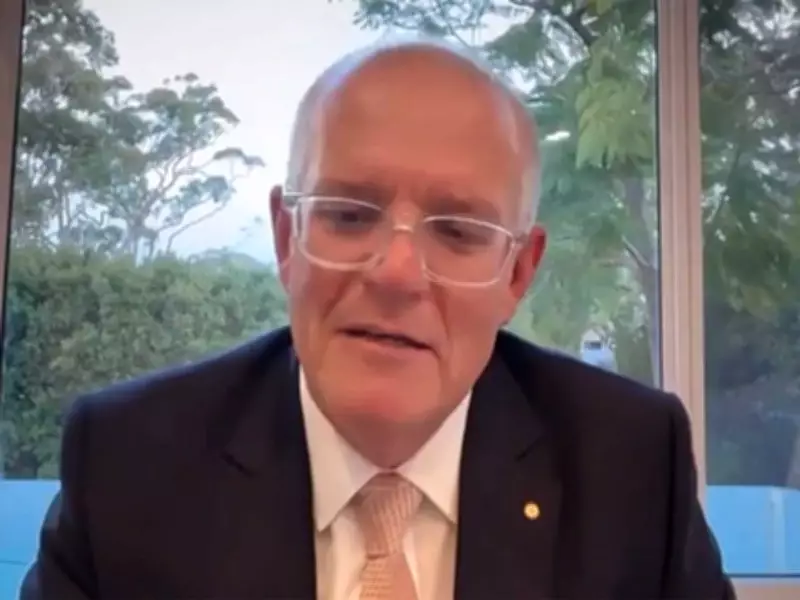
Former Australian Prime Minister Scott Morrison has thrown his support behind the proposed India-Australia Critical Minerals Corridor, asserting that India is uniquely positioned to become a global processing hub for rare earths and essential minerals. Speaking exclusively to ANI after meeting Prime Minister Narendra Modi, Morrison outlined a complementary model: Australia as an extraction leader and India as a manufacturing and refining powerhouse.
Morrison's Vision for India-Australia Partnership
"I've always had a strong view that India is well-placed to take on a lot of this critical minerals processing. Australia is outstanding and has many critical mineral resources and is very advanced on the extraction side of the business, but the cost of refining those critical minerals can be prohibitive. In India, I think they've always had an opportunity to build an ecosystem not unlike what exists in China, where they can be a real critical minerals processing powerhouse for the world," Morrison said.
Morrison argued that the initiative is vital for reducing global reliance on China, which he noted has "weaponised" its dominance in the sector. "With the way that China has leveraged, and in some cases even weaponized, its stranglehold on rare earths and critical minerals processing, all countries, whether it's India, Australia, the United States, Japan, Korea, the United Kingdom or Europe, need to look at ways in which they can put together alternative supply chains so they can't be effectively held hostage to these types of things," he added.

India-Australia Critical Minerals Investment Partnership
India and Australia are deepening collaboration to secure supply chains for lithium, cobalt, and rare earth elements. Through the India-Australia Critical Minerals Investment Partnership, both nations are fast-tracking five target mining projects—two lithium and three cobalt projects in Australia—to reduce global dependence on China and accelerate India's renewable energy and electric vehicle manufacturing goals.
The partnership is supported by the AUD 12.2 million India-Australia Critical Minerals Research Partnership, involving institutions like the Indian Institute of Technology Hyderabad and Monash University, which are advancing mineral extraction and processing methods. Under the Australia-India Economic Cooperation and Trade Agreement (ECTA), tariff reductions have integrated Australia's mining equipment and services sector with India's industrial growth. This framework is reinforced by the broader Quad Critical Minerals Initiative Framework, alongside Japan and the US, aiming to mobilise up to $20 billion in public and private capital for secure mineral supply chains.
Focus on Tangible Results
While optimistic, Morrison stressed that success depends on tangible outcomes. "The proof of these things will be how much actually gets done, how many companies are formed, how many refineries are built, and how many processed critical minerals are actually being delivered into manufacturing supply chains," he stated.
Morrison characterised the latest bilateral agreements—covering cybersecurity, critical technologies, and space cooperation—as the "natural outworking" of the Comprehensive Strategic Partnership he helped foster during his tenure. "Highlighting all of these areas of cooperation is exactly what the Comprehensive Strategic Partnership was designed to deliver. I'd call all of this implementation phase agreements, the natural outworking of being able to get the relationship to the level we were able to achieve," he said.
Space Cooperation and Gaganyaan Mission
A standout development is the commissioning of a temporary space tracking terminal on the Cocos (Keeling) Islands to support India's Gaganyaan human spaceflight program. Reflecting on India's space progress, Morrison recalled the Chandrayaan-3 Moon landing: "I'll never forget when India was able to touch down on the Moon. I'll never forget the look on Prime Minister Modi's face. He was pretty thrilled with what his nation was able to achieve, and it said a lot about the advanced space capabilities of India."
The former leader's remarks underscore a growing cross-party consensus in Australia on the strategic necessity of integrating India's manufacturing sector into global supply chains for regional stability and economic resilience.