

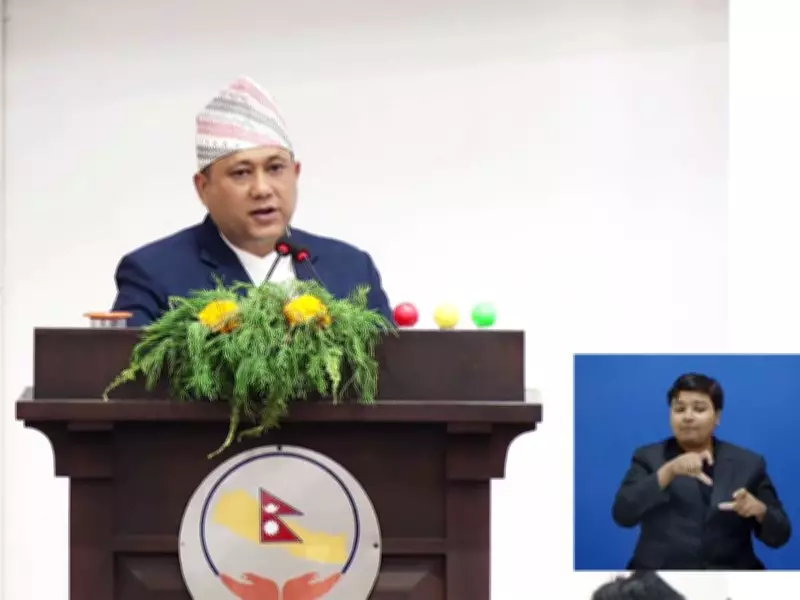
Nepal's Foreign Minister, Shishir Khanal, delivered a definitive statement in Parliament on Wednesday, clarifying that the government has not sought, and does not support, any third-party mediation to resolve border disputes with India. The clarification was issued to address the political firestorm sparked by Prime Minister Balendra Shah's remarks on May 31, which had drawn sharp criticism from the opposition and led to calls for his resignation.
Minister Khanal's Clarification
Addressing the House, Minister Khanal emphasized that Nepal remains firmly committed to a bilateral approach. He stated, "What I would like to clarify in this esteemed House is that the Nepal-India border is a bilateral issue and Nepal is always committed to resolving this problem through diplomatic dialogue and negotiations based on historical treaties, agreements and maps in accordance with the spirit of the close relationship between Nepal and India." He added that the Prime Minister's comments were not a request for mediation, but rather an observation that any historical reference materials from the era of the Sugauli Treaty could, if available, be useful as supplementary aids to the ongoing technical process.
Focus on Border Encroachments
Khanal explained that the Prime Minister's concerns were primarily focused on the practical challenges of "cross-border occupation" and encroachment within the Dashgaja (no-man's land) areas. He said, "The issue raised by the Prime Minister in the Parliament is basically related to the encroachment of the Dashgaja area and 'cross-border occupation'." He further noted that border-related mechanisms and technical teams of Nepal and India are actively working on mapping, maintaining border pillars, and collecting data on encroachment and occupation along the frontier.

Khanal highlighted that the mechanisms established between the two nations are actively addressing these friction points. He added, "The work of the technical committee, which has been stalled for a long time, is currently active in the border area, and joint data collection is underway. The Nepal-India Boundary Working Group (BWG) and other mechanisms related to the border are conducting mapping work on the locations of No Man's Land encroachment and Cross-Border Occupation along the Nepal-India border. Detailed details on this matter will be available later."
India's Stance on Bilateral Mechanisms
The remarks came after the Nepal Foreign Minister visited India from June 5 to 7. The clarification follows a firm response from the Indian Ministry of External Affairs earlier in June. MEA Spokesperson Randhir Jaiswal had reiterated that there is "no role for any third parties" in bilateral boundary matters. India reaffirmed that established, long-standing mechanisms are already in place to resolve these specific segments of the frontier through direct talks.
Jaiswal said, "We have seen the remarks of the Prime Minister of Nepal concerning India-Nepal boundary as well as the subsequent statement made by the Nepali foreign office on this matter. While close to 98 per cent of the India-Nepal boundary has been demarcated, there are some unresolved segments. The shifting of the Gandak River has resulted in this. In addition, there are cases of cross-border occupation and encroachment of no man's land in demarcated segments of the boundary, which are currently being mapped jointly." He further stated, "We have established bilateral mechanisms to deal with all aspects of boundary matters. It should be clear to all concerned that there is no role for any third parties in a bilateral matter between India and Nepal."
Political Reactions in Nepal
The remarks by Nepal PM Balendra Shah on May 31 had drawn stark protest from the opposition, who have continued to protest in Parliament, chanting slogans demanding his resignation over his remarks on the border. Lawmakers raised objections over the Prime Minister's statement in which he reportedly suggested that Nepal had encroached upon Indian territory. Opposition parties argued that the remarks were serious enough to require either an apology or resignation.






