

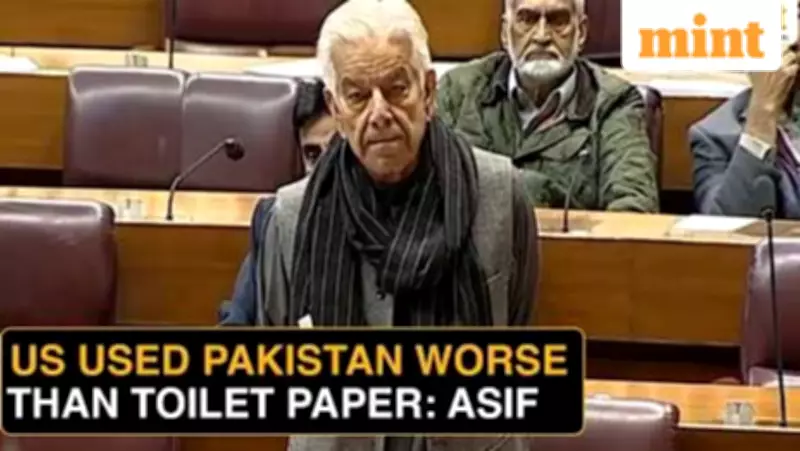
Pakistan Defence Minister Makes Startling Admission About US Relations in Parliament
In a remarkable parliamentary session, Pakistan's Defence Minister Khawaja Asif delivered a blunt assessment of his country's foreign policy missteps, particularly regarding its relationship with the United States. The minister's candid remarks have sparked widespread discussion about Pakistan's strategic positioning on the global stage.
'Used Then Discarded Like Toilet Paper'
During his address, Asif employed striking language to describe Pakistan's experience with American foreign policy. "The US used Pakistan then threw us away like toilet paper," he stated unequivocally. This vivid metaphor underscored his criticism of what he characterized as transactional and ultimately detrimental American engagement with Pakistan.
Admission of Strategic Miscalculation
The defence minister openly acknowledged what he termed a significant "miscalculation" in Pakistan's approach to its alliance with the United States. He specifically highlighted the period following the September 11, 2001 attacks as particularly costly for Pakistan's national interests.

According to Asif, the decision to realign closely with American counterterrorism efforts after 1999, and especially post-9/11, proved devastating for Pakistan. He detailed several consequences of this alignment:
- Substantial economic and security costs borne by Pakistan
- Strained regional relationships and increased internal instability
- Questionable returns on Pakistan's extensive cooperation with US-led initiatives
Historical Context and Contemporary Implications
The minister's comments reference a pivotal era when Pakistan became a frontline state in the US-led War on Terror. Asif suggested that Pakistan's leadership at the time fundamentally misjudged the long-term implications of this partnership, expecting sustained American support that failed to materialize as anticipated.
This parliamentary admission comes at a sensitive time for Pakistan-US relations, which have experienced significant fluctuations over recent decades. Analysts suggest Asif's remarks may signal:
- A recalibration of Pakistan's foreign policy narrative
- Growing domestic pressure to reassess international alliances
- An attempt to shape historical understanding of Pakistan's role in regional conflicts
The defence minister's unusually candid critique of his own country's strategic decisions represents a notable departure from typical diplomatic language. His willingness to publicly acknowledge policy failures suggests evolving political dynamics within Pakistan's governance structures.
Asif's parliamentary address has been widely circulated through video footage, amplifying its impact both domestically and internationally. The minister's blunt assessment raises important questions about how nations navigate complex geopolitical partnerships and calculate long-term strategic interests versus short-term alliances.






