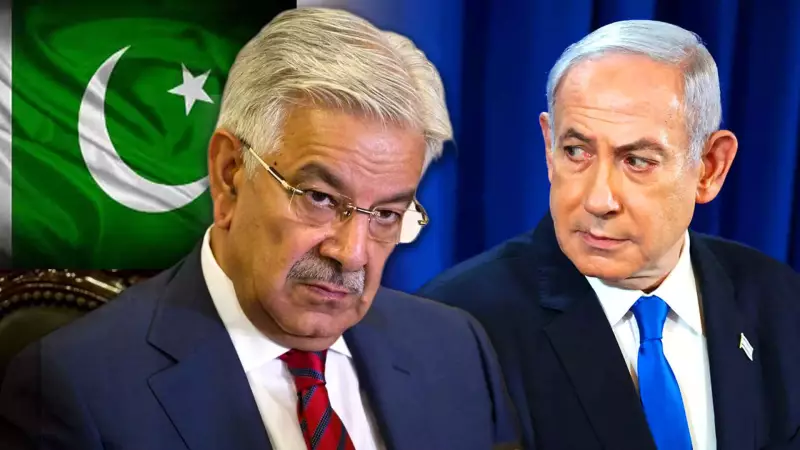
In a televised outburst that has sent shockwaves through diplomatic circles, Pakistan's Defence Minister, Khawaja Asif, made a stunning call for the abduction of Israeli Prime Minister Benjamin Netanyahu. The incident occurred during an interview on January 10, 2026, where Asif's inflammatory remarks forced the show's anchor to intervene and cut the segment short.
Explosive Remarks on Live Television
The Pakistani minister, in his on-air rant, explicitly urged the United States and Turkey to orchestrate the kidnapping of the Israeli leader. He labelled Netanyahu as the "worst criminal of humanity" in the context of the ongoing war in Gaza. To justify his extraordinary suggestion, Asif pointed to the International Criminal Court's arrest warrant against Netanyahu and referenced a past operation by the US to capture Venezuelan President Nicolás Maduro as a potential model.
Asif did not stop there. He declared that the people of Pakistan were actively "praying" for such an action to be taken. He further argued that nations which believe in the principles of humanity have a duty to enforce legal accountability against the Israeli Prime Minister, implying that extrajudicial capture was a legitimate path to justice.

Diplomatic Repercussions and Regional Alignments
This provocative statement marks a significant and dangerous escalation in rhetorical attacks related to the Gaza conflict. Pakistan has historically refused to recognise the state of Israel and has closely aligned its foreign policy with Iran's stance on the Palestinian issue. However, openly advocating for the kidnapping of a sitting foreign head of government crosses a new line in international discourse.
Security and political analysts are unanimous in warning that such statements from a senior cabinet minister could severely complicate Islamabad's diplomatic relationships. The United States, in particular, is likely to view these comments with extreme displeasure, potentially straining a already complex bilateral relationship. Other nations invested in Middle East stability may also be forced to recalibrate their engagement with Pakistan.
A Broader Context of Crisis
Asif's controversial interview comes at a time when global attention remains intensely focused on the devastating humanitarian crisis unfolding in Gaza. The broader Middle East conflict continues to be a flashpoint for international tension and polarized rhetoric. While strong criticism of Israeli military actions is common in many capitals, the call for a state-sponsored kidnapping by a defence minister is an unprecedented and alarming development.
The incident underscores how the war in Gaza is inflaming passions and leading to volatile statements that threaten to undermine diplomatic norms. The anchor's decision to cut the interview short highlights the recognition, even within the media, of the potentially incendiary and consequential nature of the minister's words.