

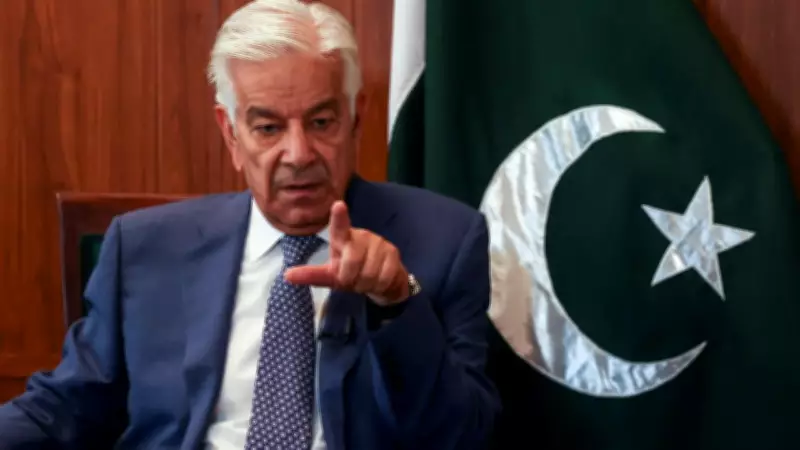
Pakistan's Defence Minister Delivers Blistering Critique of Past US Alliances
Pakistan's Defence Minister Khawaja Asif has unleashed a powerful condemnation of his nation's historical partnerships with Washington, telling the National Assembly that Islamabad had been "used like toilet paper and then discarded" after serving American strategic interests in Afghanistan. The minister's explosive remarks came during a parliamentary debate on terrorism following a devastating suicide bombing at a Shia mosque in Islamabad that claimed 31 lives and injured 169 worshippers.
Superpower Wars That Were Never Pakistan's
Asif detailed how Pakistan had repeatedly entered "superpower wars" that were never its own, specifically referencing two major conflicts fought on Afghan soil. "We took part in two wars that were fought on the soil of Afghanistan," Asif told lawmakers, describing how Pakistan entered these conflicts "in the name of Islam and religion" while former military dictators actually sought legitimacy and global power backing.
Regarding the 1979 Soviet intervention, Asif challenged the conventional narrative, claiming it was conducted "at the invitation of the government in Kabul" and that the portrayal of an outright invasion was shaped by American interests. "These were not our wars; they were superpower wars," he emphasized, adding that Pakistan and its territory were exploited and then abandoned in a degrading manner.

Terrorism as Blowback from Past Mistakes
The defence minister directly linked contemporary terrorism in Pakistan to what he called the "blowback of mistakes committed by dictators in the past." He lamented that Pakistan had failed to learn from history, continuing to oscillate between global powers in pursuit of short-term advantages.
"For our own interests, we sometimes turn to Washington, sometimes to Moscow, and sometimes to Britain," Asif stated, noting that "we have built strong franchises here, which was not the case 30 or 40 years ago." This pattern of shifting allegiances, according to the minister, has contributed to Pakistan's current security challenges.
Transactional Relationships and Political Division
Asif recalled former US President Bill Clinton's brief 2000 visit to Islamabad, which lasted only a few hours at the end of a longer India trip, as emblematic of how transactional the relationship had become. Clinton's engagement with then military ruler Pervez Musharraf was framed by American demands on democracy, non-proliferation, and militancy, reinforcing Pakistan's subordinate position.
The minister's remarks coincided with parliament passing a resolution condemning the attack on Imambargah Qasr-e-Khadijatul Kubra in Islamabad's Tarlai area. The Islamic State group claimed responsibility for the bombing that occurred during Friday prayers. Thousands attended funerals across the capital as grieving families demanded accountability.
"What happened yesterday has left us extremely angry and deeply hurt," said Bushra Rahmani, whose brother was among the wounded in the attack.
Asif urged political unity in the face of terrorism, criticizing what he called a lack of consensus even in condemning such violence. "It is very important that we have a national identity on which no one disagrees," he stated, taking aim at politicians who avoided attending victims' funerals for political reasons.
The defence minister's unprecedented critique represents a significant public airing of long-standing grievances about Pakistan's foreign policy choices and their domestic consequences, delivered against the backdrop of renewed terrorist violence and political fragmentation.






