

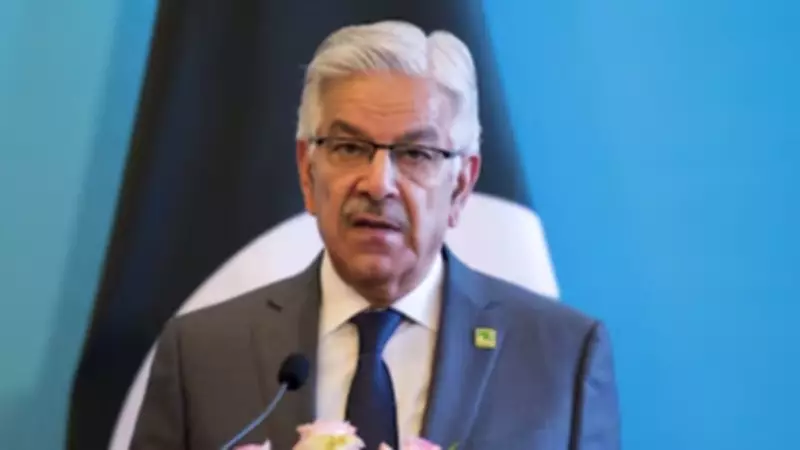
Pakistan's Defence Minister Issues Stark Warning Targeting Kolkata
In a significant escalation of rhetoric, Pakistan's Defence Minister Khawaja Asif declared on Saturday that Islamabad would launch a retaliatory strike on Kolkata should India undertake any "future misadventure." The minister made these provocative remarks during a press interaction in his hometown of Sialkot, directly addressing the ongoing tensions between the two nuclear-armed South Asian nations.
Specific Threat Against Major Indian City
"If India attempts another false-flag operation, then, God willing, we will take it to Kolkata," Asif stated unequivocally to assembled reporters. This represents one of the most specific geographical threats issued by a senior Pakistani official in recent diplomatic exchanges. Kolkata, formerly known as Calcutta, serves as the capital of West Bengal and ranks among India's largest metropolitan centers with profound historical significance as a former national capital.
The defence minister further elaborated on his concerns about potential Indian actions, alleging without presenting evidence that New Delhi might be planning a "false-flag operation." According to Asif's assertions, such an operation could involve Indian operatives or Pakistani detainees being used to stage an incident that would subsequently be blamed on Islamabad.

Context of Escalating Military Posturing
This latest warning follows Asif's characterization earlier this week of Pakistan's potential response to any Indian attack as "swift, calibrated and decisive." His comments came in direct response to Indian Defence Minister Rajnath Singh's own warning that any future "misadventure" by Pakistan would invite what he described as "unprecedented and decisive" action from New Delhi.
The bilateral tensions trace back to the devastating Pahalgam attack of April 22 last year, which resulted in the deaths of 26 civilians—predominantly tourists—at the hands of Pakistan-backed terrorists. This incident triggered a brief but intense military confrontation between May 7 and 10, 2024, marking one of the most serious escalations in recent years.
Historical Precedents and Ceasefire Dynamics
Hostilities eventually subsided after Islamabad sought a ceasefire, which New Delhi accepted while maintaining a significant caveat. Indian authorities clarified that Operation Sindoor—their military response targeting Pakistan-based terror groups—had merely been paused rather than terminated. New Delhi further asserted it would maintain a policy of not distinguishing between terrorist organizations and Pakistan's military leadership in future responses.
This is not the first instance of such strategic warnings from Pakistan's military establishment. In August 2025, Pakistan's armed forces issued a similar threat, stating they would be prepared to strike deep inside Indian territory from the eastern front. The specificity of targeting Kolkata represents an escalation in this pattern of rhetoric.
Broader Strategic Considerations
Asif's remarks arrived just days after former Pakistani High Commissioner to India Abdul Basit suggested that Islamabad should consider targeting major Indian cities including Mumbai and New Delhi if Pakistan's nuclear arsenal faced threats from the United States. Basit argued that since the United States remains beyond Pakistan's nuclear reach, India would become what he termed the "next best option" for retaliation.
"If someone casts an evil eye on us, we will strike Mumbai and New Delhi without hesitation," Basit added during his commentary, reflecting a broader strategic discussion within Pakistani diplomatic and military circles about escalation scenarios and deterrence postures.
The exchange of threats between the two defence ministers underscores the persistently fragile state of relations between India and Pakistan, with both sides maintaining heightened military readiness along their shared border. The specific mention of Kolkata as a potential target introduces a new geographical dimension to the ongoing strategic calculations between the neighboring nations.






