

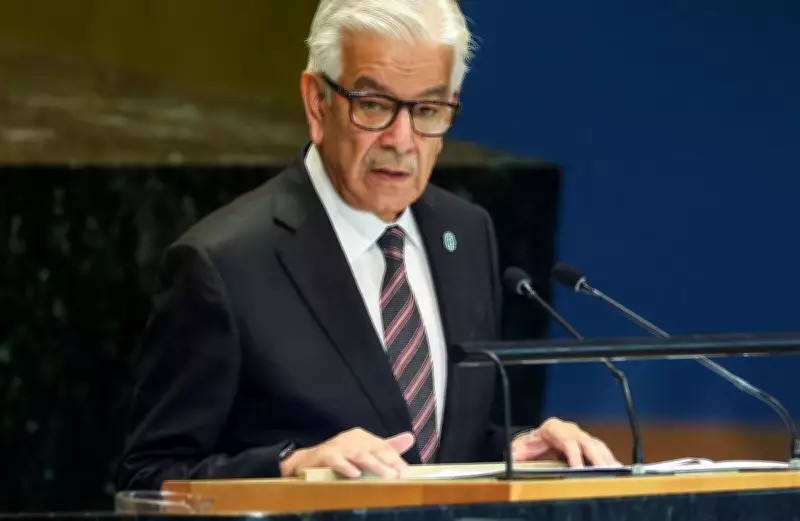
Pakistan's Defence Minister Stirs Diplomatic Storm with 'Cancerous' Israel Remark
In a fiery social media post that has ignited a fresh diplomatic controversy, Pakistan's Defence Minister Khawaja Asif referred to Israel as a "cancerous tumor" in the Middle East. The inflammatory statement, made on a popular platform, quickly drew international attention and a swift, sharp response from Israeli leadership.
Asif's Provocative Social Media Post
Khawaja Asif, a senior figure in Pakistan's government, took to social media to express his views on the Israeli-Palestinian conflict. In his post, he described Israel using highly charged language, labeling it a "cancerous tumor" that he claimed was destabilizing the region. The remark aligns with Pakistan's long-standing policy of non-recognition of Israel and support for Palestinian statehood, but the aggressive tone marked a significant escalation in rhetoric.
The post came amid ongoing tensions in the Middle East, including recent conflicts in Gaza and broader regional disputes. Asif's comments were seen as a deliberate provocation, reflecting Pakistan's hardline stance under its current political leadership. Analysts note that such statements often aim to bolster domestic support by appealing to anti-Israel sentiments within Pakistan.

Netanyahu's Forceful Rebuttal
Israeli Prime Minister Benjamin Netanyahu did not hesitate to respond, issuing a strong condemnation of Asif's remarks. In a statement, Netanyahu slammed the Pakistani minister, calling his comments "outrageous and baseless." He emphasized Israel's right to exist and defend itself, highlighting the country's contributions to technology, medicine, and regional stability.
Netanyahu further accused Asif of spreading hate and misinformation, urging the international community to reject such rhetoric. The Israeli leader's response underscored the deep-seated animosities between the two nations, which have no formal diplomatic relations. This exchange adds to a history of verbal clashes, though direct confrontations are rare given the lack of official ties.
Regional and Global Implications
The spat between Pakistan and Israel has broader implications for Middle Eastern politics and global diplomacy. Pakistan, a nuclear-armed Muslim-majority nation, has historically aligned with Arab states and Iran in opposing Israel. Asif's remarks may strain Pakistan's relations with Western allies who support Israel, such as the United States, though Islamabad has carefully balanced its foreign policy in recent years.
Meanwhile, Israel continues to seek normalization with more Muslim-majority countries under the Abraham Accords, making such public condemnations a setback for diplomatic outreach. The incident also highlights the volatile nature of social media in international relations, where offhand comments can quickly escalate into full-blown disputes.
Regional experts suggest that while this exchange is unlikely to lead to direct conflict, it reinforces the entrenched positions on both sides. Pakistan's government has not retracted Asif's statement, indicating a firm stance, while Israel remains vigilant against what it perceives as hostile rhetoric.
Historical Context and Future Outlook
Pakistan and Israel have never established diplomatic relations, with Pakistan consistently supporting Palestinian claims to statehood. Past incidents, such as Pakistan's refusal to recognize Israel and occasional verbal barbs, have kept tensions simmering. Asif's latest comment is among the most vitriolic from a senior Pakistani official in recent memory.
Looking ahead, this episode may influence Pakistan's domestic politics, where anti-Israel sentiment is widespread. It could also impact Israel's foreign policy calculations in South Asia. Both countries are likely to continue their rhetorical sparring, but substantive changes in their relationship appear unlikely without shifts in broader geopolitical dynamics.
In summary, Khawaja Asif's characterization of Israel as "cancerous" and Netanyahu's forceful rebuttal have reignited a long-standing feud, underscoring the deep divisions in Middle Eastern politics and the power of words in shaping international discourse.






