

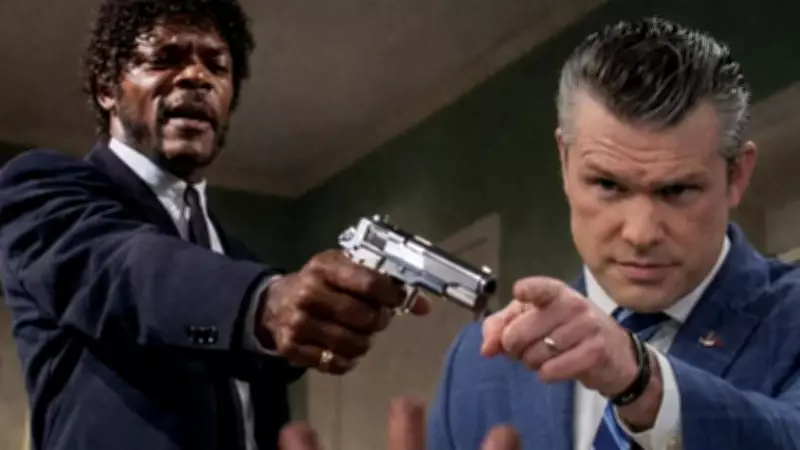
Pentagon Official Quotes Pulp Fiction Monologue as Military Prayer
Certain films achieve such monumental cultural status that their influence echoes through generations. Quentin Tarantino's groundbreaking masterpiece Pulp Fiction stands firmly among these cinematic titans, leaving an indelible cultural footprint so profound that its dialogue can be quoted without any contextual explanation. The most universally recognized meme from this film, instantly recallable by any devoted fan, is the powerful Ezekiel 25:17 monologue—a speech that sounds Biblical, feels profoundly spiritual, and for decades has been widely mistaken as actual scripture.
Except it is not authentic scripture at all.
The genuine Biblical verse is starkly austere, almost detached—a simple declaration of vengeance stripped of all poetic embellishment and theatrical drama. What visionary director Quentin Tarantino accomplished was to cloak this sparse text in magnificent grandeur, infusing it with rhythmic cadence, moral gravity, and the compelling illusion of ancient divine wisdom. He transformed a mere sentence into a full cinematic sermon, thereby creating something infinitely more memorable and impactful than the original source material. This cinematic version is what the vast majority of people recognize and remember.

The Pentagon's Cinematic Adaptation
In a surprising development this week, a slightly modified version of this iconic monologue surfaced within the hallowed halls of the Pentagon. During an official Pentagon worship service, United States Secretary of War Pete Hegseth recited what he identified as "CSAR 25:17," presenting it as a formal military prayer specifically tied to combat search-and-rescue missions. He suggested it was intended to reflect the Biblical Ezekiel 25:17, which is precisely where the fascinating confusion originates.
What Secretary Hegseth delivered was neither the authentic Biblical verse nor Tarantino's exact cinematic monologue. Instead, it represented a third distinct version—a specialized military adaptation that borrows its foundational structure and emotional resonance from the film while simultaneously anchoring itself in scriptural authority for enhanced legitimacy. Tarantino himself had performed a similar creative act of expansion, taking a minimal Biblical line and dramatically transforming it into a memorable cinematic sermon. Hegseth's military version repeats this transformative process within an entirely different context, replacing theological language with precise operational terminology.
Military Terminology Replaces Biblical Language
The adaptation involves several key substitutions: the "righteous man" from the film becomes a "downed aviator," "charity and goodwill" are transformed into "comradery and duty," and the closing invocation of divine authority is cleverly recast as a military callsign: "you will know my call sign is Sandy One." While the specific wording changes significantly, the underlying architectural framework remains unmistakably intact—complete with its rising cadence, moral framing, and climactic declaration of vengeance.
The Significance of the Setting
The formal setting lends this moment considerable weight and importance. This was not an offhand remark or casual reference but an official worship service conducted inside the Pentagon, meticulously livestreamed and presented as part of established institutional practice. Secretary Hegseth introduced the prayer as something routinely used by "Sandy 1" to address A-10 aircraft crews before embarking on critical combat search-and-rescue missions, including a recent high-stakes operation involving downed US personnel over Iranian territory.
He described it as commonplace within specific military settings, strongly suggesting that this adapted line has already been thoroughly absorbed into a particular strand of military culture where repeated usage has granted it the authentic feel of long-standing tradition. Viewers watching the service immediately recognized the familiar rhythmic cadence, and the clip rapidly spread across online platforms, prompting widespread questions about whether a Hollywood monologue had been officially repurposed as a military prayer.

Why This Cultural Convergence Matters
The instinctive interpretation is to treat this incident as a simple misquote or momentary confusion, but such a reading fundamentally misses what is actually occurring here. This is not merely a case of someone accidentally mistaking Tarantino for the Bible. Rather, it serves as a compelling example of how language progressively accumulates layers of meaning and association over extended periods of time.
The original Biblical verse provides foundational authority, the cinematic version supplies dramatic intensity and memorability, and the military adaptation offers specific contextual relevance. Together, these layered influences produce something that feels coherent, convincing, and appropriate—even though it is not textually faithful to any single original source. This explains why the question of whether Secretary Hegseth consciously knew he was quoting Pulp Fiction lacks a dramatic definitive answer.
There exists no clear evidence that he deliberately referenced the film. He presented the line as something firmly rooted in Ezekiel and deeply embedded within established military practice, which strongly suggests that the distinction between scripture, cinema, and cultural adaptation has effectively dissolved within this specific context. The line functions successfully as a prayer precisely because it sounds like one and because it has been repeated frequently enough to acquire its own institutional authority.
A Reflection of Contemporary Political Culture
This incident also fits within a broader cultural pattern that feels entirely at home within contemporary political ecosystems. We now operate within a political environment that routinely treats popular culture as a usable vocabulary, where cinema, television, and meme language are regularly drawn upon to frame complex ideas and communicate nuanced meaning. Authority is often borrowed from cultural familiarity rather than from original source material authenticity.
Pulp Fiction integrates seamlessly into this cultural framework because its most famous monologue already carries the rhythmic cadence of scripture combined with the narrative clarity of a moral fable. It offers a ready-made structural template through which concepts of violence, righteousness, and purpose can be powerfully articulated in a manner that feels both dramatically compelling and morally definitive.
Secretary Hegseth's "CSAR 25:17" sits precisely at the intersection of these diverse influences, skillfully combining elements of ancient scripture, modern cinema, and military tradition into a single cohesive piece of language that feels complete and appropriate in the moment it is delivered. The subtle discomfort it generates stems from recognizing that the line no longer requires explicit identification as a film reference to remain effective.
It has progressed beyond that initial stage and now operates as something that sounds authoritative, carries significant moral weight, and fits the occasion perfectly—even though its origins are far more complicated and culturally layered than they might initially appear.





